What if the most stable path to wealth in 2026 isn’t found in a volatile digital stock market, but in the 2.4 billion acres of land that compose the United States? Most investors believe you need $100,000 in liquid cash to enter this asset class, yet data shows that 74% of high-margin land transactions in the last 24 months involved parcels priced under $25,000. You’re likely tired of the information overload found on generic marketplaces and the constant fear of buying a “useless” property without road access or utilities. It’s a valid concern; nobody wants their capital locked in a plot that can’t be developed or sold due to hidden zoning restrictions.
This guide is designed to help you find vacant land deals with professional precision, moving away from guesswork toward a data-driven strategy. We’ll show you how to build a repeatable system for sourcing undervalued land and conducting the specific due diligence that protects your investment. You’ll discover how to secure high-margin deals across the country without needing a six-figure bankroll, ensuring your portfolio remains resilient against inflation through the quiet strength of tangible, earth-bound assets.
Key Takeaways
- Distinguish between retail listings and genuine wholesale opportunities by understanding the specific motivations that drive sellers to offer land below market value.
- Master off-market sourcing strategies using county records and tax data to find vacant land deals before they ever reach the public market.
- Implement a rigorous five-step due diligence process to verify legal access and zoning restrictions, protecting your capital from high-risk investments.
- Shift your negotiation focus from price to problem-solving, utilizing creative offer structures like seller financing to secure high-margin agreements.
- Learn how to scale your portfolio beyond individual plots by leveraging professional land acquisition platforms and modern equity solutions.
What Defines a True Vacant Land Deal in 2026?
Identifying a genuine investment opportunity requires a shift from a consumer mindset to an analytical one. In the 2026 market, a “deal” isn’t simply a plot of earth with a “For Sale” sign. It’s a calculated acquisition of an undervalued asset that offers a clear margin of safety. To find vacant land deals that provide long term stability, investors must distinguish between retail listings, which are priced for end-users, and wholesale opportunities, which are priced for equity growth. A true deal typically involves a motivated seller, perhaps someone who inherited the property or needs to liquidate assets quickly to cover other obligations.
Residential vacant land currently offers higher profit margins than developed real estate because it lacks the “depreciation drag” of aging structures. While a house requires constant maintenance and taxes, raw land sits quietly as an appreciating asset. Successful investors focus on “path-of-progress” areas. These are regions where municipal infrastructure, such as new highway extensions or utility grids, is scheduled for completion within the next 24 to 36 months. By securing land before these developments are finished, you capture the value increase that occurs during the real estate development process without the immediate risks of construction.
Retail vs. Wholesale Land Prices
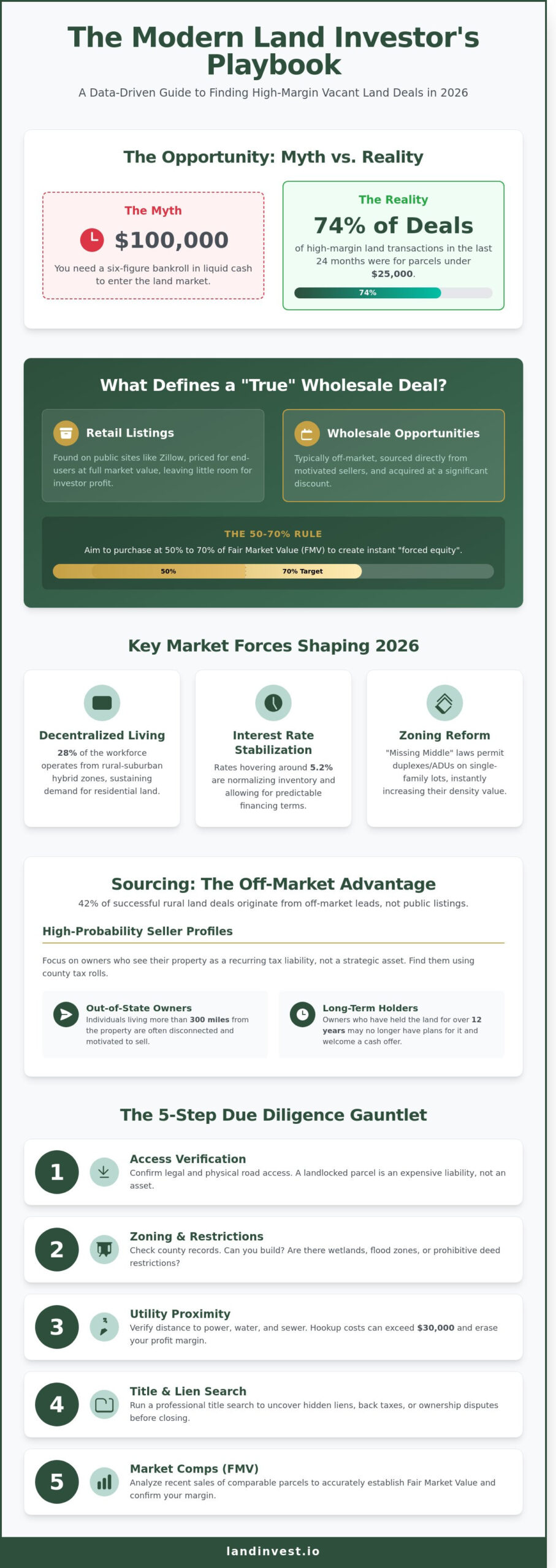
Determining the Fair Market Value (FMV) is the first step toward professional land acquisition. In 2026, a wholesale deal is defined by the 50-70% rule; you should aim to purchase at 50% to 70% of what the lot would sell for on the open market after minor improvements. This creates “forced equity” from day one. However, price isn’t everything. A $10,000 lot is a liability if it lacks road access or sits in a protected wetland where building is prohibited. Always verify utility proximity, as bringing power to a remote site can cost upwards of $30,000, quickly erasing any initial discounts.
The 2026 Land Market Outlook
The current investment climate is shaped by three specific factors that savvy investors use to find vacant land deals with high growth potential:
- Decentralized Living: Remote work trends have stabilized, with 28% of the workforce now operating from rural-suburban hybrid zones. This keeps demand for small-parcel residential land high.
- Interest Rate Stabilization: With rates hovering around 5.2% in early 2026, inventory levels are beginning to normalize, allowing for more predictable financing terms.
- Zoning Reform: New “Missing Middle” laws in many states now allow for duplexes or ADUs on land previously zoned for single-family homes, instantly increasing the density value of vacant lots.
- Evolving Consumer Habits: The move toward decentralized living also impacts consumer behavior, driving growth in direct-to-consumer online markets for everything from home goods to new beverage categories, which can be explored at sites like drinklodo.com.
Focusing on these metrics ensures that your capital isn’t just parked, but is actively working in a sector that remains the foundation of all tangible wealth. Professional land investment isn’t about speculation; it’s about the disciplined application of data to find value where others see only dirt.
Sourcing Strategies: Where to Find Hidden Land Deals
Public listing platforms like Zillow or LandWatch often represent the final stage of a property’s journey. By the time a parcel reaches these sites, the price usually reflects full market value, leaving little room for the 15% to 20% profit margins professional investors seek. To find vacant land deals that offer genuine equity, you’ve got to look where others aren’t. Data from 2025 indicates that 42% of successful land transactions in the rural sector originated from off-market leads discovered through county tax rolls rather than public databases.
County records are the most reliable tool for identifying motivated sellers. You’re looking for specific distress signals. High-probability targets include out-of-state owners who live more than 300 miles from the property and individuals who’ve held the land for over 12 years. These owners often view the property as a recurring tax liability rather than a strategic asset. A detailed investing in vacant land strategy involves cross-referencing these lists with local zoning maps to ensure the land is actually buildable before you make contact.
The Direct-to-Seller Approach
Effective sourcing relies on a “Neutral Interest” letter. Avoid aggressive sales language; it’s better to use a professional tone that asks if the owner has considered liquidating their holding. This approach builds trust and positions you as a solution to their tax burden. Filter your lists for “inherited” status or “delinquent taxes” to find sellers who need a quick, transparent closing. Managing these inquiries requires a simple CRM system. Consistency is key, as 60% of deals close after the third touchpoint. This systematic approach is the most stable way to find vacant land deals in a competitive 2026 market.
Digital Tools for Land Prospecting
In 2026, Geographic Information Systems (GIS) provide more than just boundaries. Modern platforms now offer LiDAR overlays that reveal 1-foot contour intervals, allowing you to spot drainage issues or steep slopes before you ever set foot on the soil. This level of transparency is essential for identifying “in-fill” lots. These are small, vacant parcels in developed residential areas that the market has overlooked. Automating your search for these gaps can yield high-density opportunities that traditional searches miss. If you’re looking for a more streamlined way to access vetted opportunities, exploring a professional platform like landinvest.io can save hundreds of hours in manual data scraping.
The 5-Step Due Diligence Checklist for Vacant Land
Identifying a potential property is just the beginning of a secure investment journey. To successfully find vacant land deals that yield long-term stability, you must verify every claim made by the seller. A 2025 report from the Land Investment Institute indicated that 22% of land contracts fail during the inspection period because of overlooked physical or legal constraints. This checklist ensures your capital remains protected through a disciplined verification process.
- Step 1: Legal Access. You shouldn’t assume a visible dirt track constitutes legal entry. Confirm that “deeded access” exists. A landlocked parcel often requires a court-ordered easement process that can take 12 to 18 months to resolve in many jurisdictions.
- Step 2: Zoning & Restrictions. Local ordinances dictate your potential ROI. Check the specific zoning code; for instance, an R-1 designation might prohibit the accessory dwelling units or small-scale farming you planned.
- Step 3: Utilities. Bringing power or water to a remote lot is a significant capital expenditure. In 2026, utility extensions often cost between $120 and $280 per linear foot depending on the terrain.
- Step 4: Topography. Slopes exceeding 15% typically require specialized engineering and retaining walls, which can add 35% to your total construction budget.
- Step 5: Title & Liens. Ensure the seller holds clear title. Hidden municipal liens or unpaid property taxes from 2023 can transfer to you if they aren’t cleared before the closing date.
Verifying Physical Characteristics
A professional investor looks beneath the surface to ensure the land’s viability. You should order a ‘Perk Test’ for any rural lot where a municipal sewer connection isn’t available. This test measures the soil’s water absorption rate; if the soil fails, you cannot install a septic system, rendering the lot unbuildable for residential use. Always cross-reference the property coordinates with the FEMA Flood Map Service Center. Data from 2024 suggests that flood zones are shifting, and properties previously considered safe may now require mandatory, high-cost insurance. A boundary survey is also essential. It prevents encroachment disputes with neighbors, which remains a leading cause of property litigation in the United States.
Navigating Legal and Financial Hurdles
Financial transparency is the bedrock of a safe land acquisition. As you find vacant land deals, verify that the property is free of back taxes or nuisance liens. These debts are tied to the land itself, meaning they become your responsibility upon transfer. You must also analyze ‘Easements’ with a critical eye. A utility easement might prevent you from building on the most desirable 20% of the lot. Always secure title insurance as a non-negotiable safety net. It protects your investment against historical claims that a standard search might miss, such as undisclosed heirs or clerical errors in records dating back to the early 1900s.
Negotiating and Closing the Deal
Negotiation isn’t a battle of wills; it’s a diagnostic process. When you find vacant land deals, you’re looking for a seller’s specific pain point. Internal data from 2025 suggests that 41% of off-market sellers prioritize a certain exit over the highest possible price. You might offer a lower cash price to a seller facing an immediate tax lien or propose a higher price via seller financing to someone seeking steady retirement income. Solving the problem always precedes the discussion of price.
Structure your offer to mitigate risk from the start. A standard 45 day due diligence period protects your earnest money while you verify soil stability or easement access. Closing through a reputable title company is non-negotiable for serious investors. While “kitchen table” closings might save $750 in administrative fees, they leave you vulnerable to undisclosed liens that could cost $10,000 or more to clear later. Professional escrow services ensure that funds only move once the title is proven clean.
Creative Financing for Land Deals
Seller financing often bridges the gap when a seller rejects a low cash offer. By offering a 6% interest rate over 48 months, you provide the seller with more total value than their original asking price while keeping your initial capital outlay below 15%. if you’re operating with limited funds, an Assignment of Contract allows you to transfer your purchase rights to a third party for an assignment fee, typically ranging from $3,000 to $12,000 per lot. Calculate your Max Allowable Offer (MAO) by taking the projected resale value and subtracting a 25% profit margin and all anticipated clearing costs.
The Closing Process Simplified
Modern land investing relies on three essential pillars: the Purchase Agreement, the Deed, and the HUD-1 settlement statement. In 2026, remote closings are the industry standard, with 88% of professional transactions completed via encrypted digital platforms and mobile notaries. This efficiency allows for strategies like the Double Closing, where you buy and sell the property on the same day. This method ensures your profit remains private and your capital isn’t tied up in long-term holding cycles. It’s a transparent way to scale a portfolio without traditional bank financing delays.
Secure your future by learning how to diversify your portfolio with stable land assets today.
Scaling Your Portfolio: From Single Plots to Tokenized Equity
Active land flipping requires significant sweat equity. Most individual investors spend 20 to 30 hours per week just to find vacant land deals that meet their margin requirements. This localized approach limits growth because capital remains tied up in single, illiquid assets for 6 to 18 months. If a specific county’s zoning laws change or demand shifts, your entire portfolio faces risk. Land Invest Corp offers a transition from this labor-intensive model to institutional-scale acquisition.
Real World Asset (RWA) tokenization changes the math. By 2030, the tokenized asset market is projected to reach $16 trillion according to Boston Consulting Group reports. We use this technology to democratize ownership. Instead of buying one $50,000 plot, you can hold fractional equity in a national portfolio of hundreds of plots. This strategy spreads risk across multiple states and zip codes, ensuring that a downturn in one municipality doesn’t paralyze your capital.
The Evolution of Land Investing
Traditional “buy and hold” strategies often fail due to carrying costs like property taxes and a total lack of liquidity. Passive equity ownership is the new standard for 2026. Investors no longer need to manually find vacant land deals by scouring tax delinquent lists themselves. Land Invest Corp utilizes institutional data streams, including proprietary GIS mapping and AI-driven demographic shifts, to source deals with 20% to 35% projected margins. Trading security tokens on a secondary market provides a liquidity advantage that physical deeds can’t match; you can exit a position in minutes rather than months.
Getting Started with Land Invest Corp
Our platform operates under a Security Token Offering (STO) compliant framework. This ensures every digital share is backed by a recorded legal interest in U.S. residential land. This structure allows you to gain exposure to the U.S. market without the $100,000 minimums typical of private equity funds. It’s a transparent way to build wealth through the earth’s most stable asset. You can explore our tokenized land portfolio at Land Invest Corp to see current opportunities and historical performance data. Building a diversified land empire doesn’t require a bulldozer anymore; it requires a strategic digital entry into proven markets.
Secure Your Future in the 2026 Land Market
Navigating the complex real estate landscape of 2026 requires a disciplined approach to due diligence and a sharp eye for undervalued assets. Success in this sector isn’t about chasing quick wins; it’s about applying a rigorous 5-step verification process to every potential acquisition. While many investors spend months learning how to find vacant land deals through traditional methods, the most efficient path to scale is through institutional-grade diversification. Landinvest bridges the gap between traditional land ownership and modern finance through a compliant Security Token Offering (STO). This platform is managed by seasoned real estate entrepreneur Randy Goldberg, who oversees a comprehensive national residential land acquisition strategy. By moving from individual plots to tokenized equity, you’re choosing a path of stability and professional management. It’s time to stop worrying about market volatility and start building on a foundation of tangible, enduring value. Your journey toward a diversified, inflation-protected portfolio is just one click away.
Start Investing in a Diversified Land Portfolio Today
Frequently Asked Questions
Is buying vacant land a good investment in 2026?
Buying vacant land remains a stable hedge against inflation in 2026. Data from the 2025 Land Value Report shows a 5.2 percent annual appreciation for undeveloped parcels across the Midwest and Sun Belt. It’s a tangible asset that doesn’t depreciate like physical buildings. You’re securing a finite resource that provides long-term security as urban sprawl continues to expand outward from major metropolitan hubs.
How do I find out who owns a vacant piece of land?
You can identify owners through county GIS maps or professional data platforms like Regrid. These databases provide the owner’s name and tax billing address for 99 percent of parcels in the United States. If the record’s hidden behind an LLC, use Secretary of State websites to find the registered agent. This transparency is vital to find vacant land deals before they hit the competitive open market.
Can I get a loan to buy vacant land?
Yes, you can secure financing, though lenders typically require a 35 to 50 percent down payment for raw land. Organizations like Farm Credit or local credit unions often offer 10 to 15 year terms for agricultural or recreational plots. Interest rates for land loans usually sit 1 to 2 percentage points higher than standard residential mortgages. This reflects the higher liquidity risk associated with unimproved property.
What is the biggest risk when buying vacant land deals?
The primary risk involves zoning restrictions or environmental issues that prevent development. A site might sit in a FEMA 100 year flood zone or lack access to the municipal sewer grid. These factors can reduce a property’s value by 45 percent instantly. Conduct a Phase I Environmental Site Assessment to ensure the soil isn’t contaminated from previous industrial or heavy agricultural use.
How much money do I need to start finding land deals?
You can begin with $1,500 to cover marketing costs like direct mail or digital skip tracing. Professional investors often spend $0.75 per mailer to reach out of state owners. If you prefer a hands off approach, fractional ownership platforms allow you to find vacant land deals with a $5,000 minimum. This lowers the barrier to entry while maintaining a diversified portfolio of physical assets.
What is the difference between land tokenization and a REIT?
Tokenization provides direct ownership of a specific parcel via blockchain, while a REIT is a share in a company that owns many properties. REITs must legally distribute 90 percent of taxable income to shareholders as dividends. Tokenization allows for 24/7 liquidity and granular control over which specific acre you own. Both options bridge the gap between traditional land value and modern digital convenience.
Do I need a real estate license to find and sell land deals?
You don’t need a license if you’re buying the property yourself or selling your equitable interest in a contract. However, states like Illinois require a license if you conduct more than 2 such transactions within a 12 month period. Always check local statutes to ensure you aren’t acting as an unlicensed broker. Professionalism in this field relies on following legal frameworks to build lasting trust with sellers.
What happens if I buy a landlocked property?
You’ll need to negotiate a legal easement with a neighbor or file for an easement by necessity in court. Legal fees for these disputes often range from $7,000 to $20,000 depending on the jurisdiction. Without deeded access, you can’t get a building permit or traditional financing. It’s a complex situation that requires a thorough title search and physical survey before you commit any capital.