Recent projections from the Boston Consulting Group indicate that the tokenization of global illiquid assets will scale into a $16.1 trillion market by 2026. You likely recognize that traditional property investment remains frustratingly slow, often requiring months of bureaucratic paperwork and significant capital to secure a single deed. It’s a system that hasn’t kept pace with modern needs, which is why real estate blockchain integration has moved from a niche experiment to a fundamental pillar of institutional finance. We believe the enduring stability of land deserves a delivery mechanism that matches the speed of the 21st century.
This analysis reveals how blockchain technology is transforming real estate from an illiquid legacy asset into a high-velocity digital commodity through compliant RWA tokenization. You’ll discover how smart contracts can reduce closing costs by nearly 90% and how fractional ownership is lowering entry barriers for diverse portfolios. We will examine the shift toward instant liquidity and explain why the next 24 months mark the definitive transition to transparent, on-chain property management for the modern investor.
Key Takeaways
- Understand how the real estate blockchain landscape has matured from experimental pilots into a stable, regulated ecosystem of Security Token Offerings (STOs).
- Learn how tokenization eliminates the traditional “liquidity trap” by enabling 24/7 secondary market trading for property-backed assets.
- Discover why digital tokens provide greater transparency and lower overhead costs than traditional investment vehicles like REITs or crowdfunding.
- Master a rigorous due diligence framework to verify underlying physical assets using Proof of Reserve and on-chain property registries.
- Explore why residential land is emerging as the most scalable and low-maintenance frontier for the next generation of digital finance.
The State of Real Estate Blockchain in 2026
Real estate blockchain refers to the integration of distributed ledger technology (DLT) to manage property records and facilitate investment through a transparent, immutable system. By 2026, the industry has successfully moved past the era of speculative pilots. We’ve entered a period defined by institutional adoption and regulated Security Token Offerings (STOs). This evolution provides the stability that conservative investors demand, replacing the volatility of early crypto experiments with the reliability of asset-backed digital certificates.
The market potential is immense. Industry reports from firms like Boston Consulting Group suggest that the total volume of a Tokenized real-world asset could reach $16 trillion by 2030. In 2026, we’re seeing the foundational growth of this trend as trillions of dollars in “locked” home equity and commercial titles begin to migrate on-chain. Traditional real estate is uniquely suited for this disruption because legacy systems often suffer from high entry barriers and opaque fee structures. Blockchain technology addresses these pain points by offering:
- Unprecedented Transparency: Every transaction and ownership change is recorded on a public or permissioned ledger.
- Increased Speed: Settlement times have dropped from an average of 30 days to near-instantaneous execution.
- Reduced Costs: Eliminating redundant intermediaries can save investors up to 20% in transaction-related fees.
From ‘Crypto’ to Compliant Digital Assets
The 2026 market is no longer a “wild west.” The shift from unregulated utility tokens to asset-backed security tokens is complete. Global regulators, including the SEC in the United States and the MiCA framework in Europe, have established clear guidelines that protect participants and ensure market integrity. RWA tokenization is the process of converting physical property rights into digital tokens on a blockchain. This legal clarity has allowed institutional capital to flow into the real estate blockchain space with confidence, prioritizing long-term security over short-term hype.
Key Technologies Driving the 2026 Trend
Technical maturity is the primary engine behind this year’s growth. Smart contracts now automate complex processes like escrow, dividend distributions, and jurisdictional compliance without human error. Oracles play a vital role by bridging the gap between on-chain tokens and off-chain data, providing real-time property valuations and tax information. Additionally, Layer 2 solutions have solved the scalability issues of the past. These protocols allow for the fractional transfer of property rights at a fraction of the cost, making real estate blockchain investments accessible to those who previously couldn’t afford a full down payment on a physical asset.
How Blockchain Solves the Real Estate ‘Liquidity Trap’
The traditional property market has long been defined by its lack of agility. Investors often find themselves in a “liquidity trap,” where capital is locked into physical assets that take months to liquidate. Data from 2024 shows that the average time to close a commercial property transaction remains between 90 and 180 days. This delay creates a significant hurdle for those needing to rebalance portfolios or exit positions during market volatility. It makes real estate a “slow” asset in a world that increasingly demands speed.
The real estate blockchain movement addresses this by converting physical property rights into digital tokens. This transition enables 24/7 secondary market trading, allowing investors to buy or sell their interests without waiting for a traditional buyer to emerge for the entire property. By creating a deeper pool of participants, tokenization helps eliminate the “illiquidity premium.” This premium has historically forced sellers to accept lower prices in exchange for a faster exit. With instant settlement, the time between a trade and the transfer of ownership drops from weeks to seconds, which fundamentally increases investment turnover rates.
Fractionalization: Breaking Down Barriers to Entry
High-value land deals used to be the exclusive domain of institutional funds. Fractional ownership changes this dynamic by dividing a single asset into thousands of affordable units. Instead of requiring a $500,000 down payment, a retail investor can start with a few hundred dollars. This democratization of capital provides a stable entry point for those looking to build long-term wealth through tangible assets. You can learn more about the mechanics of this system in our guide on What is Fractional Land Ownership?
Eliminating Middlemen and Transaction Friction
Traditional transactions are burdened by heavy administrative layers, including manual notary processes and expensive title insurance. Using a real estate blockchain ledger automates these functions through smart contracts. Compliance measures like KYC (Know Your Customer) and AML (Anti-Money Laundering) are integrated directly into the token layer. Research from the Federal Reserve on Tokenization highlights how these efficiencies could reshape financial stability by reducing counterparty risk. Blockchain doesn’t just speed up real estate; it re-engineers the cost of trust.
By removing these friction points, the cost of entering and exiting the market becomes predictable and transparent. This methodical approach to asset management is why many are choosing to explore land-backed digital assets as a cornerstone of a modern, stable investment strategy.
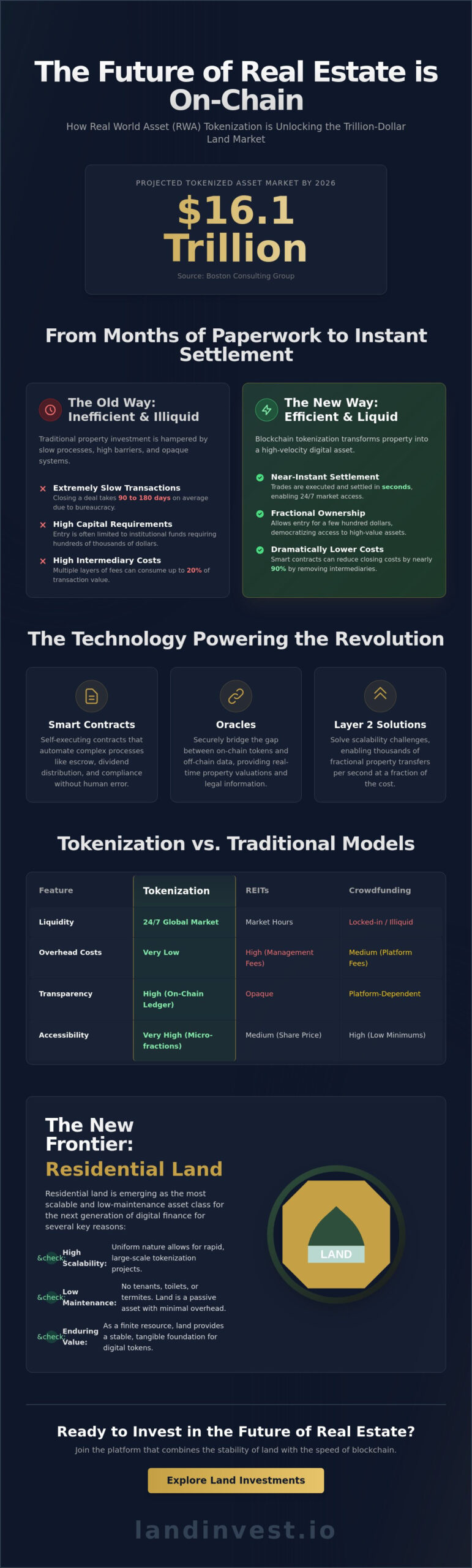
Tokenization vs. REITs vs. Crowdfunding: A 2026 Comparison
The landscape of property investment has undergone a significant shift from exclusive private syndications to accessible digital tokens. While Real Estate Investment Trusts (REITs) provided the first step toward democratization in the late 20th century, they often carry management fees ranging from 7% to 15% of gross revenue. These structures frequently lack the transparency modern investors demand. In contrast, real estate blockchain solutions offer a direct view of the underlying asset without the heavy overhead of traditional corporate layers. By 2026, the market has matured to prefer direct ownership models that eliminate unnecessary intermediaries.
Traditional crowdfunding platforms, while popular since the early 2010s, suffer from a persistent “lock-in” effect. Investors often wait 5 to 7 years for a liquidity event, such as a property sale or refinancing. Digital tokens solve this through robust secondary market trading. A U.S. Government Accountability Office report on blockchain highlights how these systems can streamline title registries and reduce administrative friction. This technological foundation allows for a 40% reduction in transaction costs compared to traditional legal transfers. Investors now prioritize platforms where they can exit a position in days rather than years.
- REITs: High fees, low transparency, no direct asset control.
- Crowdfunding: Long lock-up periods, limited secondary markets.
- Tokenization: Low fees, instant verification, high liquidity.
The Security Token Offering (STO) Advantage
Security Token Offerings represent the evolution of compliant asset tokenization. Unlike early experimental tokens, STOs are backed by tangible equity and regulated frameworks. These tokens represent a stake in the company’s operations, providing a layer of professional management while maintaining the benefits of real estate blockchain technology. For example, holding equity in a portfolio of residential vacant land offers a unique stability. Land doesn’t require the constant maintenance or insurance costs of physical buildings, making it a predictable foundation for long-term wealth preservation.
Investment Flexibility and Portfolio Diversification
Digital tokens allow for more granular portfolio construction than traditional funds. You don’t have to commit large sums to a single, opaque entity. Instead, you can allocate capital across specific parcels of land with minimal friction. This level of control was impossible with older investment vehicles. Moving capital between different property types now happens with a few clicks, ensuring your portfolio stays balanced against market shifts. When Choosing the Best Real Estate Tokenization Platform, savvy investors look for high-security standards and clear legal structures. This methodical approach to diversification ensures that your capital works efficiently without the burden of excessive fees.
Evaluating Blockchain Real Estate: A Due Diligence Framework
The most frequent question from cautious investors isn’t about the technology, it’s about the physical reality. How do you know the underlying asset actually exists? In the real estate blockchain sector, trust isn’t a feeling; it’s a verifiable data point. Modern due diligence requires checking the Proof of Reserve (PoR) and on-chain property registries. These digital ledgers link every token to a specific plot of land or building, often verified by third-party custodians or real-time IoT sensors. By 2026, the industry standard will involve automated valuation models (AVMs) that update asset values on-chain every 24 hours.
You must also analyze the legal structure of the investment. A token can represent a direct deed, which is rare due to jurisdictional complexities, or a security token representing shares in a Special Purpose Vehicle (SPV). The issuing firm’s land acquisition strategy dictates your long-term stability. Successful platforms prioritize assets with a 5-10 year history of steady yield rather than speculative developments. Don’t overlook the firm’s track record; a team that’s managed physical assets through at least one market cycle provides a layer of security that code alone cannot offer.
Regulatory Compliance and Investor Protection
Legal jurisdiction acts as your primary safety net. Delaware corporations and US-registered Security Token Offerings (STOs) offer the highest protection because they fall under SEC oversight. Accredited investors often access higher-yield opportunities through Regulation D filings, while non-accredited investors should look for Regulation A+ offerings which require more rigorous public disclosure. Before committing capital, review the whitepaper for three specific items: the legal entity’s registration number, the specific rights of token holders in a liquidation event, and the frequency of external financial audits.
Technical Security and Custody
Your digital ownership is only as secure as your storage method. For individual investors, hardware wallets provide the best balance of control and safety. Institutional-grade platforms often partner with custodians like BitGo to ensure assets are insured against theft. Audited smart contracts are essential; they ensure the real estate blockchain logic hasn’t been compromised by hidden vulnerabilities. Immutable records in property title management mean that once your ownership is recorded, it can’t be manipulated or erased by any centralized authority. This permanence is the foundation of the new digital land economy.
If you’re looking for a stable way to grow your wealth through physical assets, explore how Landinvest secures your future with transparent, land-backed opportunities.
The Future: Why Residential Land is the New Frontier for Blockchain
Residential land represents the most logical evolution for the real estate blockchain sector because it strips away the operational complexities of physical buildings. Unlike developed property, vacant land doesn’t require plumbing repairs, tenant management, or expensive insurance policies. It’s a clean asset class. This simplicity allows for high scalability within a digital ledger. By removing the overhead of property management, investors can focus entirely on the appreciation and resale value of the underlying asset.
The U.S. housing market currently faces a deficit of approximately 3.8 million housing units, according to 2024 data from Freddie Mac. Traditional financing often creates bottlenecks that prevent land from reaching developers who can solve this shortage. Blockchain technology addresses this by optimizing capital allocation. When liquidity moves through digital protocols, it speeds up the process of acquiring and preparing land for residential construction. This creates a more efficient pipeline for housing supply while offering investors a stable, inflation-hedged position in the most fundamental resource: the earth.
The Land Invest Corp Model
Land Invest Corp operates by identifying and acquiring undervalued residential vacant land across high-growth corridors in the United States. The strategy focuses on high-margin resale to builders and developers who need shovel-ready lots. Investors gain direct equity in this operational cycle through the Real Estate Token. This structure provides a unique synergy. It combines the historical stability of land with the 24/7 liquidity and transparency of a blockchain-based system. It’s a conservative approach to modern finance that prioritizes tangible value over speculative hype.
Next Steps for the Digital Investor
Entering the world of digital property requires a move toward compliant and transparent platforms. For those looking to build a resilient portfolio, the first step is education. We recommend starting with our comprehensive pillar article on tokenized real estate to understand the legal and technical frameworks involved.
- Review the 2026 market projections for RWA tokenization.
- Analyze the historical performance of residential land flipping in the US.
- Assess how digital equity fits into your long-term diversification strategy.
The year 2026 marks the definitive entry point for a decade of real estate blockchain dominance. As institutional adoption grows, the window for early-stage land equity narrows. Join the future of land investing with Land Invest Corp and secure your place in a more efficient, transparent, and accessible property market. Stability isn’t just about what you own; it’s about how you own it.
Securing Your Position in the 2026 Digital Land Economy
The transition toward real estate blockchain has moved from a technical curiosity to a fundamental pillar of global finance. By 2026, the liquidity trap that once locked capital for decades has dissolved through fractional ownership and secondary market depth. Industry data from the 2022 BCG report projected that tokenized assets would represent 10% of global GDP by 2030, a trajectory that’s currently reshaping how we view US residential land. This asset class remains a stable hedge against market volatility because land is a finite resource that doesn’t require the costly upkeep of physical buildings.
Success in this new era depends on choosing platforms that prioritize regulatory rigor over hype. Land Invest Corp operates as a compliant Delaware Corporation, providing a secure bridge between traditional property law and modern efficiency. Every share represents transparent, blockchain-verified equity ownership in high-margin US residential vacant land. It’s a method designed for those who value long-term stability and professional oversight in an evolving landscape.
Explore the Land Invest Corp STO and start your real estate blockchain journey today.
Building a resilient portfolio starts with a single, well-informed decision.
Frequently Asked Questions
Is blockchain real estate a safe investment in 2026?
Blockchain real estate is a secure investment option in 2026 because of the comprehensive implementation of the Markets in Crypto-Assets (MiCA) regulation. This legal framework provides the same level of investor protection found in traditional financial markets. By utilizing an immutable ledger, platforms ensure that ownership records can’t be altered or forged, which provides a level of transparency that was previously impossible in private equity.
What is the difference between a real estate token and a traditional REIT?
A real estate token represents direct ownership of a specific asset, whereas a REIT is a share in a company that manages a portfolio. Tokens powered by real estate blockchain technology allow for 24/7 trading on secondary markets and lower entry costs. While REITs often charge management fees ranging from 1% to 12%, tokenized assets reduce these overheads by automating administrative tasks through smart contracts.
Can I buy a fractional share of land using blockchain technology?
You can buy fractional shares of land by purchasing digital tokens that represent a specific percentage of the deed. This technology allows a single hectare of farmland to be divided into 1,000 or more individual units. It’s a practical way to diversify your portfolio without needing the capital for a full property purchase. Each token entitles you to a proportional share of the rental income or agricultural yields.
How do I sell my real estate tokens if I need liquidity?
You sell your tokens on a regulated secondary marketplace or through the platform’s internal liquidity pool. Traditional real estate sales take an average of 70 to 90 days to finalize, but digital tokens can be traded in minutes. Once a buyer is matched, the smart contract automatically updates the ownership record and transfers the funds to your account. This system provides the flexibility that traditional property markets lack.
Do I need a crypto wallet to invest in tokenized real estate?
You need a digital wallet to store your assets, but most professional platforms offer integrated custodial wallets for ease of use. This approach removes the technical barriers associated with managing private keys yourself. It’s the most efficient way to interact with real estate blockchain systems while maintaining the security standards required for high-value investments. You can usually view your holdings through a standard web dashboard.
What are the tax implications of investing in a real estate STO?
Tax obligations for Security Token Offerings (STOs) typically follow the same rules as traditional stocks or bonds in your local jurisdiction. In many regions, profits are subject to Capital Gains Tax once the asset is sold. Because every transaction is recorded on the blockchain with a 100% accurate timestamp, you’ll have a clear audit trail. This transparency makes it much easier to calculate your liabilities during the annual tax season.
How does blockchain prevent property title fraud?
Blockchain prevents fraud by storing title information on a decentralized network where data cannot be changed or deleted. This eliminates the risk of “deed theft,” which accounted for significant losses in the 2023 FBI Internet Crime Report. Since every transfer requires cryptographic verification from the current owner, it’s impossible for a fraudster to sell a property they don’t legally hold. The system creates a single, undeniable source of truth.
Is Land Invest Corp regulated for US investors?
Land Invest Corp complies with SEC guidelines by utilizing specific exemptions such as Regulation D or Regulation S for its offerings. These regulations require the platform to maintain strict transparency and report data to federal authorities. By following the standards set by the 1933 Securities Act, the company ensures that US-based accredited investors can participate in land tokenization within a legal and protected environment. This focus on compliance builds long-term stability.