Why would an investor settle for the unpredictable maintenance costs of a single rental unit when they could secure a stake in the literal foundation of the economy? You’re right to feel that the traditional barrier to real estate entry is far too high, especially with housing affordability hitting a 40 year low in recent market reports. It’s frustrating to watch property values climb while your capital sits on the sidelines. Since its inception in 2021, lofty has promised to solve this by breaking homes into $50 tokens, but as we move through 2026, the question of long-term liquidity and platform stability remains a valid concern for many.
This guide provides a transparent comparison between the residential rental model and the emerging land-flipping equity tokens offered by Land Invest Corp. You’ll learn how the Security Token Offering (STO) model provides a regulated framework for building passive income without the headaches of property management. We’ll examine the specific mechanics of these digital assets to help you choose a path that offers both technological convenience and the timeless security of land ownership.
Key Takeaways
- Understand how the 2026 RWA landscape has evolved and why fractional ownership remains a cornerstone for modern, diversified portfolios.
- Evaluate the core mechanics of the lofty marketplace, focusing on its blockchain infrastructure and the practical process of daily rental distributions.
- Learn the critical differences between direct residential property ownership and holding equity tokens in specialized land-flipping firms.
- Identify essential strategies for managing liquidity and asset class diversification to protect your capital during potential market shifts.
- Discover why land-focused equity models provide a professional alternative for investors prioritizing asset security and long-term growth.
Understanding Lofty and the Fractional Real Estate Boom in 2026
Lofty emerged as a primary innovator by bridging the gap between traditional property markets and the Algorand blockchain. By 2026, the landscape for Real World Assets (RWA) has matured from an experimental niche into a standard component of balanced portfolios. Investors now prioritize the transparency and direct control that digital equity provides. While traditional Real Estate Investment Trusts (REITs) often hide specific asset performance behind layers of management fees and complex corporate structures, digital equity allows for granular, asset-by-asset selection.
The 2026 market reflects a significant departure from the burdens of whole-property ownership. High entry barriers and the logistical headaches of property management have pushed retail investors toward more liquid, manageable alternatives. Fractional ownership enables individuals to own specific portions of residential or commercial units without the liability of a full mortgage or the stress of being a solo landlord. This shift provides a stable foundation for those seeking long-term wealth preservation and consistent rental yields rather than speculative volatility.
The Evolution of Tokenized Property
Since its launch in 2021, lofty has led the movement to make real estate accessible to anyone with a digital wallet. The underlying blockchain technology has matured, providing a secure and immutable record of ownership rights that bypasses traditional bureaucratic delays. RWA tokenization is the digital representation of physical assets on a ledger. This evolution ensures that property rights are now as tradable as liquid stocks, yet they remain anchored by the tangible value of physical buildings.
Why Fractional Ownership is Trending Now
The economic environment of the mid-2020s has fundamentally redefined how we build wealth. With interest rates for traditional mortgages remaining high, the cost of debt has made solo property acquisition difficult for the average person. This reality has democratized access to high-value markets that were previously the exclusive playground of institutional firms. You can explore the mechanics of this shift in our detailed guide on What is tokenized real estate? to understand the underlying infrastructure.
- Accessibility: Entry points as low as $50 allow for immediate market participation.
- Diversification: Investors can spread capital across dozens of properties in different states rather than tying all wealth to a single zip code.
- Liquidity: Secondary markets allow for the sale of shares in days, not the months required for a traditional home sale.
- Transparency: Real-time data on occupancy and maintenance costs is available directly on the lofty platform.
By lowering the barrier to entry, the platform removes the gatekeeping inherent in the legacy financial system. Investors no longer have to choose between high-risk stocks or inaccessible real estate. Instead, they find a professional middle ground that offers the stability of real assets combined with the efficiency of modern technology.
How Lofty Works: Tokenized Residential Rentals on the Blockchain
Lofty operates as a bridge between traditional real estate and decentralized finance. The platform utilizes the Algorand blockchain to host its marketplace, where residential properties are divided into digital tokens. Each property is held by an individual Limited Liability Company (LLC). When you purchase a token, you aren’t buying the physical bricks directly. Instead, you’re acquiring a membership interest in the LLC that owns the asset. This structure ensures that ownership remains legally compliant while benefiting from the speed of the blockchain. It’s a method that removes the high entry barriers usually associated with property ownership.
The Rental Income Mechanism
The process begins with selecting a property and purchasing fractions. Lofty calculates rent on a daily basis. They take the monthly gross rent, subtract recurring costs like property taxes and insurance, and distribute the remainder to token holders every 24 hours. If a property faces a $1,500 repair, the cost usually comes from a pre-funded maintenance reserve established at the time of purchase. If that reserve is depleted, daily distributions might pause until the balance is restored. This model creates a hands-off experience because professional property management firms handle tenant screening and maintenance calls. While the income is passive, investors should realize that returns aren’t guaranteed. Market conditions and local vacancy rates still dictate the final yield.
Blockchain Security and Transparency
Transparency is the primary advantage of the lofty model. Every transaction, from the initial token sale to the daily rent payment, is recorded on the Algorand ledger. You can view property deeds, inspection reports, and closing statements directly through the platform interface. Traditional real estate relies on paper-based county records that can take 30 days or more to update. In contrast, smart contracts handle ownership transfers instantly. This technical infrastructure ensures that your ownership stake is immutable and verifiable without a middleman. If you decide to exit your position, you can list your fractions on the secondary market for other users to buy. This provides a level of liquidity that traditional residential investing simply cannot match. For those looking to build a resilient portfolio, understanding these digital mechanisms is as vital as evaluating the stability of the underlying asset itself.
- Tokenization: Assets are split into $50 fractions for maximum accessibility.
- Daily Payouts: Rent is credited to your account in real-time, not once a month.
- Governance: Token holders vote on major decisions, such as when to sell the property or fire a manager.
- Secondary Market: Investors can sell their tokens to other users, often within minutes if there is demand.
The lofty ecosystem effectively replaces the traditional closing process with a digital transaction. By using the blockchain, the platform reduces administrative overhead, which allows a larger portion of the rental income to stay with the investors rather than being lost to bank fees and title companies.
Lofty vs. Land Invest Corp: Comparing Two Paths to Digital Equity
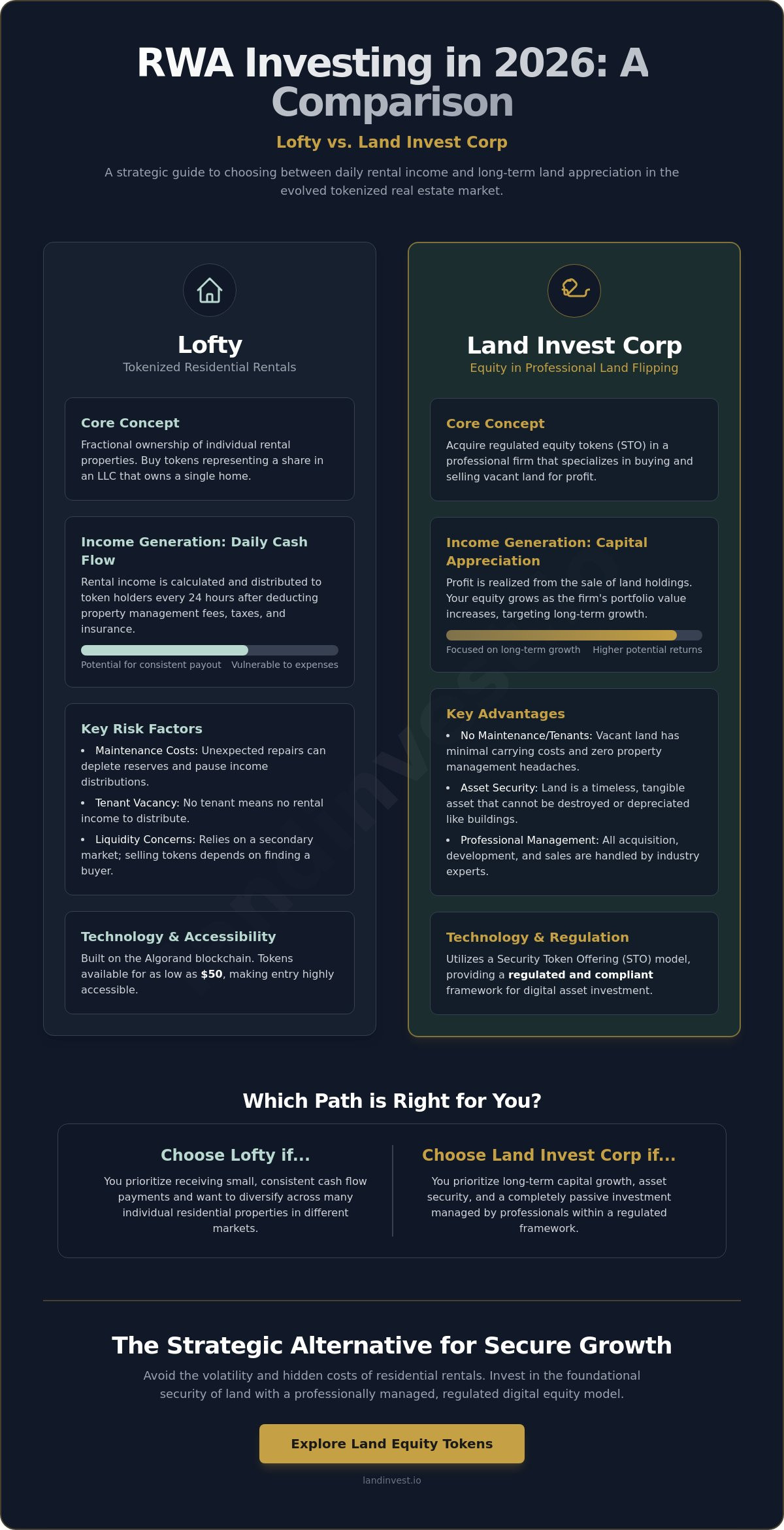
Investors looking for digital real estate exposure in 2026 generally choose between two distinct legal and operational structures. Lofty facilitates direct property ownership through fractional tokens on the Algorand blockchain. Each token represents a share in a specific Limited Liability Company (LLC) that holds a single residential home. This model provides a high degree of transparency for those who want to pick individual houses in specific neighborhoods. It’s a granular approach that mirrors traditional landlordism but without the barrier of high entry costs.
Land Invest Corp takes a different path by offering company equity ownership through a Security Token Offering (STO). Instead of owning a piece of one house, investors hold equity in a corporation that manages a diversified portfolio of vacant residential land. This structure emphasizes stability and professional management over individual asset selection. The legal framework of an STO often provides a more robust layer of regulatory compliance, which appeals to conservative investors who prioritize long-term security over the ability to trade tokens on a 24/7 secondary market. While lofty focuses on the micro-management of rental units, the Land Invest model focuses on the macro-growth of land as a finite resource.
Residential Rentals vs. Vacant Land Flipping
The 2026 rental market has shown significant volatility, with urban centers seeing a 5.4% fluctuation in occupancy rates over the last fiscal year. This unpredictability makes residential rentals a more intensive asset class to manage. Even with automated systems, investors must account for property taxes, insurance hikes, and the inevitable “roof and water” issues that plague physical structures. Vacant residential land serves as a lower-overhead alternative because it lacks these depreciating components. There are no pipes to burst and no tenants to manage, which simplifies the investment thesis for those seeking a “set and forget” strategy. For a deeper analysis of how these assets are categorized, you can read about what is fractional land ownership? to understand the mechanics of land-based equity.
Yield Models: Daily Rent vs. Capital Appreciation
The financial outcomes of these platforms depend on two different revenue drivers. Lofty’s primary appeal is its daily rent distribution, providing immediate liquidity and cash flow. However, this yield is capped by the local rental market’s ceiling and can be wiped out by a single month of vacancy. Land Invest Corp focuses on land flipping margins, where the profit comes from purchasing undervalued parcels and reselling them after basic entitlement or market appreciation. This model prioritizes capital growth over monthly checks.
- Risk Assessment: Lofty investors face tenant default risks and high maintenance costs.
- Market Liquidity: Land markets are generally less liquid than residential ones, but they offer higher protection against inflation.
- Operational Efficiency: Land requires zero utility payments or “wear and tear” repairs.
The tax implications also differ significantly, as rental income from lofty properties is often treated as ordinary passive income, while the profits from land equity resale are typically structured to benefit from long-term capital gains rates. This distinction is vital for investors who are building a digital portfolio with an eye on after-tax total returns rather than just gross yield. Investors comparing traditional crowdfunding platforms should also review our CrowdStreet review 2026 comparing traditional crowdfunding vs. tokenized land equity to understand how lock-up periods and capital minimums affect overall portfolio flexibility.
Key Considerations: Risk, Liquidity, and Asset Class Diversification
Investing in fractional assets requires a clear-eyed view of the underlying mechanics and potential pitfalls. While lofty provides an accessible gateway to the US housing market, your success depends on how you handle systemic risks. Liquidity remains a primary concern. In a stable market, selling tokens on a secondary exchange feels seamless. However, during a market downturn, liquidity often dries up. If buyers vanish, you might have to sell your tokens at a 15% or 20% discount to the net asset value (NAV) to exit a position quickly. You shouldn’t treat these digital assets like a high-yield savings account; they’re long-term commitments.
Diversification is your most effective shield against hyper-local volatility. Putting your entire budget into a single rental property in one city exposes you to concentrated risk. A single tenant default, a sudden rise in local property taxes, or a localized economic slump can wipe out your annual returns. Professional investors in 2026 typically spread capital across at least 15 different zip codes and property types. This strategy ensures that a localized issue doesn’t compromise your entire portfolio’s performance. Always perform due diligence on the platform’s leadership. By 2026, many early entrants in the tokenization space have vanished; checking the track record of lofty and its founders is essential for verifying long-term platform stability.
The Importance of SEC Compliance
The regulatory environment has matured significantly since the early days of real estate tokenization. By 2026, the era of “utility tokens” for property has ended. Most legitimate platforms now operate through Security Token Offerings (STOs). This shift provides you with legal recourse and ensures transparent financial reporting. Whether you’re an accredited or non-accredited investor, SEC-compliant structures offer a layer of protection that was missing in the 2021 era. You can see how these regulatory standards compare to other market leaders in our Fundrise Review 2026, which explores different crowdfunding compliance models.
Managing Your Digital Real Estate Portfolio
Successful portfolio management involves balancing yield-focused assets with growth-focused holdings. While residential tokens offer monthly cash flow, they often lack the massive appreciation potential seen in undeveloped land. Use professional dashboard tools to track your Real World Asset (RWA) performance across multiple platforms. It’s vital to set realistic expectations. Chasing 15% returns often leads to high-risk areas with poor tenant quality. A steady 6% to 8% yield, backed by transparent data, remains the benchmark for a healthy, conservative portfolio. If you want to anchor your digital holdings with tangible, low-volatility assets, consider the benefits of stable land assets to balance your strategy.
Why Land Invest Corp is the Strategic Alternative for Land-Focused Investors
While platforms like lofty have successfully popularized fractional ownership in residential rentals, savvy investors in 2026 are looking toward more specialized niches. Land Invest Corp fills this gap by operating as a land-flipping powerhouse. The strategy isn’t about collecting monthly rent checks from aging structures. Instead, it’s about the precision acquisition and resale of residential vacant land. This approach eliminates the headaches of property management, tenant disputes, and unexpected maintenance costs that often eat into rental yields.
Choosing Land Invest Corp means moving beyond the limitations of individual property deeds. In many fractional models, your success is tied to one specific house. If that house sits empty, your returns vanish. Land Invest Corp utilizes a corporate equity model that spreads risk across a diversified portfolio of land assets. It’s a sophisticated way to gain exposure to the real estate market without the volatility of single-asset dependence. The focus remains on the intrinsic value of the earth, which historically provides a stable hedge against currency fluctuations.
The Land Invest Corp STO Model
The Security Token Offering (STO) model is designed for transparency and professional alignment. When you invest, you hold fractional equity in the corporation itself. This ensures that every successful flip and every strategic land acquisition benefits the entire token-holder base. The company focuses on residential vacant land across the United States, targeting areas where housing demand is high but inventory is low. This alignment of interests is fundamental to the brand’s philosophy of mutual growth.
Expertise is the primary driver of these margins. Randy Goldberg leads the acquisition strategy, utilizing decades of market experience to identify parcels that others overlook. The process involves several key steps:
- Data-driven identification of undervalued residential lots in high-growth corridors.
- Direct negotiation with sellers to secure properties below current market value.
- Streamlined legal and administrative processing to ensure clear titles and rapid closing.
- Aggressive marketing to builders and developers who are hungry for ready-to-build land.
How to Get Started with Land Tokenization
Navigating the Land Invest Corp platform is straightforward. New investors can register and access a dashboard that provides a clear view of the current portfolio and historical performance metrics. The 2026 roadmap is already in motion, with a focus on expanding into emerging markets where infrastructure development is driving land prices upward. This forward-looking strategy provides a sense of security in an otherwise volatile financial environment.
The transition from traditional real estate to tokenized land equity is the next logical step for those seeking stability. You don’t need to be a land expert to benefit from these cycles; you just need to partner with a firm that has the proven track record to execute. If you’re ready to move beyond the rental model and embrace the growth potential of land, you can Join the Land Invest Corp STO and start building a more resilient portfolio today.
Navigating the Future of Digital Real Estate Equity
The landscape of fractional real estate has shifted significantly since the early days of tokenization. As we navigate through 2026, it’s clear that platforms like lofty paved the way for accessible property ownership, yet the market now demands deeper specialization. Investors are no longer just looking for any digital asset. They’re seeking transparency and proven asset classes that resist the volatility of traditional residential rental markets. Diversification today means looking beyond monthly yields and considering the raw potential of the land itself.
Land Invest Corp offers a strategic evolution in this space. Led by real estate veteran Randy Goldberg, the platform utilizes a compliant Security Token Offering (STO) structure to provide institutional-grade security for every participant. Instead of managing the overhead of tenants and property repairs, the focus remains on high-margin residential vacant land flipping. This approach prioritizes capital growth and stability in an increasingly complex financial environment. By choosing a model built on tangible assets and regulatory clarity, you’re not just following a trend; you’re securing a foundation for long-term wealth.
Explore the Land Invest Corp Security Token Offering and discover how land-focused digital equity can strengthen your portfolio today.
Building a resilient portfolio starts with choosing the right partner for the journey ahead.
Frequently Asked Questions
Is Lofty a safe platform for real estate investing in 2026?
Lofty is a safe platform because it utilizes the Algorand blockchain to provide transparent, immutable records of ownership. In 2026, the platform continues to operate under strict SEC guidelines, ensuring each property is held within a specific LLC. This structure isolates your investment from the company’s operational risks. It’s a proven model that protects your assets even if the parent platform faces financial challenges.
How does Lofty compare to Land Invest Corp for passive income?
Lofty focuses on daily rental dividends from residential homes, whereas Land Invest Corp prioritizes long-term stability through agricultural land appreciation. While residential rentals offer immediate cash flow, they’re often more sensitive to local economic shifts. Land Invest Corp offers a hedge against inflation, as farmland has historically shown lower volatility than the housing market. Investors often choose land for wealth preservation and steady, long-term growth.
What is the minimum investment for fractional real estate tokens?
The minimum investment for lofty tokens is typically $50 per share, making real estate accessible to a wider audience. This low entry point allows you to diversify your portfolio across 10 or 20 different properties with a relatively small capital outlay. By spreading your risk, you ensure that a single vacancy doesn’t compromise your entire monthly yield. It’s a practical way to build a real estate portfolio without needing a massive down payment.
Can I sell my Lofty tokens at any time on a secondary market?
You can list your tokens for sale on the secondary market at any time, but the speed of the sale depends on current buyer demand. Unlike traditional property sales that take 60 days to close, these blockchain transactions settle almost instantly once a buyer is found. It’s important to realize that market liquidity fluctuates. If you need to exit a position quickly, you might need to adjust your asking price to attract immediate interest.
Does Land Invest Corp offer direct deeds to the land parcels?
Land Invest Corp provides ownership through a legal entity that holds the deed, which simplifies the management process for every investor. You won’t receive a physical paper deed in your name for a small fraction of a field. Instead, you hold shares in a vehicle that owns the land. This professional structure handles all the administrative burdens, such as property taxes and local zoning laws, while you benefit from the land’s value.
What are the tax implications of owning tokenized real estate equity?
Tokenized real estate is treated as a partnership by the IRS, so you’ll receive a Schedule K-1 for your annual tax filings. Rental income is generally taxed as ordinary income, but you can also benefit from depreciation pass-throughs to lower your taxable gains. Since the 2024 tax year, the lofty dashboard has automated much of this reporting. It’s always wise to consult a professional to ensure you’re maximizing your specific tax advantages.
Is an STO more secure than a standard fractional property token?
A Security Token Offering (STO) is more secure because it’s a regulated financial instrument that follows the 1933 Securities Act. Standard tokens may lack this level of legal oversight and investor protection. By choosing an STO, you’re investing in a product that requires full transparency and regular audits. This regulatory framework provides a higher level of recourse if the platform fails to meet its legal obligations to investors.
How does vacant land flipping generate returns compared to rental income?
Vacant land flipping generates returns through capital appreciation and land development, while rental income provides a consistent monthly check. Industry data from 2025 indicates that strategic land flips can produce 15% to 25% returns upon the final sale. Rental properties usually offer a lower annual yield, often between 4% and 7%, but they provide immediate liquidity. Land is a finite resource, so its value doesn’t depend on building maintenance or tenant management.