The most secure real estate strategy for 2026 might actually be the one that feels the most unconventional. While many investors still view direct ownership as the only path to stability, the rise of fractionalized assets has fundamentally altered the risk profile of a modern portfolio. You likely recognize that high-tier commercial deals often demand a $25,000 minimum commitment, which creates a significant barrier for those seeking genuine diversification. If you’ve analyzed a crowdstreet review lately, you’ll see the platform has facilitated over $4 billion in total capital investment, yet this traditional crowdfunding model still requires investors to accept five to seven year lock-up periods.
We agree that the lack of liquidity and the complexity of due diligence shouldn’t keep you from institutional-grade assets. This article compares the established CrowdStreet marketplace with emerging tokenized land equity models to help you determine the best fit for your 2026 strategy. You’ll learn the structural differences between standard private equity and Security Token Offerings (STOs) to identify which provides better risk-adjusted returns. We’ll show you how to combine the ancient value of land with digital transparency to build a resilient, diversified portfolio.
Key Takeaways
- Understand how crowdstreet bridges the gap between individual investors and institutional commercial developers within the 2026 real estate landscape.
- Compare the traditional marketplace model against modern RWA tokenization to determine which structure offers better transparency and simplified investor management.
- Analyze the risk profiles of commercial property investments versus the stability and low-maintenance benefits of residential vacant land.
- Gain a clear checklist for evaluating real estate Security Token Offerings (STOs) to ensure your capital is backed by tangible, long-term assets.
- Learn how to seamlessly integrate tokenized land equity into a traditional portfolio to enhance diversification and inflation protection.
The Evolution of Real Estate Crowdfunding: Where CrowdStreet Stands in 2026
The private real estate market in 2026 operates with a level of transparency and data-driven precision that was absent a decade ago. Investors now prioritize asset stability and tangible value over the speculative growth patterns seen in previous cycles. Since the legislative shifts of the early 2010s, real estate crowdfunding has matured from a novel alternative into a multi-billion dollar pillar of the global financial ecosystem. CrowdStreet established itself as a pioneer during this growth period, acting as a primary bridge between individual accredited investors and institutional-grade commercial developers.
The marketplace has shifted away from generalist platforms that attempt to be everything to everyone. In 2026, we see a clear divide between broad commercial platforms and specialized niche investment vehicles. While the early 2020s focused on rapid expansion, the current year is defined by a flight to quality and a preference for assets that provide genuine inflation protection. It’s no longer enough to simply offer access; platforms must now prove the underlying resilience of their specific asset classes.
The Core Mechanism of CrowdStreet
CrowdStreet operates on a marketplace model where the platform acts as a gatekeeper rather than a direct fund manager. Investors have the autonomy to pick individual commercial deals based on their own risk tolerance. This structure relies heavily on traditional legal frameworks, specifically Limited Liability Companies (LLCs) and Private Placement Memorandums (PPMs), which define the rights and obligations of each partner. The typical investor profile on the platform remains the accredited individual. These participants usually seek long-term capital appreciation or steady quarterly distributions by owning a direct stake in specific physical developments like medical offices or multi-family housing.
Market Saturation and the Need for Niche Assets
Commercial real estate faces increased volatility in the 2026 economic environment. Urban office sectors and high-street retail have seen yields compress to 4% or 5% in many major markets, making it harder for traditional models to outperform inflation. This saturation has created a phenomenon known as “Asset Fatigue” among experienced users of real estate crowdfunding platforms. Investors are increasingly looking beyond the standard apartment complex or office park. They’re searching for more resilient, less maintenance-intensive assets like agricultural land or tokenized equity that can offer better diversification in a fluctuating market. As CrowdStreet continues to host traditional commercial deals, many investors are starting to question if these legacy structures still offer the best risk-adjusted returns compared to emerging, land-based alternatives.
Analyzing the CrowdStreet Investment Model: Strengths and Limitations
CrowdStreet operates on a marketplace model that prioritizes institutional-quality assets. Their vetting process is famously stringent. Since their inception, they’ve reported reviewing thousands of deals but only listing approximately 5% of them on the platform. This level of scrutiny provides a layer of professional due diligence that individual investors often cannot perform alone. By facilitating direct ownership in specific commercial projects, crowdstreet allows for targeted portfolio construction. You choose the specific asset, location, and sponsor. This differs significantly from the diversified, pool-based approach found in our Fundrise review 2026, where capital is spread across many projects automatically.
The Accredited Investor Barrier
The platform primarily caters to accredited investors, creating a significant barrier to entry for the general public. While this model ensures compliance with traditional private placement rules, it limits the democratization of high-yield real estate. As of 2026, the SEC defines an accredited investor as an individual with a net worth exceeding $1 million, excluding their primary residence, or an annual income over $200,000 for the past two years. These rigid frameworks are why many are looking toward SEC regulations for tokenized assets to find more inclusive investment structures. Traditional crowdfunding remains tethered to these exclusive categories, leaving out a vast segment of potential wealth builders.
Liquidity Challenges in Traditional Private Equity
Liquidity remains a persistent concern within the crowdstreet ecosystem. Most offerings involve hold periods ranging from 5 to 10 years. During this time, your capital is effectively locked away. Selling a fractional interest in a private real estate deal is notoriously difficult because no robust secondary market exists for these specific legal structures. Investors must commit to long-term cycles, which can be risky if personal financial needs change. This lack of flexibility is a primary driver for the shift toward tokenization, which aims to provide the same asset security with better exit options. If you prefer a more stable, accessible foundation for your portfolio, exploring diversified land equity might offer a more balanced path forward.
- Vetting: Rigorous 5% acceptance rate for sponsors.
- Control: Direct selection of specific commercial assets.
- Minimums: Often start at $25,000, which is steep for many.
- Horizon: Fixed 5-10 year commitments with no early exit.
CrowdStreet vs. Land Invest Corp: Traditional Crowdfunding vs. RWA Tokenization
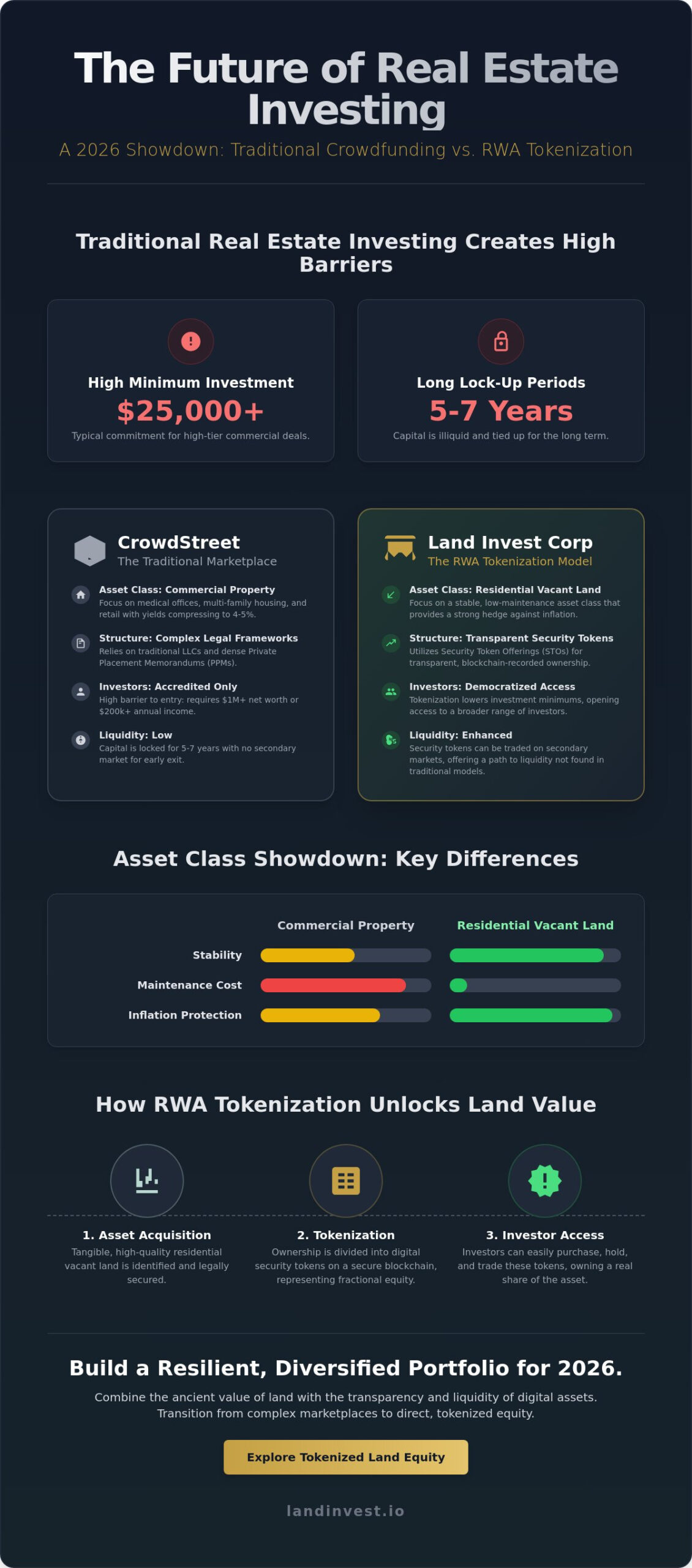
CrowdStreet operates as a marketplace where investors select individual commercial projects managed by various third-party sponsors. This traditional crowdfunding model requires the platform to vet each deal separately, while investors often manage multiple K-1 tax forms and varied reporting standards across different developers. In contrast, Land Invest Corp utilizes a tokenized equity model. This approach moves beyond simple deal-matching. By using tokenized real estate, the platform simplifies the cap table. Instead of managing hundreds of manual entries on a spreadsheet, the blockchain acts as an immutable ledger that records ownership instantly and accurately. This digital infrastructure reduces the administrative burden that typically slows down traditional real estate firms.
Investing in a single building through a marketplace carries specific asset-level risks. If that specific project fails, the capital is at risk. Land Invest Corp shifts this focus by offering equity in the land-buying firm itself. This structural difference provides a layer of stability. Investors aren’t just buying into one deed; they’re gaining exposure to the professional operator’s entire strategy and portfolio. The use of blockchain technology ensures that every transaction is transparent and verifiable, creating a level of trust that manual reporting can’t match.
Structural Transparency: STOs vs. Private Placements
Security Token Offerings (STOs) integrate compliance directly into the digital asset. While a crowdstreet private placement relies on manual verification and traditional bank wires, STOs use smart contracts to automate KYC (Know Your Customer) and AML (Anti-Money Laundering) checks. This automation provides several benefits:
- Speed of Distribution: Digital tokens allow for near-instant profit distributions, whereas traditional bank transfers can take 3 to 5 business days.
- Reduced Overhead: Tokenized platforms often see a 20% to 30% reduction in administrative costs by eliminating manual reconciliation.
- Automated Compliance: The smart contract prevents the transfer of tokens to unverified wallets, ensuring the investment remains regulatory-compliant at all times.
Accessibility and Fractionalization
The traditional commercial real estate world is often gated. Most deals on marketplace platforms require a $25,000 minimum investment, which limits how many people can participate. Through fractional land ownership, investors can access real-world assets with much lower entry points. This democratizes access to land, an asset class traditionally reserved for institutional buyers.
Diversification is much simpler with a tokenized approach. Instead of putting $25,000 into one office building, an investor can hold a single token that represents equity in a firm managing thousands of land parcels. It’s a more conservative, diversified way to build wealth. You aren’t chasing a single “home run” deal. Instead, you’re participating in the steady, predictable growth of a professional land-buying operation. This model prioritizes long-term stability over the volatility often found in individual property developments.
Asset Class Showdown: Commercial Property vs. Residential Vacant Land
Commercial properties often carry heavy operational baggage. Investors on platforms like crowdstreet typically fund office buildings or retail centers where success depends on high occupancy rates. These assets require constant capital for HVAC repairs, property management, and structural upgrades. Residential vacant land operates on a different logic. It’s a “Real World Asset” (RWA) that doesn’t age or deteriorate. In 2026, the tax burden on raw land remains a fraction of what commercial landlords pay, making it a low-carry cost investment with high upside. While an office building depreciates without constant reinvestment, land value remains tied to the soil itself.
Why Vacant Land is the “Hidden” Real Estate Gem
The United States faces a persistent shortage of buildable residential lots, especially in the Sunbelt and mountain regions. This scarcity drives the “Buy Low, Sell High” strategy within the modern vacant land marketplace. Land Invest Corp focuses on acquiring these parcels at 20-40% below market value from motivated sellers who prioritize speed over price. Unlike commercial buildings, land has no “tenants, toilets, or termites” to manage. It’s a pure play on geographic value. Residential land acts as a superior inflation hedge because its value is tied to the fundamental human need for housing, which historically outpaces retail or office demand in volatile economies where remote work has lowered commercial utility.
Risk Mitigation in 2026
Concentration risk is the silent killer of many real estate portfolios. A typical crowdstreet deal might involve a single $50 million office tower. If a major tenant like a law firm or tech company exits, the ROI collapses instantly. Land Invest mitigates this by pooling capital into hundreds of smaller, independent parcels across various counties. This diversification ensures that a single bad plot doesn’t ruin the fund. Liquidity also favors land. Selling a $25,000 residential lot in a high-growth area often takes 30-60 days; unloading a massive commercial complex can take 12-18 months. This speed provides a safety net that large-scale commercial investors simply don’t have in a shifting market.
Choosing Your Path: How to Transition from Marketplace Platforms to Tokenized Equity
Investors who utilized crowdstreet in the past decade understand the power of collective capital. However, the 2026 market demands the increased liquidity and transparency that only tokenization provides. Transitioning from traditional marketplace platforms to tokenized land equity involves shifting your focus from rigid, long-term lockups to flexible, digital ownership. While commercial real estate offers growth, arable land provides a foundational stability that remains uncorrelated with volatile stock markets.
To evaluate a land-based Security Token Offering (STO) against a traditional crowdfunding deal, use this professional checklist:
- Secondary Market Access: Does the platform allow you to trade your equity tokens, or is your capital locked for 5 to 10 years?
- Asset Tangibility: Is the investment backed by physical land with intrinsic value, or is it a debt instrument tied to a developer’s performance?
- Regulatory Framework: Verify the STO is registered with relevant financial authorities, ensuring the same protections you’d find on crowdstreet.
- Operational Track Record: Look for a firm like Land Invest Corp that demonstrates deep expertise in land acquisition and agricultural management rather than just tech development.
Integrating tokenized assets into a traditional 60/40 portfolio enhances diversification. Farmland has delivered an average annual return of 10.2% between 1991 and 2023, often outperforming traditional real estate during inflationary periods. By allocating 5% to 10% of your alternative bucket to land tokens, you create a defensive hedge that preserves purchasing power without sacrificing the ease of digital management.
Due Diligence for the Digital Age
A transparent STO prospectus should clearly outline the legal link between the digital token and the physical land title. You can verify the underlying land portfolio by cross-referencing platform data with public land registries and blockchain explorers. This dual verification ensures the asset exists and the ownership structure is valid. The issuer’s role is critical; they must manage the land’s productivity and soil health to ensure long-term value appreciation for token holders.
Next Steps for the 2026 Investor
Starting your journey with Land Invest Corp is a streamlined process designed for the modern professional. You’ll begin by creating an account and completing a secure KYC/AML verification, which typically finishes within 24 hours. Once your identity is confirmed, you can browse specific land parcels and acquire equity tokens through a user-friendly dashboard. These tokens allow you to track your investment’s performance in real-time. Don’t wait for the next market cycle to secure your wealth. Join Land Invest Corp today and build your portfolio on the most stable foundation on earth.
The Evolution of Ownership in a Tokenized Economy
The transition from traditional marketplace models to on-chain equity represents a fundamental shift in how we build wealth. While crowdstreet established the groundwork for digital real estate access, the emergence of RWA tokenization in 2026 offers superior transparency and fractional flexibility. Investors are moving away from the complexities of commercial management toward the simplicity of residential vacant land. According to the 2024 U.S. Census Bureau report on building permits, residential demand remains a primary driver of land value appreciation. This makes raw land a stable hedge against the volatility often found in traditional equity markets.
Land Invest Corp provides a secure entry point into this evolving market. As a Delaware-registered corporation led by industry veteran Randy Goldberg, the platform utilizes a compliant Security Token Offering (STO) to provide fractional equity ownership. The focus remains on high-margin residential plots across the United States; it combines the permanence of earth with the efficiency of blockchain technology. It’s a logical step for those seeking to ground their digital portfolio in tangible, high-demand assets.
Explore the Land Invest Corp STO and start building your tokenized land portfolio today.
The marriage of traditional land value and modern technology creates a unique opportunity for lasting financial security. Your journey toward a more stable, transparent investment future begins here.
Frequently Asked Questions
Is CrowdStreet safe for individual investors in 2026?
CrowdStreet remains a regulated platform under SEC guidelines, but safety depends on the specific project’s performance. In 2024, the platform implemented stricter sponsor vetting after the Nightingale Properties incident involving $63 million in missing funds. Investors should review the 2025 transparency reports which show a 15% increase in auditing frequency. Real estate carries inherent market risks, so diversification across multiple asset classes is essential for long-term stability.
What is the difference between CrowdStreet and a Security Token Offering (STO)?
The main difference lies in the technology used for ownership verification and liquidity. CrowdStreet typically uses traditional legal structures like LLCs and paper-based ledgers to track shares. An STO utilizes blockchain technology to issue digital tokens representing equity. This allows for automated compliance and near-instant settlement. While both provide access to commercial assets, STOs offer 24/7 fractional ownership through smart contracts on a decentralized ledger.
Can I sell my CrowdStreet investments early on a secondary market?
Liquidity on CrowdStreet is generally restricted since most offerings are private placements with 3 to 10 year hold periods. You can’t simply click a button to exit like you’d with a public stock. While the platform launched a secondary marketplace pilot in 2023, volume remains low. Most investors must wait for a capital event, such as a property sale or refinancing, to recover their initial principal.
How does Land Invest Corp generate returns compared to a commercial fund?
Land Invest Corp focuses on the appreciation of arable land and lease income from agricultural operators. Commercial funds often rely on rental yields from office or retail spaces, which saw a 12% vacancy rate increase in 2025. Farmland provides a non-correlated asset class that has historically outpaced inflation by 2.1% annually according to USDA data. Returns come from the organic growth of land value and stable crop-sharing agreements.
Do I need to be an accredited investor to use Land Invest Corp?
No, the platform is designed to be accessible to both accredited and non-accredited investors through specific regulatory exemptions. Under Regulation A+ or similar frameworks, individuals don’t need a $1 million net worth to participate. This democratizes access to high-quality agricultural assets that were previously reserved for institutional buyers. It’s a shift from the strict accreditation requirements often found on the crowdstreet platform for individual deals.
What happens to my tokens if the platform goes offline?
Your ownership remains secure because the tokens exist on a decentralized blockchain ledger independent of the platform’s servers. If the website disappears, the smart contract still identifies your wallet address as the legal owner of the land equity. You can verify your holdings through any public block explorer. This technical redundancy ensures that your 100% legal claim to the underlying asset persists regardless of the company’s operational status.
Are there tax advantages to investing in tokenized land equity?
Investors can benefit from depreciation pass-throughs and favorable capital gains treatments similar to traditional real estate. Since the tokens represent direct equity in land-holding entities, you’ll receive a Schedule K-1 for tax reporting. According to 2025 IRS guidelines, agricultural land investments can also qualify for specific conservation easements. These structures can reduce taxable income while your asset grows in value over the long term through steady appreciation.
How much money do I need to start investing in land via tokenization?
You can start investing with a much lower threshold than traditional real estate requires. While a direct land purchase might require a 20% down payment on a $500,000 plot, tokenization allows for fractional entries. Many digital platforms set their minimums at 1,000 units of currency to encourage broad participation. This low barrier lets you build a diversified portfolio across different geographic regions without committing large amounts of capital to a single farm.