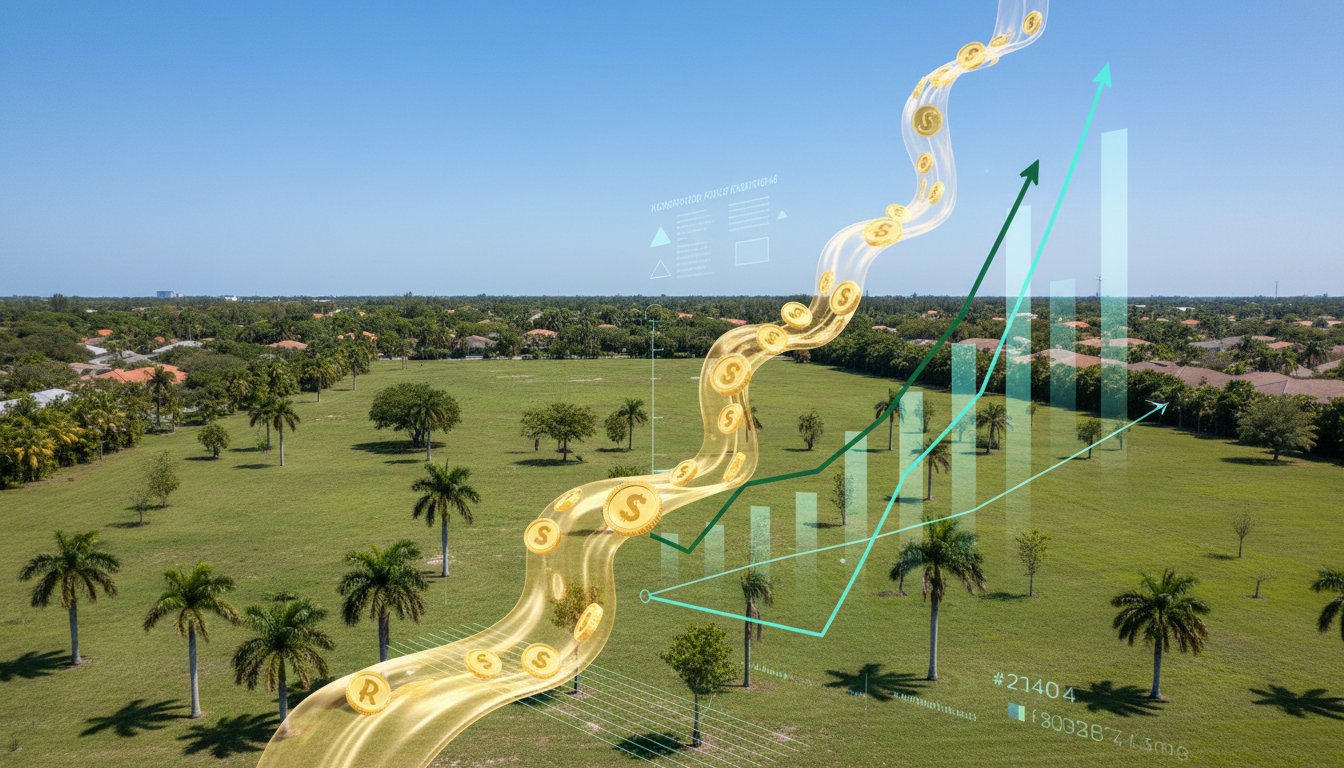
Could the most reliable foundation for your 2026 financial strategy be a piece of land you never have to visit? With central bank interest rates hovering near 4.5% as we entered the first quarter of 2026, the traditional path of leveraging mortgages to secure real estate as an investment has become a steep climb for many. You likely recognize that while tangible assets offer the best shield against inflation, the reality of managing physical tenants or being priced out of Tier 1 cities makes the entry barrier feel insurmountable.
We understand that you’re looking for stability without the operational friction of property maintenance. This guide promises to show you how to build lasting wealth by bridging the gap between centuries-old land value and modern financial technology. We’ll explore how you can secure passive income and diversify your portfolio through both traditional ownership and the emerging frontier of land tokenization. From analyzing current market yields to understanding the transparency of digital land shares, you’re about to discover a more sophisticated way to ground your capital in 2026.
Key Takeaways
- Learn the critical distinction between a primary residence and using real estate as an investment to ensure your capital is positioned for maximum long-term growth.
- Identify the mechanics of wealth creation by comparing “Buy and Hold” vs. “Flip” strategies and leveraging powerful tax advantages like 1031 exchanges.
- Compare traditional property deeds with modern land tokenization to understand how fractional ownership and secondary markets are solving liquidity issues.
- Follow a five-step strategic framework to audit your finances and discover why national land portfolios often outperform local residential picks in 2026.
- Understand how compliant Security Token Offerings (STOs) allow individual investors to access institutional-grade land flipping with transparency and security.
What is Real Estate as an Investment in 2026?
Real estate as an investment represents the strategic acquisition of land or buildings to generate wealth through recurring income or long term value growth. Unlike a primary residence, which serves as a personal utility and often carries ongoing liabilities, an investment asset is selected strictly for its financial performance. To build a foundation for this strategy, it’s helpful to review What is Real Estate Investing, as this encompasses the various methods of financing and leverage used to maximize returns.
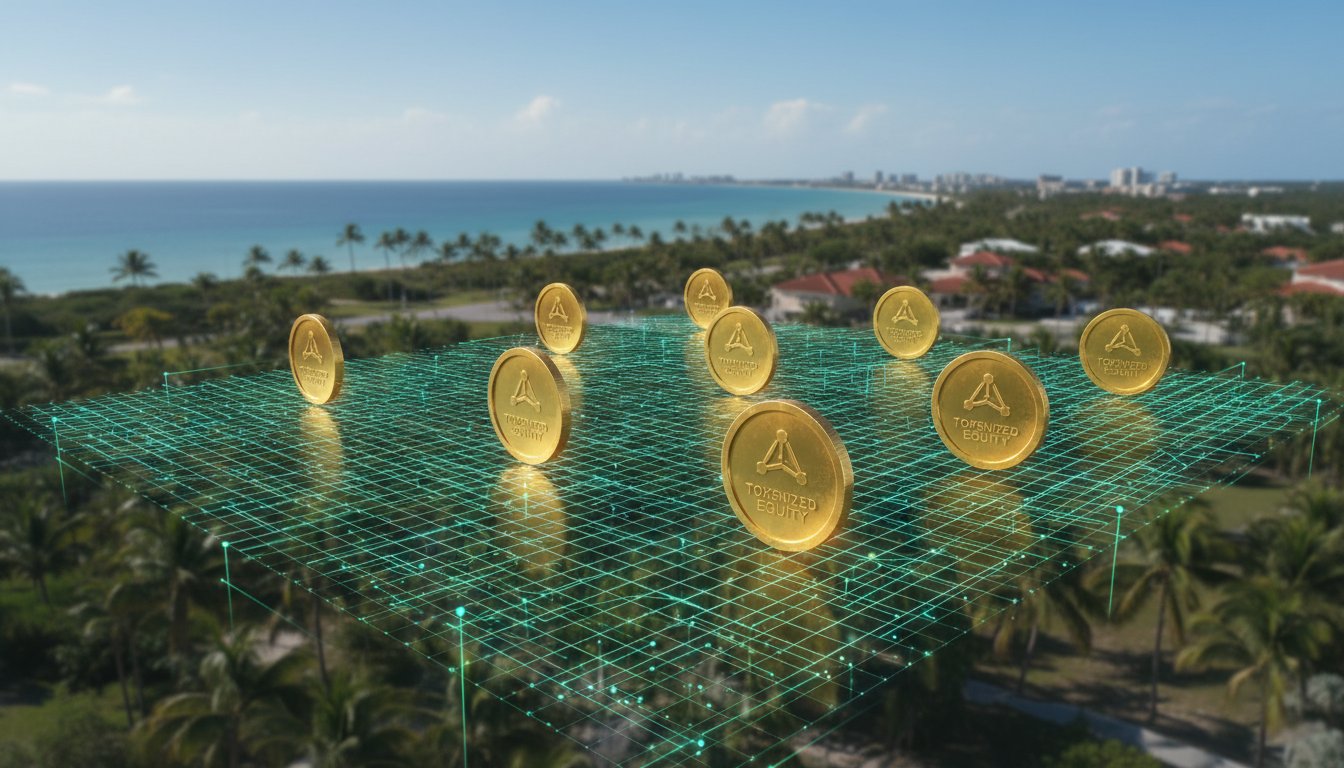
In the 2026 economic environment, the distinction between “shelter” and “asset” has never been clearer. While a home provides stability, real estate as an investment focuses on tax efficiencies and capital gains that outpace inflation. We’ve seen a massive transition toward “Digital Bricks,” a concept where physical land is fractionalized through secure platforms. This allows you to own specific portions of high value acreage without the traditional barriers of massive down payments or complex title transfers. It’s a shift from being a high maintenance landlord to becoming a low overhead land equity holder.
The Core Drivers of Real Estate Value
Traditional rental income faces unique hurdles in 2026. Rising labor costs for repairs and stricter tenant protections have compressed yields for many residential landlords. Consequently, sophisticated investors are prioritizing capital appreciation over monthly checks. Real Estate Appreciation is the sustained increase in a property’s market price driven by the absolute scarcity of land in regions with growing populations. Because we can’t manufacture more earth, well located parcels naturally gain value as demand scales.
Why Investors Are Flocking to Real Estate Now
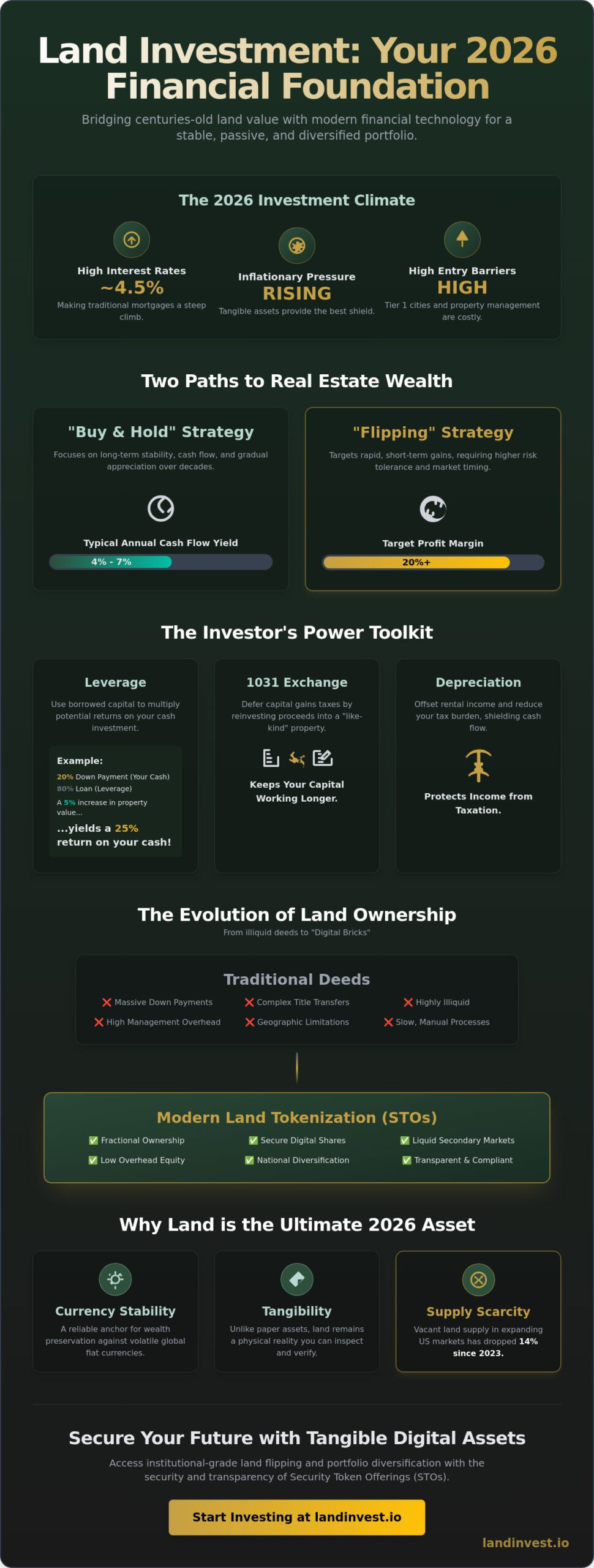
- Currency Stability: With the volatility seen in global fiat currencies throughout 2025, tangible assets provide a reliable anchor for wealth preservation.
- Tangibility: Unlike “paper” assets or digital equities that can vanish during market liquidations, land remains a physical reality you can inspect and verify.
- Supply Scarcity: In expanding US markets, the availability of residential vacant land has dropped by 14 percent since 2023, creating a natural price floor.
Investors don’t just buy property for the sake of ownership anymore; they buy for the security of a finite resource. The 2026 market rewards those who move away from the “fixer-upper” headache and toward the stability of land equity. This approach minimizes the risks of property degradation while capturing the full upside of regional development and economic expansion.
The Mechanics of Real Estate Wealth: Appreciation and Cash Flow
Real estate generates wealth through two primary engines: capital appreciation and consistent cash flow. Choosing the right path depends on your risk tolerance and liquidity needs. A “Buy and Hold” strategy focuses on long-term stability, often yielding 4% to 7% in annual cash flow while the property value grows over decades. In contrast, “Flipping” targets faster gains, usually requiring a 20% profit margin to account for renovation costs and market volatility. Success in these ventures requires following good real estate investing principles to ensure the initial purchase price leaves enough room for market fluctuations.
Tax advantages provide a hidden layer of profit that other asset classes rarely match. Investors use depreciation to offset rental income, which shields cash flow from immediate taxation. A 1031 exchange allows you to defer capital gains taxes by reinvesting sale proceeds into a “like-kind” property, keeping your capital working longer. Leverage remains the most powerful multiplier in this field. By using a 20% down payment, a 5% increase in property value results in a 25% return on your actual cash invested. For those seeking exposure without the burden of direct management, the U.S. Securities and Exchange Commission provides an official guide to REITs which explains how these vehicles distribute at least 90% of taxable income to shareholders.
Residential vs. Commercial vs. Vacant Land
Residential properties offer a lower entry bar, yet they demand high management intensity due to tenant turnover and maintenance. Commercial assets often provide higher yields but remain sensitive to 10-year economic cycles and shifting workplace trends. Vacant land represents a high-margin niche that many overlook. It requires zero maintenance costs and no utility payments, making it a stable choice for patient capital. You can explore how land-based assets provide a resilient hedge against currency devaluation.
Understanding ROI and ROA in Property Markets
When evaluating real estate as an investment, ROI provides a snapshot of a single deal’s success. To calculate ROI for a land flip, subtract the purchase price and taxes from the sale price, then divide by the total cost. If you buy a parcel for $50,000 and sell it for $75,000 after $5,000 in holding costs, your ROI is 40%. Return on Assets (ROA) is equally significant for portfolio health, as it measures how efficiently your total assets generate income regardless of how they’re financed. Land has a unique holding cost profile because it lacks depreciating structures, meaning your carry costs are limited almost exclusively to property taxes. This simplicity makes real estate as an investment more accessible for those who prefer a “set and forget” approach to wealth building.
Traditional Ownership vs. Modern Tokenization
Choosing real estate as an investment used to require hundreds of thousands of dollars in upfront capital. A traditional down payment on a median priced U.S. home, which reached $417,700 in late 2023, often exceeds $80,000. This high barrier historically excluded most young professionals from the market. Digital tokenization changes this equation by splitting a property’s equity into thousands of digital units. Instead of one person holding a single physical deed, a thousand investors can hold tokens representing their specific share. This shift moves the market from stagnant, illiquid assets toward a high-velocity secondary market where tokens trade in minutes, not months.
The Downside of Traditional Landlording
Physical property management is rarely a passive endeavor. Owners face property taxes, which averaged $4,000 annually in states like New Jersey in 2023, alongside constant maintenance costs. The 3 AM emergency call for a burst pipe isn’t a myth; it’s a structural risk of the trade. Most individual landlords suffer from geographic bias, buying only what they can drive to within 60 minutes. This limits their portfolio to local economic cycles. Managing insurance risk management adds another layer of complexity, as premiums for physical structures rose by approximately 20 percent in several regions between 2022 and 2024.
The Rise of Real World Asset (RWA) Tokenization
Blockchain technology removes the administrative friction that plagues traditional deals. By using tokenized real estate investment, platforms lower the entry barrier from a $50,000 down payment to a $500 commitment. This allows for massive diversification. You don’t have to bet your entire savings on one house in one neighborhood. You can own a slice of 100 different properties across various jurisdictions. This democratized approach ensures that real estate as an investment remains accessible to the next generation of wealth builders.
Security Token Offerings (STOs) provide the legal backbone for this digital model. In the US, these offerings comply with strict SEC regulations, such as Regulation D or Regulation S. These frameworks provide the same legal protections as traditional securities while offering the technical liquidity of a digital exchange. The benefits of this modern approach include:
- Liquidity: You can sell tokens on a secondary market instantly instead of waiting 60 days for a traditional closing.
- Transparency: Every ownership stake is recorded on an immutable ledger, reducing the paperwork mess.
- Efficiency: Smart contracts automate dividend distributions, removing the need for manual bookkeeping or chasing tenants for rent.
By moving away from direct deeds toward fractional tokens, investors gain the stability of land without the operational headaches of being a landlord. It’s a transition from active labor to true passive income.
Strategic Framework: 5 Steps to Start Investing in 2026
Success in the 2026 market requires a shift from speculative hype toward methodical wealth preservation. Using real estate as an investment in this climate isn’t about chasing the next viral trend; it’s about building a foundation on tangible assets. This five step framework provides a disciplined path for the modern investor.
- Step 1: Financial Audit. Determine your liquid capital reserves versus your long term risk tolerance. In 2026, maintaining a 12 month liquidity buffer is essential before committing to illiquid assets.
- Step 2: Market Selection. Local residential picks often carry concentrated regional risk. National land portfolios offer superior stability by diversifying across multiple growth corridors rather than betting on a single zip code.
- Step 3: Platform Due Diligence. Evaluate the sponsor’s track record over at least a five year period. Transparency in reporting and regulatory compliance are the primary indicators of a reliable partner.
- Step 4: Investment Execution. Choose between direct title ownership or participation through a Security Token Offering (STO). STOs provide a digital entry point with lower capital requirements while maintaining the security of the underlying asset.
- Step 5: Portfolio Rebalancing. Monitor appreciation every 24 months. Strategic investors exit when the “Buy Low, Sell High” cycle reaches peak suburban expansion, rotating capital back into fresh land assets.
Approaching real estate as an investment with this level of precision ensures that your capital works efficiently without exposing you to unnecessary volatility.
How to Evaluate a Land Portfolio
A high quality land portfolio must have a clear, unencumbered title and verified zoning for residential or mixed use. Investors should focus on the “path of progress,” which refers to land located in suburban expansion zones where infrastructure is already planned. You can learn how to buy vacant land strategically by analyzing 10 year population migration data. This data driven approach identifies where demand will peak before prices reflect that reality.
Avoiding Common Beginner Pitfalls
Over-leveraging remains the most frequent mistake in a high interest rate environment. If your debt to equity ratio exceeds 60%, a slight market cooling can erase your equity. Additionally, many beginners ignore the legal structure of their holdings. Whether you use an LLC, a C-Corp, or Tokenized Equity, the structure dictates your tax liability and your ability to exit the investment. Always account for exit liquidity; land is a stable asset, but it requires a planned 3 to 7 year horizon for maximum profit realization.
Ready to secure your future with stable, land-backed assets? Explore our transparent investment opportunities and start building your 2026 portfolio today.
Why Land Invest Corp is the Logical 2026 Conclusion
By 2026, the barriers to entry for high-yield property deals have shifted significantly. Traditional methods often require massive capital or exhaustive management that most individuals can’t sustain. Land Invest Corp bridges this gap by offering institutional-grade land flipping opportunities to individual investors. It’s a refined approach to real estate as an investment that prioritizes security and efficiency over speculative hype. You don’t need to be a developer to profit from development-ready land.
The core of this model is the Security Token Offering (STO). Unlike unregulated digital assets, an STO represents a compliant equity stake in a Delaware Corporation. This structure ensures your ownership is legally binding and protected by established US corporate law. You’re securing a piece of a company that specializes in high-margin land acquisitions, backed by tangible assets. It’s a marriage of old-world stability and modern financial technology.
This is a truly passive strategy. The company handles the identification, acquisition, and resale of undervalued residential land. You hold the equity while the professional team executes the flips. It removes the typical landlord’s burden. There are no tenants to manage, no pipes to fix (which usually requires 24/7 support from Miami 305 Plumbing), and no local zoning boards to fight. The company flips the land; you hold the value. It’s the most logical way to scale a portfolio without increasing your daily workload.
The Power of a Diversified National Portfolio
Spreading risk is essential for long-term stability. Investing in a single house carries concentrated risk. If that specific neighborhood declines, your ROI suffers. Land Invest Corp utilizes a diversified national portfolio across various US growth markets. Data from 2024 showed that vacant land values in emerging suburbs often outperformed developed residential units by 12% to 15% in terms of raw appreciation. The Delaware Corporation structure provides a tax-efficient and legally robust vehicle for these investors. The company identifies high-margin resale opportunities by analyzing proprietary data sets that most retail investors can’t access.
Getting Started with Land Invest Corp
The onboarding process is designed for clarity and professional speed. Investors complete a digital verification process and gain access to a transparent dashboard. You won’t find vague promises here. Instead, you’ll receive regular reports detailing the portfolio’s performance and the status of current land flips. This level of transparency builds the trust necessary for a long-term partnership. It’s time to move beyond volatile markets and embrace a stable, land-backed future. If you’re ready to redefine real estate as an investment, the path forward is clear. Join the future of land investing today and secure your stake in a diversified American portfolio.
Securing Your Financial Legacy in the 2026 Market
The evolution of real estate as an investment has reached a pivotal moment where digital efficiency meets physical land security. By 2026, the shift from cumbersome traditional acquisitions to streamlined tokenization will be the standard for diversified portfolios. You’ve explored how high-margin residential vacant land serves as a foundational asset, especially as U.S. housing inventory shortages continue to drive long-term demand. Success today isn’t about chasing volatile trends; it’s about anchored growth and professional oversight.
Land Invest Corp provides this stability through a compliant Security Token Offering (STO), ensuring every transaction meets rigorous regulatory standards. Managed by seasoned real estate entrepreneur Randy Goldberg, the platform focuses on the intrinsic value of US soil to protect against inflationary pressures. It’s a method that simplifies complex land deals into accessible opportunities for any serious investor. You don’t have to wait for the next market cycle to build a tangible legacy. Taking a methodical, data-driven approach now ensures you’re positioned for the stability that only land can provide.
Start your journey with Land Invest Corp and own a piece of the US land market today.
Frequently Asked Questions
Is real estate as an investment safe during high inflation?
Real estate as an investment remains one of the most reliable hedges against inflation because property values and rents typically rise alongside consumer prices. Data from the Federal Reserve shows that US home prices increased by 45% between 2020 and 2023, significantly outpacing the Consumer Price Index. This physical asset provides a buffer that cash or bonds can’t match during periods of currency devaluation. It’s a strategy built on tangible value rather than speculative paper wealth.
How much money do I need to start investing in real estate in 2026?
You can start with as little as $100 through fractional tokenization platforms, though traditional direct purchases often require a 20% down payment. In 2026, the median home price in many urban markets remains above $400,000, making entry points for full ownership difficult for many. Tokenization bridges this gap by allowing you to purchase smaller shares of high-value land or commercial buildings. This lower barrier to entry helps you build a diversified portfolio without huge capital outlays.
What is the difference between a REIT and tokenized real estate equity?
REITs are shares in a corporation that manages a portfolio of properties, while tokenized equity provides direct ownership of a specific asset via blockchain. When you buy a REIT on the stock market, you’re investing in a company’s management and its entire pool of assets. Tokenization allows you to choose a single plot of land or building. This gives you more control over your specific strategy and avoids the overhead costs typical of large corporate structures.
Can I invest in US real estate if I am not a resident?
Non-residents can legally invest in US real estate by following the guidelines set by the Foreign Investment in Real Property Tax Act (FIRPTA). You don’t need a green card or citizenship to own land or tokens. Many international investors use an Individual Taxpayer Identification Number (ITIN) to facilitate these transactions. This ensures they meet IRS reporting requirements for any income generated while benefiting from the stability of the US property market.
What happens if the real estate market crashes while I hold tokens?
If the market crashes, the digital token’s value will decrease in direct proportion to the underlying property’s appraised value. Physical assets like land rarely drop to zero, unlike volatile stocks or speculative cryptocurrencies. Historical data from the 2008 financial crisis shows that while prices fell, land values in prime agricultural or development zones recovered faster than residential structures. Your tokens represent a claim on a real, physical asset that retains intrinsic utility.
Is vacant land a better investment than rental houses?
Vacant land is often a more stable long-term play because it lacks the depreciation and maintenance costs associated with rental houses. While rental properties offer monthly income, they also involve tenant management and a 1% to 3% annual maintenance fee. Land requires minimal oversight and benefits from the finite supply of earth. This supports steady appreciation in growing regions and makes real estate as an investment much simpler for those seeking passive growth.
How do I verify the ownership of the land in a tokenized portfolio?
You can verify ownership by cross-referencing the blockchain’s smart contract with the official digital records at the local County Clerk’s office. Each token represents a legal claim to the property title held in a Special Purpose Vehicle (SPV). This transparent link ensures that your digital holdings are backed by a recorded, physical deed in the real world. You can audit the blockchain ledger 24/7 to confirm the asset’s status and your specific percentage of ownership.
What are the tax implications of real estate tokens?
Real estate tokens are generally subject to capital gains taxes, with rates ranging from 0% to 20% depending on your income and holding period. The IRS treats these as property for tax purposes rather than currency. You’ll need to report rental dividends as ordinary income and track your cost basis carefully to ensure accurate filing during the 2026 tax season. Using a digital platform often simplifies this process by providing automated annual tax statements for your records.