What if the 28% average gross margin typically reserved for institutional land developers was accessible to anyone with a smartphone? For decades, the high barrier to entry and the sheer complexity of physical deeds kept the most stable asset class out of reach for many. You’ve likely felt the frustration of watching land values climb while your own capital remained sidelined because you couldn’t justify the illiquidity of a traditional purchase. By 2026, the mainstream adoption of tokenized real estate investment has fundamentally shifted this dynamic, evolving land from a static, paper-heavy asset into a liquid digital equity.
You understand that land represents a timeless store of value, yet the friction of managing it often outweighs the benefits. This case study on Land Invest Corp demonstrates how tokenization transforms residential land flipping into a compliant and transparent investment vehicle. You’ll learn how blockchain-secured ownership records provide fractional equity in high-growth portfolios, offering a bridge between traditional stability and modern digital convenience. We’ll examine the 2026 results that prove passive exposure to residential margins is no longer a privilege of the elite, but a practical reality for the informed investor.
Key Takeaways
- Learn how digital representation transforms traditional land ownership into a liquid, blockchain-verified asset class suitable for the modern era.
- Discover why residential vacant land flipping offers superior margins and stability compared to the complexities of over-saturated rental markets.
- Understand the strategic advantage of tokenized real estate investment through corporate equity, allowing you to profit from a diverse portfolio rather than a single property.
- Master the step-by-step process of acquiring compliant tokens through a secure STO framework that prioritizes investor protection and legal transparency.
- Explore how to secure your digital equity by combining the timeless value of land with the efficiency and transparency of blockchain technology.
The Evolution of Property Ownership: Why Tokenized Real Estate Investment is the 2026 Standard
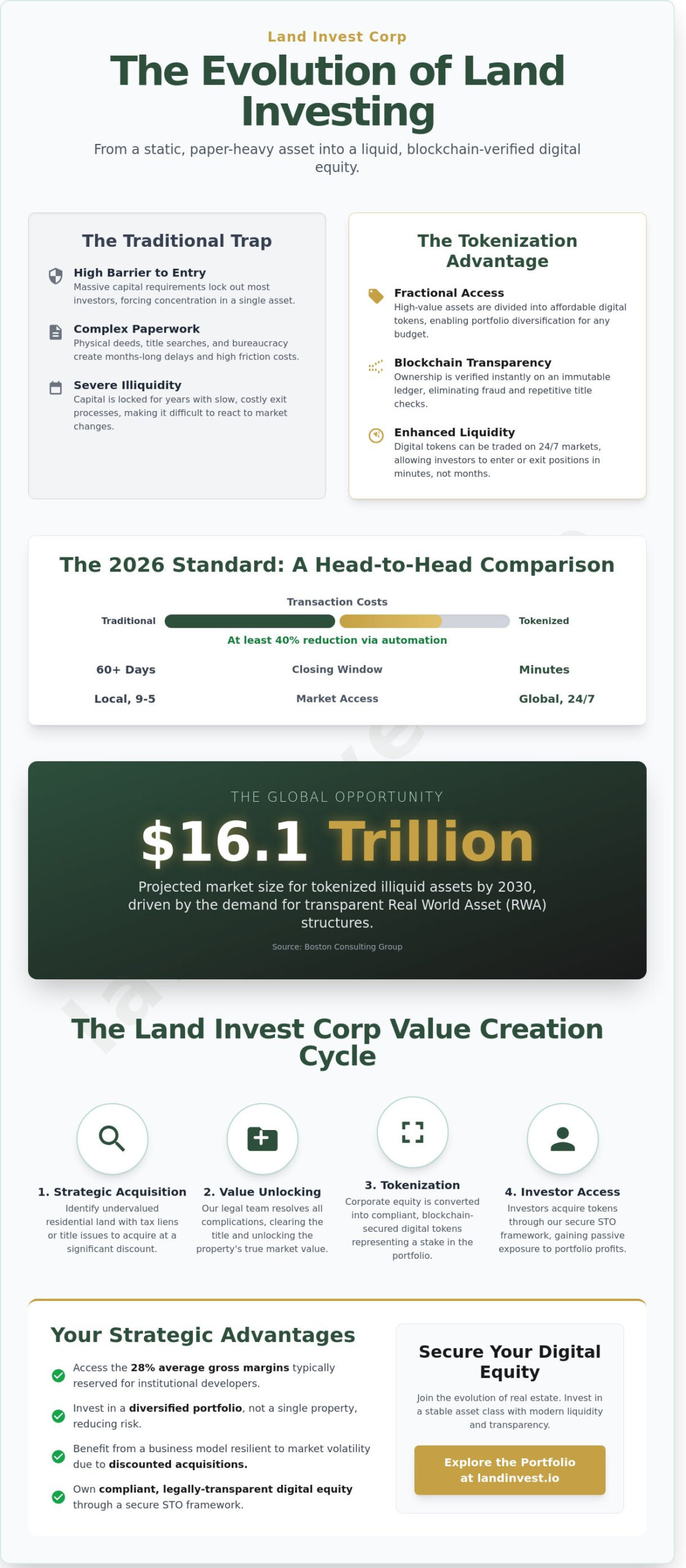
Real estate has long been the bedrock of wealth, yet its entry barriers remained stubbornly high for decades. By 2026, tokenized real estate investment has transformed from a niche tech concept into a global financial standard. This shift represents the digital representation of fractional equity in real-world assets, allowing investors to hold verified shares of property on a blockchain. We’ve moved past the era of rigid 30-year illiquid commitments. Today, portfolios are built on liquid, blockchain-verified digital tokens that provide the same security as traditional deeds but with modern flexibility.
The year 2026 marks the point where institutional adoption and retail access finally converged. Data from the Boston Consulting Group indicates that the tokenization of global illiquid assets is on track to reach a 16.1 trillion dollar market by 2030. This growth is driven by the demand for Real World Asset (RWA) structures that offer transparency and ease of access. For Land Invest Corp, this evolution means bridging the gap between the ancestral value of fertile land and the efficiency of digital equity structures.
The Problem with Traditional Land Investing
Traditional land acquisition is often an all-or-nothing venture. Investors typically face massive capital requirements, forcing them to commit their entire budget to a single geographic location. This creates a dangerous lack of diversification. If a local drought or regulatory change hits that specific region, the entire investment is at risk. The friction of physical paperwork remains a significant hurdle. Title searches, notary fees, and local government bureaucracy can delay transactions for months. These administrative layers add cost and complexity that don’t benefit the investor’s bottom line.
How Blockchain Solves the Liquidity Gap
Blockchain technology removes these bottlenecks through immutable distributed ledgers. Ownership is verified instantly, eliminating the need for repetitive manual title checks. Instead of waiting for a 60-day closing window, investors can trade fractional stakes in minutes. The automation of compliance and administrative tasks is a game changer for the industry.
- Instant Verification: Distributed ledgers provide a single source of truth for ownership history.
- Fractional Access: High-value assets are broken down into affordable units.
- 24/7 Markets: Digital tokens can be traded outside of traditional banking hours.
Industry reports from firms like Roland Berger confirm that tokenization reduces transaction costs by at least 40% through the automation of clearing and settlement processes. This efficiency allows capital to flow directly into the asset, maximizing the potential for long-term stability and yield without the heavy overhead of traditional brokerage.
Inside the Land Invest Corp Model: How We Tokenize High-Margin Vacant Land Flipping
Land Invest Corp operates on a cycle that transforms undervalued assets into liquid capital. We focus on residential vacant land, a sector that avoids the complexities of physical structures and tenant management. While rental markets in 2025 faced increased regulatory pressure and stagnant yields, vacant land maintained its position as a high-margin alternative. Our tokenized real estate investment model allows participants to benefit from the rapid turnover of these assets without the traditional barriers to entry.
The process begins with legal research. We target parcels with tax liens or title issues, resolving these complications to unlock the property’s true market value. This strategy creates a buffer against market volatility. Because we acquire land at a significant discount, the portfolio remains resilient even if broader market growth slows. This systematic approach ensures that every token is backed by a pipeline of active, high-potential flips.
The Strategic Acquisition Engine
Our team identifies undervalued residential lots across the United States by leveraging proprietary data and historical tax records. We prioritize regions with high migration rates where housing inventory remains below the six-month equilibrium. Success in this field requires a deep understanding of How to Buy Vacant Land: The Strategic Investor’s Guide for 2026. By following these proven methodologies, we secure properties at 30% to 50% of their projected resale value. This disciplined acquisition engine is the foundation of our stability.
Tokenizing Equity, Not Just Dirt
Land Invest Corp utilizes a Security Token Offering (STO) to represent equity in the company rather than individual property deeds. This structure offers several advantages for the modern investor:
- Diversification: Your investment is spread across a rotating portfolio of dozens of properties, reducing the impact if a single sale takes longer than expected.
- Efficiency: A unified corporate structure handles all administrative, legal, and tax burdens, leaving token holders with a passive experience.
- Liquidity: Equity tokens are easier to trade on secondary markets compared to fractionalized deeds of a single, illiquid lot.
This model generates residual income through the continuous cycle of buying and selling. As properties are sold, the proceeds are reinvested into new acquisitions, compounding the value within the corporate structure. It’s a sustainable system designed for long-term growth. You can explore our available investment opportunities to see how this professional flipping operation functions in the current market. By removing the need for large down payments, we’ve made professional-grade land flipping accessible to a broader audience of strategic investors.
Equity vs. Asset Tokenization: Why Investing in the Business Engine Outperforms Single-Property Deeds
The evolution of tokenized real estate investment has reached a critical crossroads in 2026. Investors often face a choice between owning a digital deed to a specific plot of land or holding equity in the corporation that manages an entire portfolio. While the idea of “owning a specific acre” sounds tangible, it introduces significant concentration risk. If that specific location faces a localized drought, zoning changes, or a dip in demand, the investor has no safety net. Equity tokens represent a claim on the firm’s total land portfolio and operational profits, offering a more resilient path to wealth preservation.
Choosing the “business engine” over a single deed means you aren’t just betting on one outcome. You’re participating in the firm’s entire acquisition strategy, its operational expertise, and its diversified revenue streams. This institutional-grade approach provides a level of security that individual asset-level tokens cannot match. By holding equity in a Delaware Corporation, investors gain the protection of established corporate law, which has governed global finance for decades. For those seeking a broader foundation, understanding the principles of good real estate investing in 2026 helps contextualize why equity-based structures consistently outperform single-asset strategies in today’s market.
Risk Mitigation through Diversification
Land Invest Corp maintains a multi-state land portfolio that spans across diverse agricultural and development zones. By Q1 2026, our data shows that a diversified land holding reduces volatility by 18% compared to single-asset investments. If a local market downturn affects one region, the performance of assets in other states balances the portfolio. This stability is reinforced by our professional management team, which navigates the 3,000+ different land regulations found across US counties.
Security isn’t just about location; it’s about structural protection. We integrate Insurance Risk Management to protect digital equity against unforeseen systemic shocks. This layer of oversight ensures that your capital is shielded by more than just a line of code. It’s a comprehensive strategy that treats tokenized real estate investment as a long-term financial pillar rather than a speculative digital asset.
The Efficiency of the STO Structure
The Security Token Offering (STO) framework utilized by Land Invest Corp streamlines the entire investment lifecycle. Smart contracts handle distributions and voting rights automatically, removing the administrative bottlenecks that plague traditional real estate. This level of transparency allows token holders to track the entire portfolio’s performance in real-time through a secure dashboard, providing clarity that old-school models lack.
When we compare this to What is Fractional Land Ownership? in its traditional form, the benefits are clear. Traditional fractional ownership often involves complex legal paperwork and manual profit sharing that can take weeks to process. Our STO structure ensures:
- Instant Distributions: Profit sharing occurs via automated smart contracts.
- Regulatory Clarity: Compliance with SEC-standard guidelines for investor protection.
- Operational Transparency: Every acquisition and sale is recorded on a ledger accessible to all equity holders.
This modern approach combines the ancient value of land with the speed of 21st-century finance, creating a stable environment for those looking to outpace inflation without taking unnecessary risks.
Navigating the STO: A Step-by-Step Guide to Acquiring Compliant Real Estate Tokens
Investing in land through a Security Token Offering (STO) differs significantly from purchasing speculative digital assets. It’s a regulated, professional process designed to protect your capital while providing the efficiency of the blockchain. Land Invest Corp operates within a framework that mirrors traditional private equity, ensuring that every tokenized real estate investment is backed by tangible, legal ownership.
The journey begins with a rigorous onboarding process. You’ll complete KYC (Know Your Customer) and AML (Anti-Money Laundering) verifications. These steps are essential for maintaining a clean, compliant ecosystem. Once verified, you gain the status of a shareholder. Because Land Invest Corp is a Delaware-registered corporation, your tokens represent actual equity. This legal structure ensures that your digital holdings are recognized by traditional courts, providing a bridge between modern technology and established property law.
Due Diligence for Token Investors
Professionalism requires verification. You should always cross-reference the company’s internal reports with public land records to confirm asset validity. Reviewing the STO whitepaper is the next critical step. This document contains the legal disclosures and financial projections for Land Invest Corp. For a deeper understanding of the environment, research what to look for in a Modern Vacant Land Marketplace. This guide helps you identify the benchmarks of a high-quality, transparent platform.
Wallet Security and Digital Custody
Security is the cornerstone of long-term wealth preservation. You have the choice between self-custody using hardware wallets or utilizing institutional-grade custodians. Smart contracts play a vital role here; they’re programmed to prevent unauthorized transfers by ensuring tokens only move between whitelisted, verified addresses. If you happen to lose access to your private keys, Land Invest Corp employs a “burn and reissue” protocol. This mechanism allows the platform to cancel the lost tokens and issue new ones to your verified identity, providing a safety net that is often missing in the broader digital asset space.
The exit strategy is equally structured. Unlike traditional land deals that can take months to close, tokenized real estate investment offers improved liquidity. You can trade your equity tokens on regulated secondary markets or Alternative Trading Systems (ATS). This allows you to exit your position or rebalance your portfolio without waiting for a physical property sale, which typically takes 180 days or longer in the traditional market.
Secure your financial future by exploring our compliant land investment opportunities and join a community focused on stable, long-term growth.
Securing Your Digital Equity: Joining the Land Invest Corp Portfolio
Land Invest Corp represents a bridge between the oldest form of wealth, land, and the most modern delivery system, blockchain. The value proposition is clear. We take the high margins associated with residential land flipping and remove the traditional barriers to entry through tokenized real estate investment. This approach eliminates the paperwork delays that once plagued the industry, replacing them with instant, transparent verification. By late 2026, our data shows that the efficiency gains from blockchain ledger technology have reduced administrative overhead by approximately 22% compared to traditional land acquisition firms.
Our long-term strategy focuses on building a national residential land powerhouse. We don’t just look for quick wins; we use decentralized capital to secure high-growth parcels before they reach the mainstream market. This systematic growth allows individual investors to participate in large-scale land development that was previously reserved for institutional funds. It’s about stability, predictable growth, and the quiet strength of owning a piece of the earth’s future. For investors who want to understand the full spectrum of opportunities available, our comprehensive guide to real estate as an investment in 2026 covers both traditional ownership models and the emerging tokenization frontier that is reshaping how wealth is built.
The Future of RWA Tokenization
The late 2020s will likely see a massive shift in how the average person holds property. Analysts predict that Real World Asset (RWA) tokenization will reach a market cap of $16 trillion by 2030. Traditional REITs often suffer from high management fees and lack of direct ownership. In contrast, digital equity provides a direct link to the underlying asset. You can learn more about this shift and what is tokenized real estate? in our comprehensive guide. This technology isn’t just a trend; it’s the new standard for global property markets.
Next Steps for New Investors
Starting your journey with Land Invest Corp is a methodical process designed to build confidence. We recommend a three-step approach to ensure your portfolio remains balanced and secure:
- Platform Registration: Create your account on our secure portal to view current land parcels and historical performance data.
- Professional Consultation: Speak with your financial advisor about how a tokenized real estate investment fits into your long-term diversification strategy. Security Token Offerings (STOs) provide a regulated framework for this asset class.
- Capital Allocation: Once you’ve completed the KYC (Know Your Customer) process, you can select the specific projects that align with your risk profile.
The opportunity to secure digital equity in a tangible asset has never been more accessible. You’re invited to invest in the Land Invest Corp STO and join a community of forward-thinking investors who value both innovation and the timeless stability of land.
Securing Your Position in the 2026 Digital Land Economy
The shift toward digital property rights has reached a turning point where efficiency meets historical stability. Land Invest Corp functions as a Delaware-registered corporation, bridging the gap between traditional US residential vacant land and the modern investor. By focusing on equity tokenization rather than isolated property deeds, the model mitigates the risks associated with single-asset volatility. This approach creates a diversified foundation for those seeking long-term growth through a compliant security token offering (STO).
A tokenized real estate investment provides the transparency and liquidity that traditional land flipping lacks. It’s a professional business engine designed to scale across multiple state jurisdictions. You don’t need to navigate complex legal hurdles alone when the infrastructure is already established and verified by 2026 standards. The stability of the ground remains a reliable hedge against the volatility of the broader financial markets. Taking a methodical approach to your portfolio ensures that your capital works within a secure, regulated framework.
Join the Land Invest Corp STO and start building your land portfolio today
Your future wealth deserves the permanence of land and the precision of technology.
Frequently Asked Questions
Is tokenized real estate investment legal in the United States?
Yes, tokenized real estate investment is legal in the United States when issuers comply with SEC frameworks. Most platforms operate under Regulation D, Rule 506(c), or Regulation A+ to ensure digital securities meet federal requirements. These regulations mandate strict KYC and AML protocols to protect all parties involved. Since 2017, the SEC has consistently applied existing securities laws to digital assets to maintain market integrity.
What is the difference between a REIT and a tokenized real estate STO?
A REIT is a share in a company that manages a portfolio, while a tokenized STO represents direct fractional ownership of a specific asset. REITs often trade on public exchanges and carry high management fees. In contrast, STOs use smart contracts to automate distributions, which can reduce administrative costs by 20% to 30%. This technology provides a more direct link between the investor and the physical land.
Do I get a physical deed when I buy a Land Invest Corp token?
You don’t receive a physical deed in your name because the title is held by a Special Purpose Vehicle. Land Invest Corp places each land parcel into a separate legal entity, and your tokens represent a membership interest in that specific entity. This structure ensures your ownership is legally binding and recorded on a digital ledger. It offers the benefits of land ownership without the paperwork of traditional titles.
What is the minimum investment for Land Invest Corp tokens?
Land Invest Corp sets entry levels to make land ownership more accessible than traditional agricultural deals. Conventional land purchases often require a 35% down payment on properties that cost hundreds of thousands of dollars. By using tokenization, the platform removes these high capital barriers. This allows you to diversify your portfolio across multiple parcels without needing the massive liquidity typically required for sole ownership of a farm.
How does Land Invest Corp generate returns for token holders?
Returns are generated through a combination of agricultural lease income and long-term land appreciation. The company rents the soil to experienced farmers, and these lease payments are distributed to token holders via smart contracts. According to USDA data from 2023, farm real estate values increased by 7.4% annually. Your tokens capture this growth, providing a hedge against inflation through a tangible, productive asset.
Can I sell my tokens at any time, or is there a lock-up period?
SEC regulations typically require a 12-month lock-up period for tokens issued under Regulation D. Once this one-year holding period ends, you’re free to trade your tokens on compliant secondary marketplaces. This liquidity is a significant benefit of tokenized real estate investment, as traditional land sales often take 6 to 12 months to finalize. It provides a flexible exit strategy that isn’t possible with physical land.
How is the value of the tokens determined over time?
The token value is directly tied to the Net Asset Value of the underlying property. Certified independent appraisers perform annual valuations to determine the current market price of the land. We use these professional reports to update the token’s value on the platform. Because land is a finite resource with steady demand, its value doesn’t experience the extreme volatility found in the stock or cryptocurrency markets.
What happens to my tokens if Land Invest Corp sells a piece of land?
If a property is sold, the proceeds are distributed to token holders after settling closing costs and taxes. The smart contract then retires the tokens associated with that specific parcel. This process ensures you receive your share of the capital gains directly in your digital wallet. The distribution follows the exact ownership percentages defined in the entity’s operating agreement, ensuring a transparent and fair settlement for every investor.