What if the most reliable path to wealth in 2026 doesn’t require you to manage a single tenant or save for a massive down payment? While traditional property ownership remains a cornerstone of stability, the barrier to entry has shifted significantly. By 2024, average property prices in many developed markets rose by over 30% compared to 2019 levels, making the old ways of entry difficult for many. You’ve likely realized that good real estate investing is no longer just about buying a house down the street. It’s about finding assets that offer genuine inflation protection and long-term security without the volatility of the stock market or the stress of physical upkeep.
We believe that building a legacy shouldn’t be reserved for those with millions in liquid capital. This guide will show you exactly how to identify high-performing assets and use modern fractional equity strategies to build your portfolio. You’ll learn how to secure passive wealth and diversified exposure through a professional, transparent approach that prioritizes safety over speculation. We’re going to break down the specific criteria for 2026 success and explain how technology is finally making the stability of land and property accessible to everyone.
Key Takeaways
- Learn how the definition of good real estate investing is shifting toward passive equity models that prioritize risk-adjusted returns over active management.
- Discover a 5-point evaluation framework to vet opportunities across different asset classes and legal structures, ensuring your portfolio is built on a secure foundation.
- Explore why vacant land serves as a strategic pillar for 2026, offering a high-demand, finite resource with minimal overhead and no maintenance headaches.
- Understand how fractional ownership and RWA tokenization are dismantling traditional barriers, allowing you to diversify across multiple high-value parcels.
- Identify the essential steps to align your investment budget with modern, compliant platforms to begin building a transparent and future-proof portfolio.
What Defines “Good” Real Estate Investing in 2026?
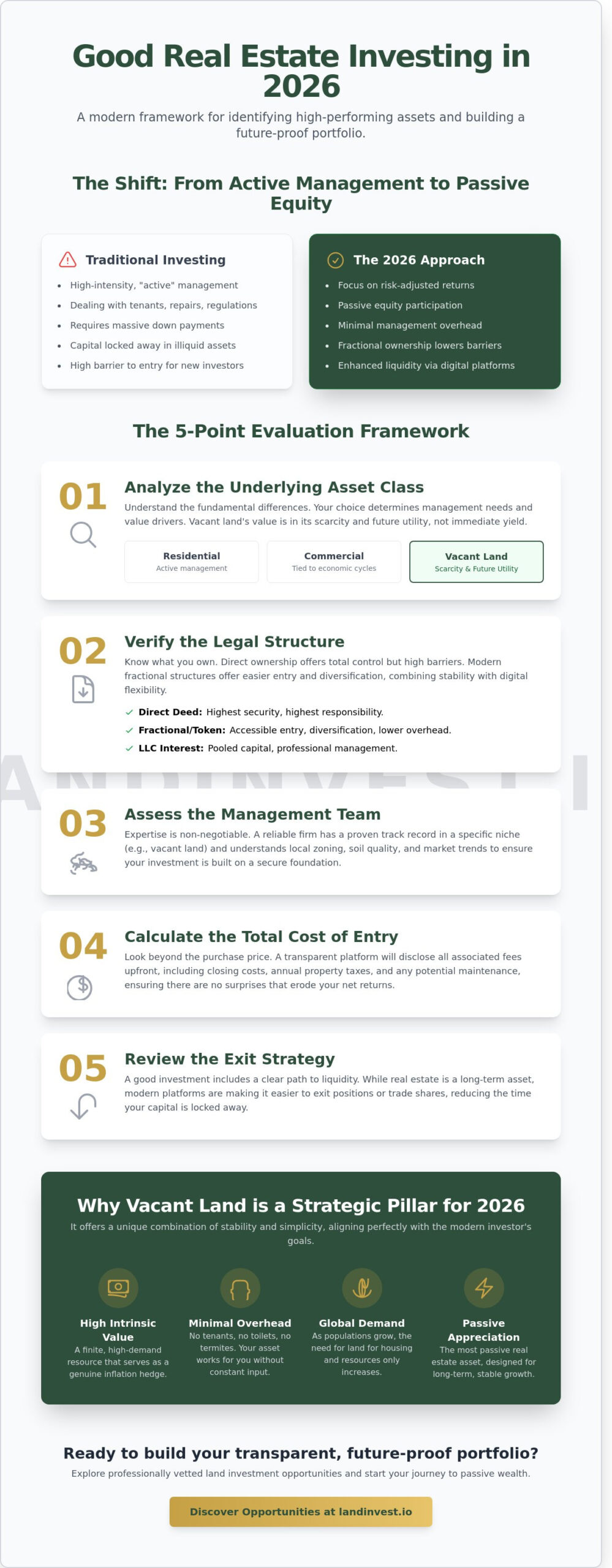
The definition of good real estate investing has fundamentally changed as we move through 2026. Historically, investors prioritized high-intensity “active” management, often spending hours every week dealing with tenants, repairs, and local regulations. Today, the focus has shifted toward a balance of risk-adjusted returns and minimal management overhead. Investors now seek assets that provide the security of tangible property without the operational burdens of traditional landlording. This evolution reflects a broader trend where time is valued as highly as capital gains; leading many to favor passive equity participation over direct property management.
While monthly cash flow remains a component of the equation, it’s no longer the sole metric of success. In the current economic climate, asset appreciation and long-term stability have taken center stage. Market volatility in other sectors has proven that the Fundamentals of Real Estate Investing still rely on the intrinsic worth of the land. Diversification acts as a primary shield against regional economic shifts. By spreading capital across different geographic zones and asset types, investors protect themselves from localized downturns that might otherwise deplete their portfolios.
The Core Pillars of a Quality Real Estate Asset
A quality asset must possess high intrinsic value. This means the underlying land or structure has a clear, functional utility, such as high-quality soil for agriculture or strategic location for residential expansion. Market demand remains a critical pillar; identifying areas with projected residential growth ensures that the asset remains relevant. Modern investors also prioritize liquidity. Historically, real estate was a “slow” asset, but digital platforms now make it easier to exit positions or trade shares of ownership, reducing the time capital stays locked away.
Traditional vs. Modern Investment Vehicles
Direct ownership offers the most control, as you hold the deed yourself. However, it requires significant capital and carries the burden of total responsibility for maintenance and taxes. Publicly traded REITs provide an alternative, but they often suffer from the same volatility as the broader stock market, detaching the investor from the actual land value. Good real estate investing in 2026 often involves tokenized real estate investment. This modern vehicle bridges the gap by allowing for fractional ownership of high-value land, combining the stability of traditional property with the flexibility of digital assets. It’s a transparent, data-driven approach that fits the needs of the modern digital investor.
How to Evaluate an Opportunity: A 5-Point Checklist
Identifying a stable entry point is the hallmark of good real estate investing. Success doesn’t stem from market timing alone; it requires a methodical breakdown of the asset’s fundamentals. Investors should apply this 5-point checklist to ensure every acquisition aligns with a conservative, long-term wealth strategy.
- Step 1: Analyze the underlying asset class. Residential properties require active management, while commercial assets depend heavily on local economic cycles. Vacant land represents a unique category where the primary value lies in scarcity and future utility rather than immediate rental yield.
- Step 2: Verify the legal structure. You must know if you’re holding a direct deed, a security token, or an interest in an LLC. Direct ownership offers the highest level of security, while fractional structures provide easier entry for those looking to diversify into tangible assets without managing the entire parcel.
- Step 3: Assess the management team. A firm with a 10-year track record in a specific niche is more reliable than a generalist firm. Expert knowledge in analyzing real estate investment deals ensures that the sponsor understands local zoning laws and soil quality.
- Step 4: Calculate the total cost of entry. Beyond the purchase price, consider closing costs, annual property taxes, and potential maintenance fees. A transparent platform will disclose these figures upfront to avoid eroding your net returns.
- Step 5: Review the exit strategy. Determine how and when you’ll realize gains. Whether it’s a 5-year hold for land appreciation or a 10-year development plan, a clear path to liquidity is essential for good real estate investing.
Conducting Due Diligence on the Sponsor
The sponsor’s history is the most critical variable in any passive investment. Look for firms that provide quarterly reports and utilize independent third-party valuations to ensure transparency. A national scope is often safer than hyper-local concentration. For instance, a sponsor operating across five different states reduces the risk of localized economic downturns or specific regional weather events affecting the entire portfolio. Professionalism in communication and a clear resale strategy are indicators of a stable partner.
Understanding Return on Assets (ROA)
ROA is the net income produced by an asset relative to its total cost. This metric allows you to compare a plot of farmland in Eastern Europe with a commercial warehouse in the Midwest on equal footing. It’s vital to distinguish between “paper gains,” which are theoretical increases in market value, and realized equity growth. While a 15% increase in local land prices looks impressive on a spreadsheet, the true value is only confirmed through consistent appraisals or actual cash distributions. Focus on assets that show steady, historical growth rather than volatile, speculative spikes.
Why Vacant Land is a Strategic Pillar for 2026 Portfolios
The 2026 investment landscape rewards those who prioritize stability over speculation. While many investors chase volatile digital assets, vacant land remains a tangible foundation for good real estate investing. It offers a unique advantage: zero overhead. You won’t face the “three Ts” of traditional property management: tenants, toilets, or termites. This lack of physical structures reduces maintenance costs to nearly zero, allowing capital to work harder through appreciation rather than being drained by repairs.
Residential land is a finite resource. While developers can build upward, they can’t create more surface area in high-demand zones. This inherent scarcity drives long-term value. The modern vacant land marketplace has shifted from local auctions to global digital platforms, making these high-margin assets accessible to anyone with an internet connection. Whether you choose to hold for generational wealth or flip for a 25% margin, the flexibility of land fits various risk profiles. Understanding how to position real estate as an investment within a broader financial strategy is essential for maximizing these advantages in today’s market.
The Resilience of Residential Land
Land acts as a natural hedge against inflation. When currency loses purchasing power, the value of physical earth typically rises in tandem. There’s a critical distinction between raw “wilderness” land and residential-ready parcels. Wilderness land may sit idle for decades without utility. In contrast, residential-ready lots are positioned near existing infrastructure. Land Invest Corp focuses exclusively on this residential niche because these parcels have a clear, predictable path to development. Identifying these opportunities requires a disciplined approach to how to analyze real estate deals, ensuring the numbers support the long-term vision of the portfolio.
Risk Management in Land Investing
Critics often label land a “dead” asset because it doesn’t produce monthly rent. This perspective ignores the strategic growth potential that defines good real estate investing. Risk is further mitigated through modern insurance risk management, which protects owners from liability and title disputes. By learning how to buy vacant land within high-growth corridors, you align your portfolio with municipal expansion plans. This data-driven strategy ensures that your “quiet” asset is actually a coiled spring, ready to realize significant value as the surrounding community matures.
Leveraging Fractional Equity to Overcome High Barriers
Traditional property markets have long functioned as a closed club. For decades, the most lucrative land deals were reserved for “accredited investors,” a designation that typically requires a net worth exceeding $1 million or a consistent annual income over $200,000. This gatekeeper system effectively sidelined smaller, disciplined investors who recognized the value of tangible assets but lacked the massive capital required for a single, outright purchase. Fractional equity dismantles these walls by allowing capital to be divided into manageable portions, making good real estate investing accessible to a broader demographic.
Instead of concentrating all your capital into one specific plot of land, fractional ownership enables you to spread your risk. You can diversify your portfolio across multiple parcels in different geographic regions. This strategy protects your wealth from localized economic downturns or environmental shifts. Owning equity in a professional firm that manages a diverse land portfolio is often more efficient than holding a single deed. It removes the administrative burden of property taxes, local zoning disputes, and maintenance, leaving the technical management to experts while you focus on long-term growth.
What is Fractional Land Ownership?
At its core, fractional land ownership involves dividing the equity of a property into digital shares or tokens. These tokens represent a direct legal claim to the underlying asset’s value and any potential yields it generates. By lowering the minimum entry point, investors can build a robust portfolio with smaller increments of capital. This approach mirrors the transition from traditional stock certificates to digital trading, focusing on transparency and ease of access. For a deeper dive into the technical frameworks and legal structures, refer to the fractional land ownership guide which outlines the 2026 standards for digital equity.
The Security Token Advantage
Security Token Offerings (STOs) represent a significant evolution in how we track ownership. Unlike speculative “crypto-currencies” that often lack intrinsic value, security tokens are fully compliant digital contracts backed by real-world assets like residential or agricultural land. The blockchain serves as an immutable source of truth, ensuring that every transaction is recorded and verifiable. This technology creates a more liquid gateway for land participation. You don’t have to wait months for a traditional sale to close; instead, you can trade your equity stakes in a secondary market, providing a level of flexibility that traditional land deeds simply cannot match.
Ready to secure your future with stable, land-backed assets? Explore how you can start building your portfolio through transparent fractional land opportunities today.
Getting Started: Your Path to a Good Real Estate Portfolio
Building a resilient portfolio requires a methodical approach. Your strategy for 2026 starts with a clear assessment of your financial boundaries and risk appetite. While land is a historically stable asset, your allocation must reflect your personal liquidity needs. Successful investors don’t rush into high-stakes deals without a roadmap. They analyze the numbers first.
Digital platforms have simplified the entry process, but compliance remains the most important factor. You should research platforms that offer compliant Security Token Offerings (STOs) and Real World Asset (RWA) tokenization. These technologies bridge the gap between traditional property deeds and digital efficiency. They allow for fractional ownership, which is a cornerstone of good real estate investing for those looking to diversify without purchasing entire parcels outright. For a comprehensive overview of how tangible assets fit within a modern financial plan, the ultimate 2026 strategic guide to real estate as an investment provides essential context for aligning your goals with today’s market realities.
- Identify your total investment capital for the upcoming fiscal year.
- Verify the regulatory standing of any digital land platform you consider.
- Commit to a reinvestment plan to maximize the power of compound growth in land equity.
Initial commitments should be modest. This phase is for testing the reporting accuracy and the ease of digital transfers. Once you’re comfortable with the platform’s mechanics, you can scale your operations. Reinvesting your gains back into the portfolio accelerates equity building, transforming small gains into a substantial asset base over several years.
Setting Realistic Expectations
Land isn’t a liquid asset like a stock or a cryptocurrency. It takes time to realize its full value. Typically, residential land appreciation cycles span 3 to 7 years, influenced by local infrastructure and zoning changes. You won’t find success in “get rich quick” schemes here. They’re the opposite of good real estate investing. A long-term perspective in the residential land market ensures you can weather temporary economic shifts while waiting for the optimal resale window.
Why Choose Land Invest Corp?
We focus on high-margin residential vacant land across the United States, specifically targeting areas where housing demand outstrips available supply. Our team uses tokenization to offer compliant equity stakes in our operations. This approach combines the ancient value of the earth with the speed of modern technology. We invite you to view our current STO and land portfolio details to understand how we maintain transparency and professional standards in every transaction.
Securing Your Future on Solid Ground
Building a resilient portfolio for 2026 requires moving beyond outdated speculation toward assets with intrinsic, lasting value. We’ve explored how residential vacant land provides the stability needed in a volatile market; it’s the fundamental starting point for all housing development. Through a disciplined 5-point checklist, you can verify that good real estate investing today isn’t about chasing trends but about securing tangible land with clear utility. Modern RWA tokenization has transformed this landscape, making it possible to own fractional shares of prime locations without the traditional high entry barriers that often exceed six figures for private acquisitions.
Land Invest Corp facilitates this transition by offering a compliant Security Token Offering backed by a national portfolio of residential vacant land. This professional platform combines the security of traditional land ownership with the efficiency of digital technology. It’s a strategic way to protect your capital against inflation while participating in the essential growth of national housing infrastructure. Taking the first step toward a diversified land-based portfolio is simpler than it used to be. Explore Modern Land Investment with Land Invest Corp. You have the tools to build a legacy that stands on solid ground.
Frequently Asked Questions
What makes a real estate investment “good” for a beginner?
A good real estate investing opportunity for a beginner prioritizes capital preservation and low entry barriers. According to 2023 market data from Eurostat, agricultural land values in countries like Hungary have shown consistent annual growth of 10% or more, providing a stable hedge against inflation. You should look for assets that don’t require daily management or complex renovation skills. This approach allows new investors to build equity without the high risks associated with volatile urban residential markets.
Can I invest in real estate with less than $1,000 in 2026?
You can absolutely start investing with less than $1,000 in 2026 by utilizing digital land platforms. These technologies allow for the division of large land parcels into smaller, accessible shares. While traditional land purchases often require a 20% down payment on properties costing hundreds of thousands, digital fractionalization lowers the entry point to as little as $100 or $500. It’s a method that democratizes access to high-quality agricultural assets that were previously reserved for institutional buyers.
How does fractional ownership differ from a traditional REIT?
Fractional ownership gives you direct control over which specific plot of land you own, whereas a Real Estate Investment Trust (REIT) involves buying shares in a company that manages a diverse portfolio. With fractional land, you hold a digital token representing a specific piece of the earth. REITs are often traded on public stock exchanges and are subject to market volatility. Data from Nareit shows that REIT prices can fluctuate significantly based on interest rate shifts; direct land ownership remains more decoupled from stock market swings.
Is vacant land a safe investment during an economic downturn?
Vacant agricultural land is considered a defensive asset because it lacks the maintenance costs and tenant risks of developed property. During the 2008 financial crisis, while US residential real estate prices dropped by 33% according to the Case-Shiller Index, farmland values remained remarkably resilient. It’s a finite resource that provides a tangible foundation for wealth. Since there are no buildings to decay or utilities to pay for, your overhead remains minimal while the land’s intrinsic value persists.
What is a Security Token Offering (STO) in real estate?
An STO is a digital fund-raising mechanism where investors receive a blockchain-based token that represents a legal stake in a real estate asset. Unlike speculative cryptocurrencies, these tokens are backed by tangible property and are governed by financial regulations like the EU’s MiCA framework established in 2023. This technology ensures a transparent, immutable record of your ownership. It bridges the gap between traditional land law and modern digital efficiency, making good real estate investing more liquid and accessible.
How do I earn money from a fractional land investment?
You earn returns primarily through the long-term increase in the land’s market value. If the land is leased to local farmers, you also receive a proportional share of the rental income. For example, if a 100-hectare plot generates a specific annual lease fee, your payment is calculated based on the number of tokens you hold. This dual-income stream combines the stability of land value growth with the recurring cash flow of agricultural production, providing a balanced return profile for your portfolio.
Do I get a physical deed when I buy a security token?
You don’t receive a traditional paper deed in your name, but you hold a digital token that represents your legal interest in the entity that owns the land. This structure is similar to owning shares in a corporation. The underlying property title is held by a Special Purpose Vehicle (SPV), and your ownership is recorded on a transparent blockchain ledger. This digital record serves as your proof of claim, ensuring your rights are protected without the administrative burden of filing physical paperwork at a local land registry.
What are the tax benefits of investing in land through a corporation?
Investing through a corporate structure often allows you to benefit from lower corporate tax rates compared to personal income tax brackets. In many jurisdictions, expenses related to management, digital platform fees, and interest can be deducted from the gross income. According to OECD reports, corporate tax structures can provide a more efficient way to reinvest profits and manage capital gains. This professional approach helps preserve more of your yield, especially when managing a growing portfolio of international land assets.