Why do 65% of first-time investors still treat a land purchase like a gamble when modern geospatial data can predict a lot’s viability with 98% accuracy? You likely recognize that raw earth is the ultimate hedge against market volatility, but when you decide to buy vacant land, the complexity of remote due diligence often creates a barrier to entry. It’s natural to worry about hidden defects or “buying a swamp” when you can’t physically walk every acre. You want the stability of real estate without the traditional headaches of property management or high capital requirements.
This guide will show you how to identify and acquire residential parcels with the technical precision of a seasoned developer. We’ll move past the guesswork to master a framework for identifying high-margin lots using modern digital tools and fractional ownership models that lower the cost of entry. You’ll learn exactly how to verify soil stability, check zoning, and secure liquid equity in the most promising parcels of 2026. We’ll explore everything from automated valuation models to the legal safeguards that ensure your investment remains a foundation for long-term growth.
Key Takeaways
- Understand why residential-zoned land is emerging as the premier strategic asset of 2026, offering lower carry costs and higher growth potential than rural alternatives.
- Master a 5-point due diligence checklist to safely buy vacant land, ensuring you can accurately verify buildability and the hidden costs of utility access.
- Discover how to leverage big data and satellite imagery to identify undervalued residential lots remotely, scaling your portfolio across diverse national markets.
- Compare traditional direct purchases with modern fractional equity models to determine the most capital-efficient path for your investment goals.
- Learn how Land Invest Corp uses advanced analytics to identify high-margin opportunities, providing a stable, data-driven approach to land diversification.
Why Vacant Land is the Strategic Asset of 2026
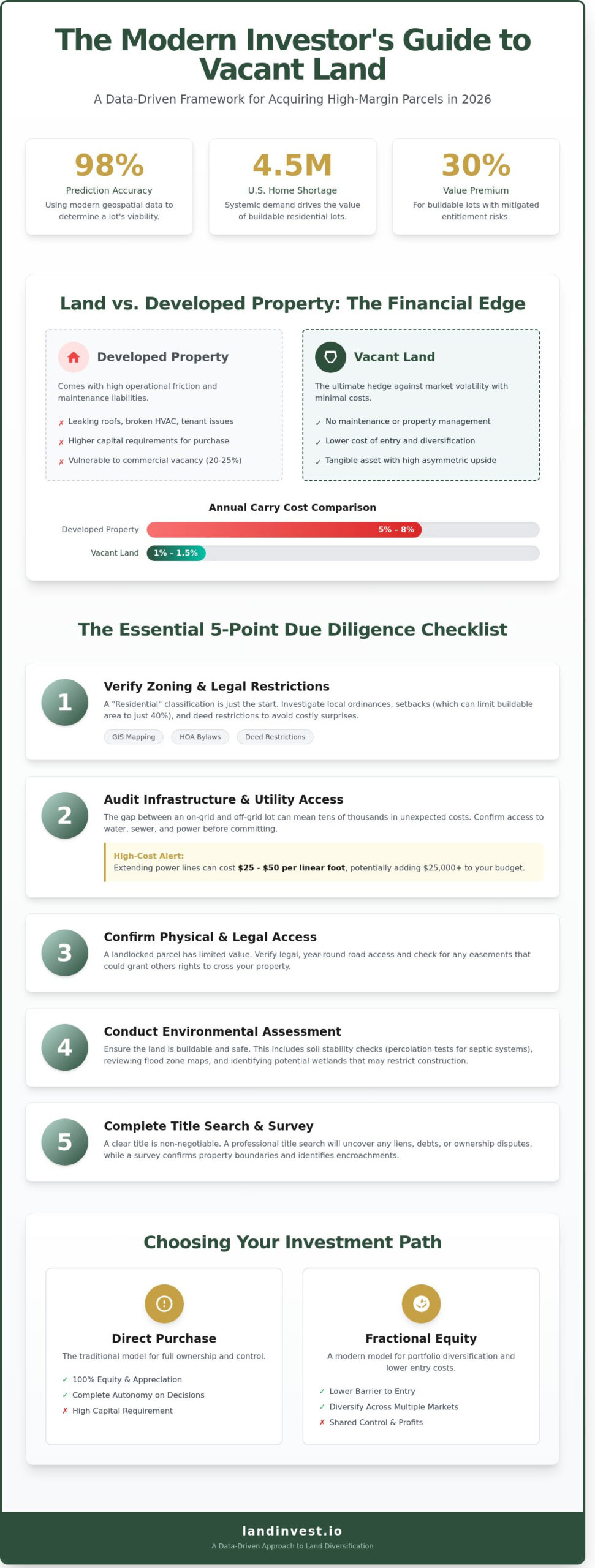
Investors often overlook the simplest asset class, yet land remains the only resource that cannot be manufactured or replicated. By 2026, the decision to buy vacant land has evolved from a speculative gamble into a defensive necessity for diversified portfolios. Unlike developed real estate, vacant land carries minimal holding costs. You won’t face leaking roofs, broken HVAC systems, or delinquent tenants. This inherent stability provides a calm harbor when equity markets fluctuate. Current data suggests that residential-zoned parcels are outperforming commercial sectors, which still grapple with the 20% to 25% vacancy rates seen in office spaces since the 2020 shift in labor dynamics.
Strategic investors generally follow one of two paths. The “Buy and Hold” philosophy treats land as a generational store of value, much like gold but with higher utility. Conversely, the “Strategic Flip” focuses on rapid value-add activities. Digital infrastructure has made these transactions more transparent than ever. You can now buy vacant land using high-resolution satellite imagery, soil drainage data, and digital title transfers that were unavailable to the average person just five years ago. A deep understanding land use is essential because zoning dictates everything from density to tax rates, acting as the primary lever for future valuation.
The Scarcity Factor in Residential Zoning
Residential infill lots are the 2026 market’s hidden gems. The US faced a shortage of 4.5 million homes in 2024, a gap that hasn’t closed despite increased interest rates. This systemic demand makes buildable lots within existing infrastructure zones highly liquid. You must distinguish between raw land and buildable lots. Raw land lacks access to basic utilities, while buildable lots are ready for immediate construction. The latter often command a 30% premium because the entitlement risks are already mitigated for the developer.
Financial Advantages of Land Over Developed Property
Land offers a lean financial profile that preserves capital. Annual property taxes on unimproved land typically range from 1% to 1.5% of the assessed value, significantly lower than the 5% to 8% total carry cost of rental properties. You can achieve forced appreciation through simple administrative actions, such as:
- Securing a zoning change from agricultural to residential.
- Obtaining a permit for a septic system or well.
- Clearing brush to improve the visual appeal for future buyers.
- Subdividing a large parcel into two smaller, more affordable lots.
Unimproved land is a tangible asset with high asymmetric upside, offering a secure foundation for wealth without the operational friction of traditional real estate. For investors who want to broaden their approach beyond land alone, understanding good real estate investing strategies in 2026 can help you identify complementary assets that strengthen your overall portfolio.
The 5-Point Due Diligence Checklist for Buying Vacant Land
Before you commit capital to buy vacant land, you need a methodical approach to risk assessment. Industry data from 2023 indicates that approximately 22% of rural land transactions encounter significant delays due to undisclosed easements or zoning conflicts. A disciplined due diligence process transforms a speculative purchase into a stable, long-term investment. This checklist focuses on the technical and legal realities that determine a parcel’s true intrinsic value.
Verifying Zoning and Legal Restrictions
Modern investors use GIS (Geographic Information Systems) mapping tools to conduct 80% of their initial research remotely. These platforms allow you to overlay flood zones, wetlands, and tax history over satellite imagery. However, a “Residential” classification is never a guarantee of building permits. You must investigate local setbacks, which can often restrict building to just 40% of the total lot size. Additionally, check for Homeowners Association (HOA) bylaws or deed restrictions that might ban specific structures, such as modular homes or secondary suites. The Consumer Financial Protection Bureau outlines these official risks of buying land to prevent buyers from acquiring properties with prohibitive legal encumbrances.
The Infrastructure Audit: Water, Sewer, and Power
The cost gap between an “on-grid” and “off-grid” lot is often the difference between a high-yield asset and a financial drain. Bringing power lines to a remote site can cost between $25 and $50 per linear foot, meaning a 500-foot extension could add $25,000 to your initial budget. If municipal sewer isn’t available, a percolation (perc) test is your most critical hurdle. A failed perc test in 2024 can reduce a lot’s market value by 50% immediately, as it renders the land unbuildable for traditional residential use. Always coordinate with national utility providers for a formal site assessment before the closing date to avoid these hidden expenses.
Beyond zoning and utilities, your checklist must include these three physical and legal pillars:
- Topography and Environment: Slopes exceeding 15% typically increase construction costs by 25% or more. Verify if the land sits in a FEMA-designated Special Flood Hazard Area, which will mandate expensive insurance.
- Legal Access: Never assume a dirt road equals legal access. Ensure the property isn’t landlocked by verifying recorded easements. Without a deeded right-of-way, you cannot legally enter your own property.
- Title and Liens: A professional title search identifies back taxes, mechanic’s liens, or ancient mineral rights claims. Clear ownership is the only path to a secured investment.
Successful land ownership relies on transparency and factual data rather than emotional appeal. If you’re looking for a partner to help identify high-quality parcels with verified potential, you can explore our curated land opportunities designed for long-term stability. When you buy vacant land with a “safety-first” mindset, you protect your portfolio from the volatility of traditional markets.
Direct Purchase vs. Fractional Equity: Choosing Your Path
Investors looking to buy vacant land face a fundamental choice between traditional deed ownership and modern fractional equity. Both paths offer exposure to a stable asset class, but they differ significantly in terms of capital commitment, management responsibilities, and exit strategies. Understanding these nuances is the first step toward building a resilient real estate portfolio.
The Traditional Deed-Holding Model
The conventional route requires a buyer to navigate a multi-step closing process involving escrow, title insurance, and county-level recording. When investors conduct due diligence for buying land, they often realize the administrative weight of direct ownership. You’re responsible for everything from property taxes to environmental compliance. This model typically requires high capital, with many quality parcels demanding $50,000 to $100,000 in upfront cash.
Traditional land is fundamentally an illiquid asset. If you need to liquidate your position, the process of listing, marketing, and closing usually takes 180 to 360 days. This capital lock-up makes it a commitment suited only for those with long-term horizons and significant cash reserves. The management burden of owning individual parcels nationwide also scales poorly, as each state has unique regulations and tax structures.
However, leveraging financing can make direct ownership more accessible without depleting cash reserves. For those looking into fast, asset-backed loans specifically for property investments, you can visit JGL Capital LLC to see what options are available.
The Tokenized Equity Alternative
Tokenized land investment leverages Security Token Offerings (STOs) to provide a regulated, fractional alternative. Instead of managing a single deed, you hold equity in a specialized entity like Land Invest Corp. This structure allows you to hold the PRPTY token, gaining exposure to a professionally managed portfolio of land assets without the burden of individual site maintenance. However, this digital approach requires comprehensive insurance risk management strategies to protect against both physical and digital vulnerabilities.
- Liquidity: Unlike physical deeds, tokens can be traded on secondary markets. This can reduce exit times from several months to just a few days.
- Diversification: You don’t have to put all your capital into one plot. You can spread your investment across multiple geographic zones and land types.
- Lower Barriers: Fractional models often allow entry for as little as $1,000, making it easier to buy vacant land exposure without a massive down payment.
Risk diversification is the primary advantage here. Owning one large parcel means your entire investment depends on local zoning and climate conditions. By holding fractional stakes in twenty different locations, you insulate your capital against localized risks. This modern approach combines the ancient stability of the earth with the efficiency of digital finance, offering a calm and calculated way to grow wealth over time. For those seeking a broader strategic framework, our comprehensive guide to real estate as an investment in 2026 explores how land tokenization fits within a complete wealth-building strategy. For a detailed examination of how this model works in practice, explore our comprehensive analysis of tokenized real estate investment through Land Invest Corp’s case study.
Navigating the National Land Market Remotely
Remote land acquisition has evolved from a niche strategy into a standard practice for institutional and retail investors. By 2026, the ability to buy vacant land across state lines depends on the integration of big data and local verification. Investors now use algorithmic filters to scan thousands of parcels, identifying properties with high equity or motivated sellers who haven’t updated their listings in over 180 days. This data-driven approach removes the emotional bias often found in local markets. While “Eyes in the Sky” provide the data, “Boots on the Ground” remain a final safety net for any serious buyer. Hiring a local photographer or land scout via a gig-economy platform for a $75 site report can confirm that the access road hasn’t washed out since the last satellite update.
Using Satellite and GIS Technology
High-resolution satellite imagery has replaced the need for initial site visits. Tools like Nearmap now provide 2.8-inch GSD (Ground Sample Distance) resolution, allowing you to see fence lines, vegetation health, and even subtle changes in soil elevation. Identifying red flags from your desk is a science; you’re looking for historical drainage patterns or neighboring industrial nuisances that a standard listing photo won’t show. GIS data has leveled the playing field for retail investors by providing the same granular soil and zoning information previously reserved for large-scale developers. You can now verify 100-year flood zones and topographic contours with a 98% accuracy rate without leaving your office.
Remote Negotiation and Closing Strategies
Understanding the seller’s psychology is key to securing a deal. Many residential lots stay off-market because owners inherited them and don’t want the hassle of a traditional listing. The “wholesale” approach involves offering 50% to 70% of the projected market value in exchange for a fast, all-cash closing. This strategy appeals to sellers who value certainty over the highest possible price. In 2026, the finality of these deals is secured through Remote Online Notarization (RON), which is now legal in 45 states. This technology ensures that digital signatures are verified through multi-factor authentication and live video recording, making the process as secure as a traditional bank closing. Working with reputable title companies that specialize in remote transactions ensures that your funds are protected until the deed is recorded. You can find secure opportunities to diversify your portfolio with land through our transparent platform.
Effective remote due diligence requires a shift in mindset. You’re not just buying a piece of earth; you’re acquiring a verified data set. By combining high-resolution imagery with local verification and secure digital closing tools, you can buy vacant land with the same confidence as a local buyer, regardless of your physical distance from the property. Pairing this approach with a broader understanding of good real estate investing principles for 2026 ensures your remote acquisitions fit into a coherent, long-term wealth-building strategy.
Modernizing Your Portfolio with Land Invest Corp
Traditional real estate acquisition often feels archaic and fragmented. We’ve refined this process by applying institutional-grade rigor to residential land markets. Land Invest Corp operates as a Delaware Corporation, providing a transparent legal framework that protects investors through established US corporate law. This structure ensures every participant, whether they’re a crypto-native or a traditional institutional investor, benefits from the same level of compliance and oversight. By moving beyond individual property management into a diversified portfolio model, you gain exposure to the land market without the typical administrative burdens or local legal hurdles.
The Land Invest Corp Acquisition Strategy
Our team uses a proprietary data-driven engine to identify high-margin opportunities. We analyze over 5,000 residential parcels monthly, filtering for specific distress signals or undervalued pricing models. This rigorous selection process means we only acquire the top 1.5% of properties reviewed. We handle the heavy lifting of due diligence, including title searches, zoning verification, and environmental assessments, so you don’t have to manage the paperwork. When you choose to buy vacant land through our model, you’re investing in a firm that specializes in high-velocity land flipping. Our strategy focuses on residential lots where liquidity is higher and exit timelines are typically 8 to 14 months shorter than agricultural or commercial holdings.
- Data-First Sourcing: We use algorithmic filtering to find lots priced at 40-60% of market value.
- Risk Mitigation: Every parcel undergoes a 20-point due diligence check before acquisition.
- Professional Management: We manage the entire lifecycle from purchase to resale, returning value to the portfolio.
Next Steps: Joining the Land Equity Revolution
The future of asset management lies in Real World Asset (RWA) tokenization. We’re leading this shift through our Security Token Offering (STO), which allows for fractional equity. This means you can own a portion of a high-value, diversified portfolio with lower capital entry points than purchasing a single lot outright. Our 2024 roadmap focuses on increasing liquidity for these tokens, allowing for more flexible entry and exit points than traditional land deals. It’s a bridge between the stability of the earth and the efficiency of digital finance. You can explore our current land portfolio and equity opportunities at Land Invest Corp. to see how we’re transforming the way people buy vacant land and build long-term wealth through professionalized land investment.
Securing Your Position in the 2026 Land Market
The decision to buy vacant land represents a strategic shift toward tangible security in a volatile financial landscape. It’s about stability. By 2026, the path to ownership has evolved from complex manual searches to streamlined, data-driven acquisitions. You’ve seen how a 5-point due diligence process protects your capital, while fractional equity models lower the barrier to entry for high-value parcels. These tools transform a traditional asset into a modern powerhouse for any diversified portfolio.
Land Invest Corp provides the professional framework needed to navigate this space with confidence. As a Delaware Registered Corporation led by 30-year real estate veteran Randy Goldberg, the platform utilizes a compliant Security Token Offering (STO) model to ensure transparency. You don’t have to manage the complexities of land titles and zoning alone. This structured approach combines the permanence of the earth with the efficiency of digital finance. It’s a reliable way to build a legacy that lasts for generations.
Invest in the future of land with Land Invest Corp
Your journey toward a more resilient financial future starts with a single, well-placed investment. Secure your ground today.
Frequently Asked Questions
Is buying vacant land a good investment in 2026?
Land remains a stable hedge against inflation in 2026. Projections from the National Association of Realtors suggest rural land values will grow by 4.2% annually. It’s a tangible asset that doesn’t disappear like paper currency. Investors choose to buy vacant land to diversify portfolios because land supply is finite. While markets fluctuate, the scarcity of buildable acreage ensures long-term value retention and provides a secure foundation for wealth.
How much does it cost to buy vacant land in the US?
Prices vary widely based on location. According to the 2024 USDA Land Values Report, the average cost of farm real estate is $4,170 per acre. However, residential lots in high-demand states like Florida can exceed $55,000 for a quarter-acre plot. You’ll also need to budget for closing costs, which typically range from 2% to 5% of the purchase price. These costs include title insurance, recording fees, and attorney charges.
What is the biggest risk when buying vacant land remotely?
The primary risk is the lack of physical verification regarding topography and utility access. Satellite imagery often fails to show 100% of drainage issues or hidden easements. A 2023 survey found that 15% of remote buyers discovered building restrictions only after closing. You should hire a local surveyor to confirm boundaries and soil stability before you buy vacant land from a distance. This step prevents expensive legal disputes or unusable acreage.
Can I buy vacant land with cryptocurrency?
You can purchase land using cryptocurrency if the seller agrees to a direct transfer or uses a specialized escrow service like BitPay. Platforms like Propy have processed over 2,500 blockchain-based real estate transactions since 2017. Most title companies still require conversion to USD for tax and recording purposes. This adds a layer of complexity but offers a modern alternative for digital asset holders who want to move into physical investments.
What is fractional land ownership and how does it work?
Fractional ownership allows you to own a percentage of a property through an LLC or a trust. Instead of paying $500,000 for a single plot, you might invest $5,000 for a 1% stake in a larger tract. This model reduces individual risk and lowers the barrier to entry for prime agricultural sites. It’s managed through a legal agreement that outlines how profits from leases or future sales are distributed to every partner.
Do I need a real estate agent to buy vacant land?
You aren’t legally required to use an agent, but 89% of buyers do to navigate complex zoning laws. Agents provide access to the Multiple Listing Service (MLS) and help negotiate price based on comparable sales data from the last 6 months. If you choose to go solo, you’re responsible for drafting the purchase agreement and coordinating with the title company. This requires a high level of expertise in local land regulations and environmental codes.
For instance, if you were looking in a competitive market like Southern California, you might visit Cardenas & Company Real Estate Group to see how a specialized team handles these types of purchases.
How do I verify if a piece of land is buildable?
You must conduct a “perc test” for septic suitability and check zoning codes with the county planning department. A 2022 study showed that 12% of vacant lots have environmental restrictions that prevent construction. Request a Jurisdictional Determination from the Army Corps of Engineers if wetlands are present on the site. These steps ensure the ground can support a foundation and meet local health requirements before you commit your capital.
What taxes do I have to pay on vacant land?
You’ll pay annual property taxes, which typically range from 0.5% to 2.1% of the assessed value depending on the specific state. For example, Texas has no state income tax but higher property tax rates than many neighbors. If the land is classified as agricultural, you might qualify for a 30% to 50% tax reduction through special exemptions. Always check for back taxes or liens before closing to avoid inheriting the previous owner’s financial debt. For investors seeking to understand how land fits within a broader wealth-building framework, our ultimate guide to real estate as an investment for 2026 provides the strategic context needed to maximize returns across all property types.