What if the most stable asset in your 2026 portfolio wasn’t a volatile tech stock, but a fractional slice of a prime residential plot you’ve never physically visited? By January 2026, digital platforms are projected to facilitate over 15% of all private land transactions globally. This shift is driven by the modern vacant land marketplace, a tool that’s turning a once-clunky manual process into a streamlined digital experience. You’ve probably felt that land is a secure long-term bet, but the high barrier to entry and the difficulty of verifying zoning from 500 miles away often make it feel unreachable.
We understand that traditional real estate markets often hide pricing behind closed doors, leaving you to wonder if you’re overpaying. This guide promises to reveal how you can now participate in land appreciation through fractionalized ownership, starting with much smaller capital outlays than traditional purchases require. We’ll explore the transparent data sets that allow for confident decision-making and how a vetted portfolio of residential plots can provide the stability your wealth deserves.
Key Takeaways
- Understand how the modern vacant land marketplace has evolved into a data-driven ecosystem that connects investors with high-potential residential opportunities nationwide.
- Learn to utilize integrated due diligence tools to verify ownership history and title chains effectively without the need for time-consuming physical inspections.
- Compare the traditional “buy-the-whole-plot” model with modern fractional equity options to determine which strategy best minimizes your management overhead.
- Master a streamlined 5-step checklist to accurately assess zoning restrictions and the true costs of utility access before committing capital to a project.
- Discover how Security Token Offerings (STOs) are creating a more secure, compliant, and transparent path to long-term land ownership and portfolio diversification.
What is a Vacant Land Marketplace in 2026?
A vacant land marketplace in 2026 represents a sophisticated digital ecosystem where residential land sellers and investors meet. It’s no longer about scrolling through local classifieds or driving past “For Sale” signs. Instead, these platforms provide a national view of the market, fueled by real-time data and institutional-grade analytics. Understanding what is a vacant land lot from a legal and zoning perspective is the first step toward securing a tangible asset that resists the volatility of paper markets. This digital transition ensures that a buyer in New York can evaluate a half-acre plot in Texas with the same precision as a local developer.
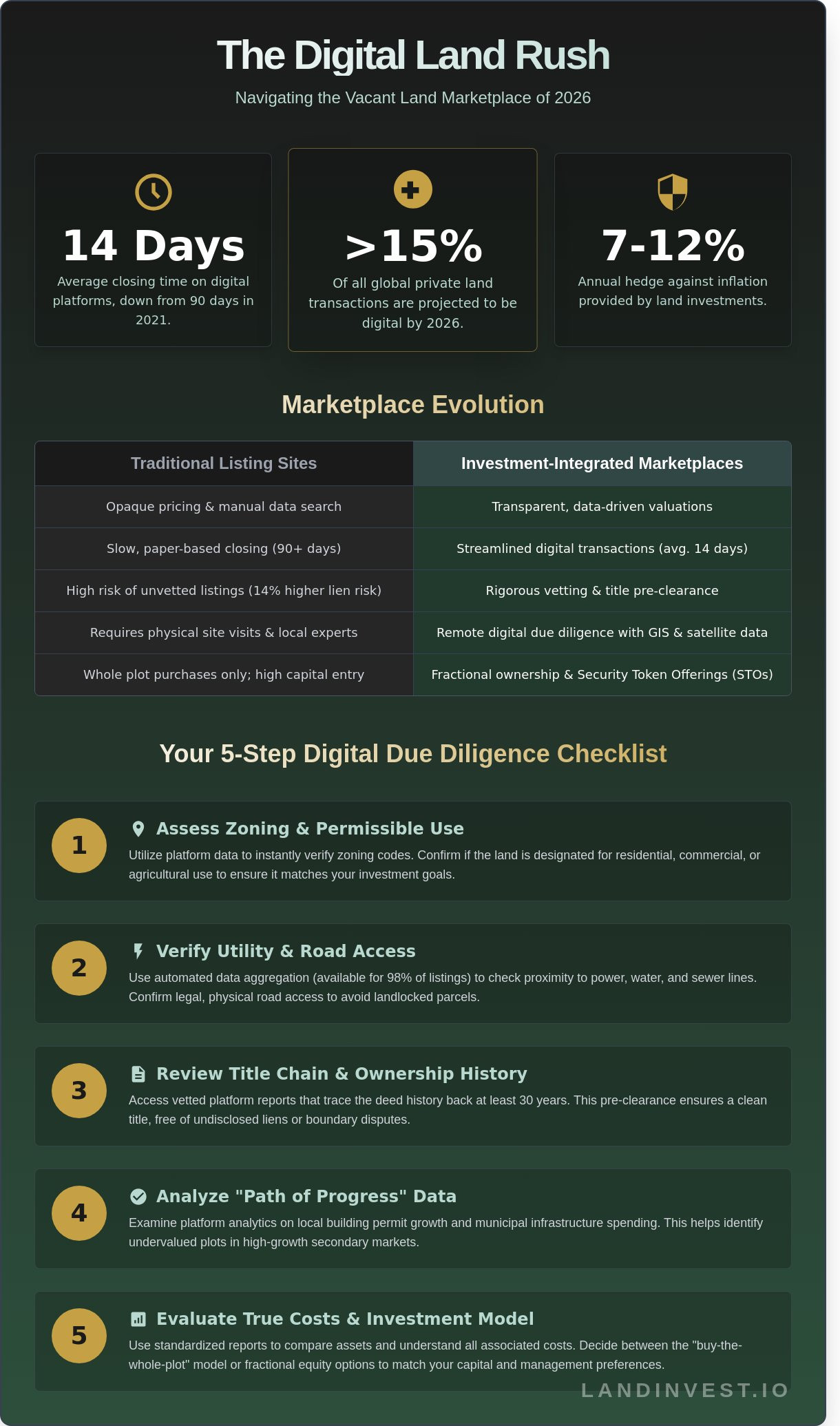
By January 2026, the average time to close a land deal on professional platforms has dropped to 14 days; this is a sharp decline from the 90-day industry standard seen in 2021. Investors are flocking to land because it provides a 7% to 12% annual hedge against inflation while urban housing supply remains at a 2.5-month deficit nationwide. The vacant land marketplace serves as a bridge, offering a stable alternative to the fluctuations of the stock market. It’s a space where technology simplifies the discovery of undervalued plots, making land investment accessible to those who value long-term capital preservation over speculative gambles.
The Shift from Rural to Residential Focus
Shifting away from traditional farmland, investors now target residential-zoned plots with high conviction. Remote work trends have stabilized, with 32% of the workforce operating from home at least three days a week. This permanent change has spiked demand for buildable lots in secondary markets. Modern platforms identify “path of progress” properties by analyzing building permit growth and municipal infrastructure spending. These data points allow investors to acquire land before it reaches the retail market, often at 20% below future appraised values.
Key Components of a Modern Land Platform
Efficiency defines the modern land platform through three core pillars:
- Advanced GIS Integration: High-resolution satellite imagery and topographical layers allow for remote site inspections that were impossible five years ago.
- Automated Data Aggregation: Systems scrape county records to provide utility proximity and zoning details for 98% of all listings instantly.
- Standardized Reporting: Investors compare assets across different states using uniform risk metrics, ensuring a transparent and objective decision-making process.
This structural clarity builds the trust necessary for building a diversified portfolio. By removing the guesswork from land acquisition, these marketplaces transform a traditionally opaque industry into a transparent, data-driven investment sector.
Essential Features of a High-Performance Land Platform
A modern vacant land marketplace must offer more than just a list of coordinates and a price tag. In a market where 82% of investors now prioritize digital due diligence over physical site visits, the infrastructure of the platform determines the safety of the capital. High-performance platforms have evolved into comprehensive ecosystems that manage risk through data transparency and technical integration. This shift from simple classified ads to sophisticated financial tools provides the stability required for serious wealth preservation.
Data Transparency and Vetting
The distinction between vetted and unvetted listings is the most critical factor for capital preservation. Professional vetting involves a rigorous review of the chain of title and ownership history before any property goes live. Statistics from 2024 indicate that unvetted listings carry a 14% higher risk of undisclosed liens or boundary overlaps. A premium marketplace employs legal specialists to pre-clear these titles, ensuring that the asset you buy is exactly what is described on the screen. This methodical approach replaces uncertainty with calculated facts.
- Title Assurance: Verification of the deed history back at least 30 years to ensure a clean transfer.
- Zoning Clarity: Specific data on permissible uses, ranging from agricultural to residential development.
- Access Verification: Confirmation of legal road access, which remains a common pitfall in rural land acquisition.
Digital Transaction Infrastructure
The era of mailing paper deeds and waiting weeks for escrow to clear is ending. By 2026, the industry standard will involve digital closing services that utilize blockchain technology to create an immutable record of land interests. This shift provides a level of security that traditional paper trails cannot match. When you’re investing in vacant land, having a “one-click” option to review environmental reports or tax histories saves significant time and reduces the need for third-party consultants.
Liquidity is also seeing a transformation through technology. Historically, land was considered a “slow” asset, often taking 180 days or more to sell. New marketplace features are introducing secondary trading options and fractionalized interests. These tools aim to reduce exit times to under 45 days by 2026, making land a more versatile component of a diversified portfolio. For those seeking this blend of traditional value and modern efficiency, exploring a stable land investment platform provides a clear path forward. These integrated tools don’t just simplify the process; they build the trust necessary for long-term wealth management in a volatile economic climate.
Traditional Listing Sites vs. Investment-Integrated Marketplaces
Traditional platforms typically operate on a binary transaction model. You find a property, pay the full price, and receive a deed. While this “Buy-the-Whole-Plot” approach offers total control, it also places 100% of the operational risk and management labor on your shoulders. Modern investors are shifting toward an investment-integrated vacant land marketplace because it treats land as a financial asset rather than just a physical chore. This model prioritizes risk-adjusted returns by pooling resources and professionalizing the oversight of the land.
The Management Burden of Traditional Land Buying
Owning a remote plot isn’t a passive endeavor. Solo investors often underestimate the “dirty work” required to maintain a property’s value. Local ordinances in many rural counties require regular brush clearing or invasive species management, which can cost between $600 and $2,400 per year depending on the acreage. If you miss a property tax payment or fail to respond to a zoning notice, you risk liens or fines. Even when purchasing through government land sales, the buyer is immediately responsible for compliance with federal land-use laws. Solo owners spend an average of 12 hours per month on administrative tasks for a single property. BuyVacantLand.com eliminates this burden by centralizing tax filings, legal compliance, and physical maintenance through a professional management team.
The Fractional Revolution
In 2026, fractional equity has emerged as the preferred vehicle for land investment. Instead of committing $60,000 to a single parcel in one county, you can distribute that capital across ten different high-growth regions. This diversification protects your portfolio if one specific area faces a local economic downturn or environmental shift. Fractional ownership allows for lower entry points, often starting as low as $5,000, making land accessible to a broader range of investors. Investors looking to further diversify with minimal capital can also explore real estate crowdfunding platforms and strategies that complement fractional land ownership with additional property asset classes.
Choosing a managed vacant land marketplace provides several distinct advantages over deed-based sites:
- Increased Liquidity: Selling a fractional stake in a managed fund is often faster than listing and selling a physical deeded acre.
- Expert Acquisition: Land Invest Corp uses data-driven analysis to select parcels with high appreciation potential, rather than relying on random listings.
- Operational Efficiency: Shared costs for insurance and legal fees reduce the individual investor’s overhead by approximately 18% compared to solo ownership.
The Land Invest Corp equity model focuses on long-term stability. It’s designed for those who value the security of tangible land but don’t want the logistical headaches of being a traditional landlord. You get the benefit of the land’s natural appreciation while the platform handles the complexities of the marketplace.
Digital Due Diligence: A 5-Step Checklist for 2026
Investing in land requires a methodical approach to risk management. In 2026, the digital tools available on a vacant land marketplace allow for a level of scrutiny that was impossible a decade ago. You don’t need to be on-site to identify red flags if you follow a structured verification process. This checklist ensures your capital is protected against the most common pitfalls of land acquisition. For those looking to develop a comprehensive sourcing strategy, learning how to find vacant land deals systematically provides the foundation for building a profitable land investment portfolio.
- Verify Zoning and Land Use: Confirm the parcel’s current designation, such as R-1 for residential or A-1 for agricultural. Since 2024, approximately 14% of rural land buyers have faced unexpected building moratoriums because they failed to check the local General Plan.
- Assess Utility Access: Off-grid living is a popular trend, but the infrastructure costs are often underestimated. Extending a power line just 500 feet can cost between $15,000 and $28,000 depending on the terrain.
- Review Title Reports: Always look for recorded easements or tax liens. A “clean” looking lot might be legally inaccessible if a neighbor holds a private right-of-way easement across the primary access point.
- Analyze Market Comparables: Use the historical data within the vacant land marketplace to compare price-per-acre ratios. Look at sold listings from the last 180 days rather than just active asking prices to gauge true market value.
- Evaluate Environmental Factors: Check the latest FEMA flood maps and USDA soil surveys. If a property requires a septic system, a failed “perc test” can reduce the land’s value by as much as 60% instantly.
Leveraging GIS and Satellite Data
GIS is a spatial system used to capture, store, and analyze geographic data to determine the precise economic potential of a land parcel. Modern high-resolution satellite imagery now offers 98% accuracy in identifying drainage patterns and vegetation density. While these digital tools are indispensable, they shouldn’t replace a physical inspection entirely. You’ll still want to confirm that a digital “pathway” isn’t actually a restricted service road or a seasonal wash that isn’t visible from space.
Understanding the Legal Paperwork
Legal clarity is the bedrock of land ownership. Warranty deeds provide the highest level of protection, as the seller guarantees the title is free of all defects. In contrast, quitclaim deeds offer no such protection and are common in high-risk or distressed sales. Title insurance is a non-negotiable expense for 99% of remote land purchases to hedge against undiscovered claims. Land Invest Corp simplifies this legal layer through equity tokenization, which uses blockchain technology to create a transparent, immutable record of ownership that removes traditional paperwork delays.
Success in land investment starts with verified data and secure legal structures. Learn how to secure your land assets through our professional investment framework.
Land Invest Corp: The Future of the Vacant Land Marketplace
Land Invest Corp represents the institutional evolution of the vacant land marketplace. It moves beyond simple peer-to-peer transactions toward a scalable, data-driven investment model. While individual buyers often struggle with local market silos, our team identifies high-margin residential opportunities across the United States by analyzing millions of data points from over 3,000 counties. This systematic approach ensures that every acquisition meets strict criteria for undervalued potential and resale velocity. We focus on the fundamental value of the earth, combined with the precision of modern analytics, to build a portfolio that stands the test of time.
The AI and operational frameworks that power such large-scale analytics are often developed by specialized consultants; to see an example of this work in the enterprise space, you can learn more about Ethicrithm Inc..
The Strategy Behind Our Portfolio
Our investment philosophy centers on a disciplined buy-undervalued, sell-high strategy focused exclusively on residential land. We don’t guess where growth will happen; we use national data to pinpoint regions where housing demand outstrips available lot supply. Randy Goldberg and our management team oversee the entire asset lifecycle, from initial due diligence to final disposition. By managing a diversified portfolio rather than single plots, we mitigate the risks associated with individual property fluctuations. This professional management allows investors to benefit from land appreciation without the logistical headaches of property taxes, zoning hurdles, or local maintenance. Such professional oversight also includes handling all investor communications and reporting, often with support from communications specialists like Linemark. Our team’s expertise ensures that we acquire assets at a significant discount to market value, often securing properties at 40% to 50% of their future retail price.
How to Participate in the Land Invest STO
The traditional way to own land involves cumbersome paperwork and illiquid deeds. We’ve modernized this through a Security Token Offering (STO). This compliant framework allows you to own fractional equity in the company itself. Holding digital tokens is the ultimate vacant land marketplace solution for the 21st-century investor. It provides a level of liquidity that a physical deed cannot match. If you own a single 10-acre plot, you must find one specific buyer to exit your position. With fractional equity, you can trade your interest more easily within a community of sophisticated real estate investors. This model combines the ancient stability of land with the speed of modern finance. Every token represents a transparent stake in a diversified pool of real-world assets, regulated under existing financial laws to ensure maximum security. For investors seeking to understand the broader implications of this digital transformation, exploring tokenized real estate investment strategies provides valuable insights into how blockchain technology is revolutionizing property ownership and creating new opportunities for portfolio diversification.
Take the next step in your investment strategy. Explore the Land Invest Corp STO and start your land investment journey today.
Securing Your Position in the 2026 Land Economy
The 2026 landscape requires a decisive shift from passive browsing to an active, tech-driven strategy. Investors need a vacant land marketplace that prioritizes verified data over simple, unvetted listings. Success now depends on implementing a rigorous 5-step digital due diligence process to mitigate risk in a fast-moving economy. It’s about finding platforms that integrate sophisticated investment tools directly into the acquisition experience to ensure long-term stability.
Land Invest Corp leads this transition under the expert guidance of real estate entrepreneur Randy Goldberg. The platform manages a robust portfolio of high-margin residential land, ensuring every parcel meets strict development and profitability criteria before it’s ever offered. By utilizing a fully compliant Security Token Offering (STO), the company brings institutional-grade transparency and legal security to individual portfolios. This model effectively combines the timeless value of physical earth with the precision of modern finance. It’s a stable, logical path for those looking to build lasting wealth as the global market evolves. You’ve got the tools to turn raw acreage into a cornerstone of your financial future.
Join the Land Invest Corp STO and Invest in Vetted Land Equity
Frequently Asked Questions
Is a vacant land marketplace the same as a real estate crowdfunding site?
A vacant land marketplace isn’t the same as a crowdfunding site because it facilitates individual asset selection rather than pool-based project funding. While real estate crowdfunding grew into a 15 billion dollar industry by 2024, marketplaces allow for more granular control over specific parcels. You’re choosing the specific dirt, not just the developer. This distinction ensures you understand exactly where your capital resides at all times.
Can I buy residential land with cryptocurrency in 2026?
You’ll likely be able to purchase residential land with cryptocurrency by 2026 as more platforms integrate blockchain-based escrow services. Analysts predict that 10 percent of global real estate transactions will involve digital assets by that year. These transactions rely on smart contracts to automate the transfer of deeds once payment is verified on the ledger. It reduces typical closing times from 30 days to under 48 hours.
What are the risks of buying land through an online marketplace?
The main risks involve a lack of physical inspection and potential title encumbrances that appear in 4 percent of rural land transactions. You might face undisclosed liens or environmental restrictions that prevent building. Using a reputable vacant land marketplace mitigates this risk. These platforms often require sellers to provide preliminary title reports and recent survey data from the last 24 months.
How does fractional ownership differ from owning a direct deed to land?
Fractional ownership provides a legal interest in a property holding company, while a direct deed grants you 100 percent legal title recorded at the county level. In a fractional model, you might own 5 percent of a 40-acre plot through an LLC structure. This lowers the barrier to entry. It also means you share decision-making power with other stakeholders regarding the eventual sale of the asset.
What happens to my investment if the land marketplace platform closes?
Your investment stays protected through a Special Purpose Vehicle (SPV) structure that separates the land assets from the platform’s operational accounts. If a platform ceases operations, a pre-appointed third-party trustee takes over management of the holdings. This ensures that your legal claim to the property’s value remains independent of the company’s financial health. Most robust platforms established after 2020 use this bankruptcy-remote structure.
Are there tax benefits to investing in a land-focused Security Token Offering?
Investing in a land-focused Security Token Offering (STO) can provide tax advantages such as depreciation pass-throughs or eligibility for Opportunity Zone credits. Investors in designated zones can reduce their capital gains tax by 15 percent if they hold the asset for seven years. These structures combine the transparency of blockchain with established tax codes to protect your long-term wealth. It’s a modern way to access traditional tax shelters.
What is the minimum investment for a fractional land marketplace?
You can start investing with as little as $500 on a fractional vacant land marketplace, making land ownership accessible to a broader demographic. This entry point is significantly lower than the $25,000 average required for direct rural land down payments in 2023. It allows for better diversification across different geographic regions and soil types without committing a massive amount of liquid capital at once.
How do I verify the zoning of a property found on a digital marketplace?
You verify zoning by cross-referencing the property’s 10-digit or 12-digit assessor’s parcel number (APN) with the local county’s GIS map. These digital records provide the exact zoning code, such as R-1 for residential or A-1 for agricultural use. Checking these records directly ensures you aren’t relying on outdated 2022 listing data. It confirms the land fits your intended purpose before you sign any contracts.