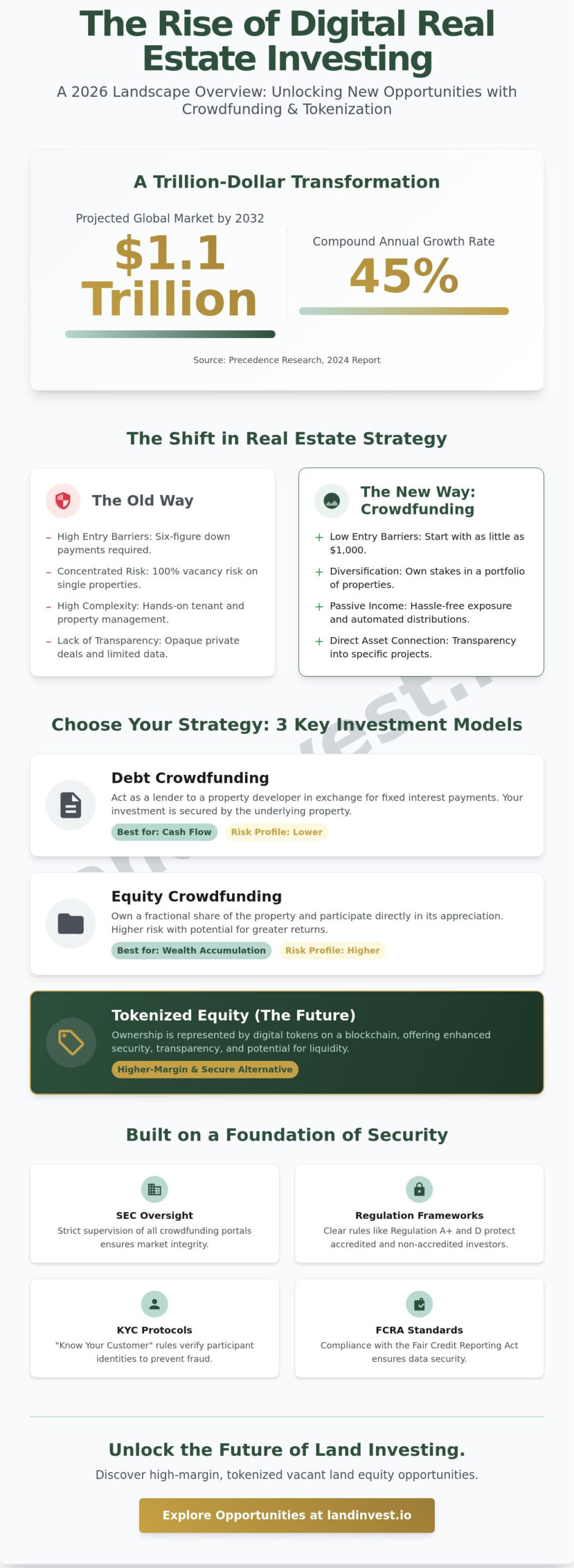
According to a 2024 report by Precedence Research, the global market for real estate crowdfunding is projected to reach $1.1 trillion by 2032, expanding at a compound annual growth rate of 45%. This rapid adoption proves that the era of needing a six-figure down payment just to enter the market is over. You’ve likely felt the weight of high entry barriers or the complexity of managing physical tenants, which often makes traditional property investment feel out of reach. It’s a common struggle to find stability when stock market volatility fluctuates by 2% or more in a single afternoon, leaving many investors searching for more tangible security.
This article promises to show you exactly how to build a diversified property portfolio with low capital using the top-rated crowdfunding and tokenization platforms of 2026. You’ll learn how to secure passive income streams and target higher returns than standard REITs while avoiding the lack of transparency often found in private deals. We’ll examine the most resilient strategies for 2026 to ensure you gain hassle-free real estate exposure that protects your wealth against inflation and builds a foundation for long-term growth.
Key Takeaways
- Understand the 2026 landscape of digital finance and how pooling capital has evolved into a sophisticated tool for modern portfolio building.
- Learn to distinguish between debt, equity, and tokenized stakes to align your risk tolerance with the right property-backed asset structures.
- Identify the top-performing real estate crowdfunding platforms of 2026 and why specialized niche portals are now outperforming generalist competitors.
- Master a professional vetting checklist to evaluate both the platform’s transparency and the underlying physical asset’s long-term potential.
- Discover how tokenizing vacant land equity provides a higher-margin, secure alternative to traditional rental models for capital growth.
What is Real Estate Crowdfunding? A 2026 Market Overview
The concept of real estate crowdfunding has transformed from a niche financial experiment into a cornerstone of modern portfolio management. At its core, this mechanism allows multiple investors to pool their capital through digital platforms to acquire high-value properties that were previously reserved for institutional players. This movement gained legal momentum with the signing of the JOBS Act on April 5, 2012, which cleared the path for online capital solicitation. By 2026, the landscape has matured into a sophisticated ecosystem where technology ensures transparency and asset security.
Investors have increasingly turned away from traditional Real Estate Investment Trusts (REITs) in favor of crowdfunding. While REITs offer liquidity, they often lack the direct connection to tangible assets that modern participants crave. Digital platforms now provide a clear view of specific projects, whether it’s a multi-family complex in a growing urban hub or a sustainable agricultural venture. The primary appeal lies in the low barrier to entry. In 2026, you can secure a stake in institutional-grade deals with as little as $1,000, a stark contrast to the six-figure minimums required for private equity funds a decade ago.
The global Crowdfunding market has seen exponential growth, with the real estate sector specifically benefiting from blockchain-based ledgers and automated distributions. This evolution provides a stable alternative to the volatility of public stock markets, focusing on long-term value creation rather than speculative day-trading.
The Shift Toward Fractional Ownership
Modern investors are moving away from the burden of single-asset management. The rise of fractional land ownership has redefined what it means to be a landlord. Instead of managing a single house and facing 100% vacancy risk, you can own equity in a diversified portfolio of twenty different properties. This psychological shift prioritizes equity growth and passive income over the logistical headaches of maintenance. In 2026, 65% of retail investors report that diversification across different geographic regions and asset types is their top priority for capital preservation.
Regulatory Progress and Investor Protection
The Securities and Exchange Commission (SEC) maintains strict oversight of all active crowdfunding portals to ensure market integrity. Offerings typically fall under three categories. Regulation A+ allows companies to raise up to $75 million from both accredited and non-accredited investors, providing a “mini-IPO” structure. Regulation D is tailored for private placements with accredited individuals, while Regulation S handles international capital. To maintain security, platforms utilize the Fair Credit Reporting Act (FCRA) standards and rigorous Know Your Customer (KYC) protocols. These layers of protection verify the identity of participants and ensure that every transaction meets federal anti-money laundering requirements, fostering a secure environment for long-term growth.
Key Investment Models: Debt, Equity, and Tokenized Stakes
Real estate crowdfunding has matured into a sophisticated market where investors choose between three primary structures. Understanding the distinction between debt and equity is the first step toward building a balanced portfolio. Debt crowdfunding acts as a fixed-income product. In this model, you essentially act as a lender to a property developer. You receive regular interest payments, and the investment is typically secured by the property itself. This structure appeals to conservative investors because it sits higher in the capital stack, meaning debt holders are paid before equity holders.
Equity crowdfunding offers a different risk-return profile. Instead of earning interest, you own a fractional share of the specific property or a portfolio of assets. While this carries more risk, the upside is significantly higher because you participate in the property’s appreciation. These offerings often fall under Regulation Crowdfunding, providing a transparent legal framework that protects individual participants. By 2026, the market has clearly bifurcated: debt for cash flow and equity for wealth accumulation.
Traditional Equity Crowdfunding vs. STOs
The mechanics of ownership are shifting from traditional LLC shares to Security Token Offerings (STOs). While a standard equity deal involves manual ledger updates and paper contracts, an STO uses blockchain technology to automate ownership verification. This shift provides a superior audit trail that is immutable and accessible in real-time. Real World Asset (RWA) Tokenization is the 2026 industry gold standard for representing physical property value on a digital ledger. This technology allows tokenized real estate to be traded on secondary markets, solving the liquidity issues that once plagued the industry.
Understanding Your Returns: Dividends vs. Capital Gains
Investors must distinguish between immediate yield and long-term growth. In residential real estate crowdfunding, returns usually come via monthly or quarterly rental distributions. These function like dividends, providing a steady stream of passive income. Conversely, land flipping or opportunistic development models focus on capital gains. Data from 2025 indicates that land-based projects often target a Return on Assets (ROA) between 12% and 18% upon final sale, though they offer little to no cash flow during the holding period.
To calculate your total return, you must combine the annual yield with the projected equity growth. A property with a 5% cap rate might seem modest, but if the local market is appreciating at 7% annually, your total return profile changes drastically. For those seeking to anchor their wealth in tangible assets, it is wise to examine land-backed investment options that offer a hedge against market volatility. Balancing these different return types ensures that your capital remains productive through various economic cycles.
Comparing the Top Real Estate Crowdfunding Platforms in 2026
The real estate crowdfunding market in 2026 is no longer a monolithic industry. It has evolved into a sophisticated ecosystem where specialized knowledge outweighs broad-market reach. Investors have learned that “one-size-fits-all” platforms often lack the operational depth required to manage specific asset classes effectively during economic shifts. Consequently, capital is flowing toward portals that offer granular control and niche expertise. Choosing a platform now requires a rigorous audit of performance during the 2023-2024 interest rate cycles and a clear understanding of fee structures, which typically range from 0.15% to 1.5% annually across the sector.
Success in this mature market is defined by three critical pillars:
- Liquidity: Secondary markets are now a baseline expectation, allowing investors to exit positions before the underlying asset is sold.
- Transparency: Leading portals provide real-time data on occupancy rates, tax obligations, and localized market trends.
- Stability: Preference is given to firms that maintained consistent distributions during the credit tightening of the early 2020s.
Residential and Commercial Giants
Fundrise remains the veteran choice for those seeking diversified exposure through its proprietary eREITs. With over $7 billion in assets under management as of 2025, its focus on long-term stability and tech-driven cost reduction appeals to conservative portfolios. Arrived has solidified its position as the leader in single-family rental (SFR) fractionalization. It allows users to buy shares of individual rental properties for as little as $100, catering to those who want the benefits of being a landlord without the maintenance burdens. Groundfloor continues to dominate the short-term debt space, providing capital for residential fix-and-flip projects. It remains popular for its high-yield potential, with historical returns on debt tranches often averaging 10%. For institutional-grade commercial deals, a detailed CrowdStreet review comparing traditional crowdfunding against tokenized land equity models reveals how the platform’s $4 billion in facilitated capital stacks up against emerging alternatives in 2026.
Niche and Emerging Platforms
Specialization is the defining trend of 2026. Lofty utilizes the Algorand blockchain to offer tokenized rental properties, providing 24/7 liquidity and daily rent distributions that traditional models cannot match. Yieldstreet has expanded its reach beyond property, allowing investors to access private credit and other alternative assets within a single interface. For those focused on the most fundamental and resilient asset class, Land Invest Corp has emerged as the premier choice for tokenized equity in the vacant land marketplace. By focusing on raw land, they provide a hedge against the depreciation and management risks associated with physical buildings. This shift toward niche platforms reflects a broader investor desire for transparency and targeted risk management in an increasingly complex financial world.
Due Diligence Checklist: How to Vet a Crowdfunding Opportunity
Successful real estate crowdfunding isn’t a matter of luck; it’s the result of rigorous, dual-track verification. You must evaluate the platform’s operational stability with the same intensity you apply to the physical property. A high-quality asset can’t compensate for a platform that lacks transparent oversight or robust legal protections. Your first step is requesting the Offering Circular or Private Placement Memorandum (PPM). These documents outline the legal structure, use of proceeds, and risk factors that marketing brochures often gloss over.
The sponsor’s track record serves as the most reliable indicator of future performance. Look for sponsors who’ve navigated at least one full market cycle, typically 7 to 10 years, and managed a minimum of $50 million in assets. Alignment of interest is vital. Verify if the sponsor has “skin in the game” by committing 5% to 10% of their own capital to the project. This ensures they’re financially motivated to protect the investment during market volatility.
Fee structures require a sharp eye to prevent return erosion. Standard models often include a 1% to 2% annual management fee and a performance “hurdle,” where investors receive a 7% to 8% preferred return before the sponsor shares in the profits. Be wary of hidden costs. High acquisition fees or exit loads exceeding 3% can significantly lower your net Internal Rate of Return (IRR).
Analyzing the Underlying Asset
Evaluating a land deal involves different metrics than a multi-family apartment complex. For apartments, you’ll focus on the Cap Rate, which is the net operating income divided by the purchase price, to determine current value. Land deals are more speculative and rely on future rezoning or development potential. Vacant land requires a different risk assessment than improved property because it lacks immediate cash flow and carries higher carry costs like taxes and insurance. Always compare the IRR projections against historical 10-year averages for the specific submarket to ensure the numbers aren’t overly optimistic.
Platform Security and Liquidity
Liquidity is a common hurdle in this asset class. You should confirm if the platform facilitates secondary market trades or if your capital is locked for the full 3-to-7-year term. Security protocols are non-negotiable. Professional platforms use third-party custodians to hold investor funds, ensuring your capital isn’t co-mingled with the platform’s daily operating expenses. Watch for these specific red flags during your review:
- Guaranteed high returns: Real estate markets fluctuate, and any promise of “guaranteed” double-digit yields is a sign of potential fraud.
- Opaque ownership: If you can’t identify the principals or the specific legal entity holding the title, walk away.
- Missing audits: A reliable platform should provide audited financial statements covering at least the last 24 months of operation.
The Future of Land: How Land Invest Corp Tokenizes Vacant Land Equity
Real estate crowdfunding has matured into a sophisticated market by 2026. Savvy investors now look beyond volatile rental markets toward the stability of the earth itself. Land Invest Corp facilitates this shift by focusing exclusively on residential vacant land. This model bypasses the complexities of property management and focuses on the high-margin potential of land flipping. By acquiring undervalued parcels and reselling them to developers or individuals, the company creates a streamlined path to profit that isn’t tied to the headaches of physical structures.
Unlike traditional “buy-and-hold” strategies that rely on slow rental yields, Land Invest Corp targets rapid appreciation. Holding equity in the company provides a diversified shield. You aren’t tied to a single deed; you’re a stakeholder in a professional operation that manages a vast portfolio of assets. This approach provides a layer of security and professional oversight that individual land ownership often lacks. It’s a calculated way to benefit from the foundational value of US soil without the operational burdens of being a landlord.
The Competitive Advantage of Vacant Land
The primary appeal of vacant land lies in its simplicity. It’s an asset class famously described as having “no tenants, toilets, or trash.” This low-overhead nature means more of the invested capital goes toward growth rather than repairs, insurance, or property management fees. Land Invest Corp focuses on specific acquisition strategies to drive these margins:
- Tax-Deed Acquisitions: The team secures properties where owners have defaulted on taxes, often at a fraction of the actual market value.
- Undervalued Parcels: Using national market data, the company identifies land in the path of urban sprawl before prices spike.
- High-Margin Resales: Strategic marketing ensures these parcels are sold to builders who need inventory to address the US housing shortage, which reached a deficit of 4 million homes in recent years.
In 2024, industry data showed that residential land values in high-growth corridors increased by over 15% annually. Land Invest Corp leverages this by using proprietary analytics to find parcels priced 30% to 50% below their potential value. This data-driven approach ensures that the portfolio remains robust regardless of fluctuations in the broader housing market.
Investing in Land Invest Corp via STO
The gateway to this market is the Security Token Offering (STO). This isn’t a speculative utility token; it’s a digital representation of legal equity in the business. This digital approach to real estate crowdfunding allows for fractional ownership and liquidity that traditional land deeds simply don’t offer. The process is transparent and compliant with modern financial regulations, providing a secure environment for capital.
The step-by-step process involves a secure KYC verification followed by the acquisition of tokens that reside in your digital wallet. These tokens grant you a share in the profits generated by the company’s land flipping activities across the United States. It’s a modern solution for a timeless asset class, combining the “old world” stability of land with “new world” blockchain efficiency.
Explore the Land Invest Corp STO and start your land investment journey today.
Building Your Portfolio with Modern Land Equity
The landscape of real estate crowdfunding in 2026 demands a shift from speculative hype toward tangible, asset-backed stability. Industry reports from 2025 indicate that the fractional real estate market grew by 22% annually as investors sought reliable alternatives to volatile equities. The transition toward tokenization and debt models offers various paths to diversification. Successful investors now focus on rigorous due diligence and platforms that prioritize transparency through blockchain technology.
Land Invest Corp stands at this intersection, providing a professional bridge between traditional land ownership and digital efficiency. Our platform utilizes an SEC-compliant Security Token Offering (STO) structure to ensure every stake is legally grounded. We focus on expert-led acquisition of high-margin residential vacant land, which has historically maintained value during inflationary cycles. By combining modern blockchain transparency with the inherent stability of physical land, we’ve created a path for consistent growth. You don’t have to navigate the complexities of land development alone.
Join Land Invest Corp: Secure Your Fractional Equity in the US Land Market
Take the next step toward a more secure financial future today.
Frequently Asked Questions
Is real estate crowdfunding safe for beginners in 2026?
Real estate crowdfunding is generally safe for beginners if you choose platforms regulated by the SEC and focus on diversified portfolios. Market data from 2024 shows the industry grew by 15.6%, reflecting increased institutional trust and better regulatory oversight. You should prioritize platforms that provide transparent historical performance data and third-party audits to ensure your capital is handled with professional care.
What is the difference between an accredited and non-accredited investor?
The primary difference depends on meeting specific SEC Rule 501 financial thresholds regarding income or net worth. An accredited investor must have an annual income over $200,000 for the last two years or a net worth exceeding $1 million, excluding their primary home. Non-accredited investors don’t need to meet these high benchmarks, which allows them to participate in the market through specific regulation tiers like Reg A+.
Can I lose all my money in a real estate crowdfunding deal?
You can lose your entire investment if the underlying property project fails or the developer defaults on their obligations. While the default rate for major platforms in 2025 stayed below 3%, real estate markets can be unpredictable. Spreading your capital across ten or more projects is a logical way to protect your principal from the failure of a single asset.
How much money do I need to start real estate crowdfunding?
You can start real estate crowdfunding with as little as $10 on several popular retail platforms. While institutional-grade deals often require $25,000, the market’s shift toward accessibility means many entry-level options exist for $500. Starting with smaller amounts lets you test the platform’s stability before you commit larger portions of your savings to long-term projects.
Are real estate crowdfunding dividends taxable?
Yes, the dividends you receive are typically taxed as ordinary income at your current marginal tax rate. Depending on the platform’s legal structure, you’ll receive either a Form 1099-DIV or a Schedule K-1 for your annual tax filings. It’s important to account for these obligations, as they impact your net yield just like traditional rental income or stock dividends.
How does tokenization differ from traditional crowdfunding?
Tokenization uses blockchain technology to represent ownership as digital tokens rather than traditional paper or ledger-based certificates. This method allows for the fractionalization of assets into units as small as 0.01% of a property’s value. It provides a more transparent record of ownership that’s updated instantly, which reduces the administrative costs associated with traditional share management.
Can I sell my shares or tokens whenever I want?
Most real estate crowdfunding investments are illiquid and involve typical holding periods of 3 to 7 years. Even with tokenized assets, a secondary market must exist for you to find a buyer quickly. You shouldn’t invest funds you might need soon, as early redemption programs often charge a penalty ranging from 1% to 3% of the share value.
Why should I invest in vacant land equity instead of a rental property?
Vacant land equity provides a stable foundation with significantly lower maintenance costs and no tenant management issues. Industry reports from 2024 indicate that high-quality land often appreciates steadily, serving as a reliable hedge against inflation. This strategy focuses on the intrinsic value of the earth itself, offering a calm and predictable alternative to the volatile residential rental market. For investors weighing their options, a detailed Lofty review comparing fractional rental tokens against land equity models can help clarify which structure best fits your long-term goals.