What if you could own a piece of a high-yield commercial farm or a prime apartment complex for the same price as a single share of a tech stock? You likely recognize that land is the ultimate foundation for long-term wealth, but the $100,000 minimum entry fees and rigid five-year lock-up periods often make traditional deals feel out of reach. It’s frustrating to watch property values outpace your savings while your capital remains on the sidelines. This guide explains how tokenized real estate is dismantling those barriers, turning illiquid bricks and mortar into fractional, tradable digital equity. We’ll explore the legal bridge between blockchain and physical property, show you how to spot a safe entry point, and provide a framework for evaluating asset-backed tokens. You’ll learn how to combine the ancient stability of land with the efficiency of modern technology to build a more resilient portfolio for the years ahead.
Projects like luxury condominium developments are prime examples of the high-value assets now being viewed through this modern investment lens. To understand the caliber of property that underpins these new financial models, you can learn more about what a premier development entails.
Key Takeaways
- Learn how blockchain technology digitizes real-world assets into fractional security tokens, making high-value property accessible to a wider range of investors.
- Understand the legal and technical mechanisms, from Special Purpose Vehicles to smart contracts, that ensure secure and transparent digital ownership.
- Discover why residential vacant land is considered the gold standard for tokenized real estate due to its inherent stability and lack of maintenance requirements.
- Master the essential due diligence steps for evaluating digital offerings by verifying underlying assets and the professional track record of the issuer.
- Explore how modern investment models bridge the gap between traditional land flipping and the efficiency of digital property equity to build long-term wealth.
Understanding Tokenized Real Estate in 2026
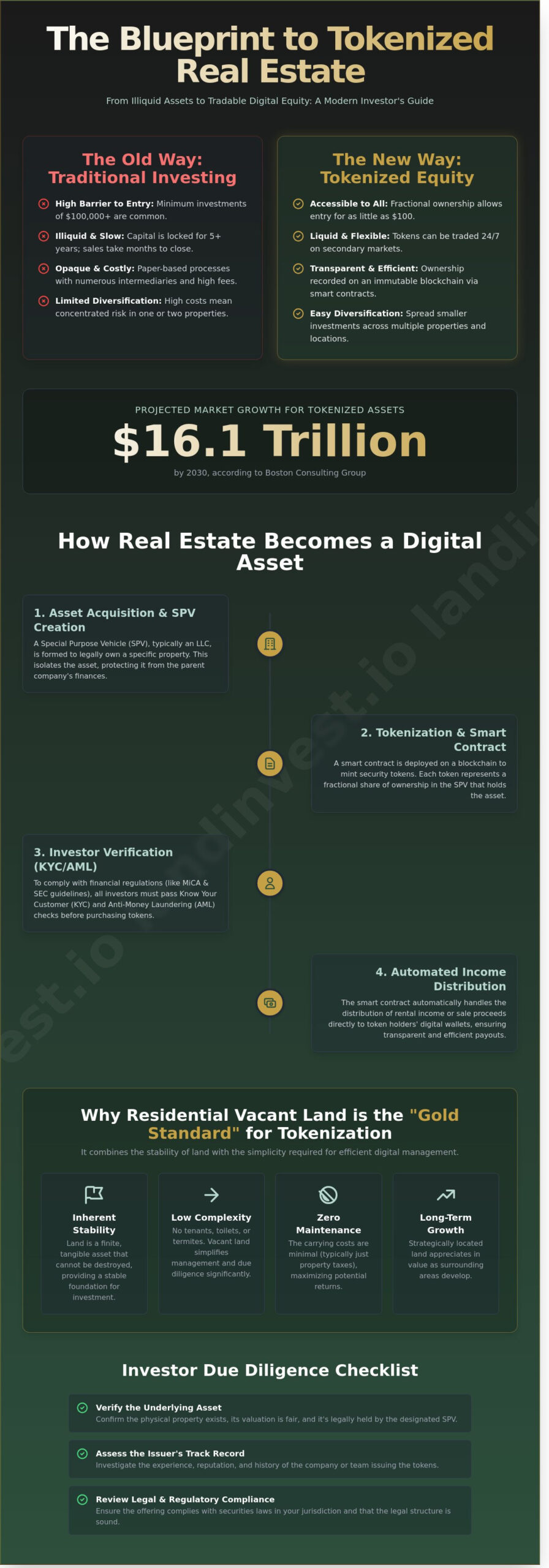
The digital transformation of property ownership has reached a pivotal maturity point. In 2026, we’ve entered what analysts call the Institutional Era of finance. This shift follows the 2024 implementation of comprehensive frameworks like the EU’s MiCA and updated SEC guidelines, which provided the legal certainty large-scale investors required. Tokenization represents the process of converting a Tokenized real-world asset (RWA) into digital security tokens on a blockchain. Unlike utility tokens, which might grant access to a service or a platform’s features, security tokens are digital representations of actual equity. They’re backed by physical property and subject to strict financial regulations. This ensures that your investment isn’t just a digital entry; it’s a legally enforceable claim to a share of a building or land. We’re seeing a transition from rigid, paper-based ownership to a fluid ecosystem where tokenized real estate equity can be traded as easily as stocks on a global scale.
The Evolution from Physical Deeds to Digital Assets
Property records began as handwritten paper ledgers, eventually moving to centralized digital databases managed by local governments. These systems often suffered from transparency issues and high administrative costs. Blockchain technology solves this trust gap by using decentralized ledgers that are immutable and accessible to all parties involved. Real estate tokenization is the fractionalization of property rights into programmable digital units. This allows for clear, automated tracking of ownership without needing a dozen intermediaries to verify every transaction. It simplifies the path for investors who want the stability of land without the burden of traditional management. By 2026, the shift from illiquid 30 year investment cycles to tradeable digital stakes has become the standard for modern portfolio construction.
Why the Market is Moving Toward Tokenization
The Boston Consulting Group projected in a 2022 report that the market for tokenized assets would reach $16.1 trillion by 2030. By 2026, we’re already seeing this trajectory accelerate as major banks integrate blockchain into their core systems. High interest rates, which hovered near 5.25% in the mid-2020s, forced investors to look for more efficient ways to manage capital. Fractional ownership allows for better diversification with smaller amounts of money, reducing the entry barrier for the average person. Secondary markets now operate 24/7, effectively solving the liquidity trap that has historically plagued the property sector. This means you don’t have to wait months for a sale to close if you need to rebalance your assets. Tokenized real estate offers a level of flexibility and transparency that traditional deeds simply cannot match in a digital-first economy. For a deeper understanding of how this broader trend is reshaping modern finance, the comprehensive guide to asset tokenization and real world asset investing provides essential context for navigating this evolving landscape.
How Real Estate Tokenization Works: The Step-by-Step Mechanism
The process of creating tokenized real estate begins with legal shielding rather than digital coding. A developer or platform establishes a Special Purpose Vehicle (SPV), often a Limited Liability Company (LLC), which exists solely to hold the title of a specific physical property. This structure ensures the asset is isolated from the platform’s balance sheet. If the parent company faces financial difficulties, the property remains protected for the investors. Once the legal entity owns the land or building, the ownership interest is divided into digital units. Understanding how real estate blockchain technology reduces closing costs and streamlines ownership transfers helps clarify why this mechanism has become the preferred structure for institutional-grade offerings.
The transition from a physical building to a digital asset follows a precise sequence:
- Asset Acquisition: The property is vetted and purchased by the SPV.
- Legal Structuring: Documents are filed to link digital tokens to shares in the SPV.
- Tokenization: A smart contract is deployed on a blockchain like Ethereum or Polygon to mint the tokens.
- Whitelisting: Investors complete identity verification to access the offering.
Minting tokens involves writing code that defines the total supply and the rights of the holders. For a $2,500,000 commercial warehouse, the issuer might create 25,000 tokens priced at $100 each. Before anyone can purchase these, they must pass through a strict KYC (Know Your Customer) and AML (Anti-Money Laundering) layer. This verification ensures that every participant is identified; keeping the ecosystem compliant with regulations like the EU’s MiCA framework or the US SEC guidelines.
The Role of the Smart Contract
Smart contracts act as the digital backbone of the investment. They automate the distribution of rental income or sale proceeds directly to investor wallets without human intervention. This eliminates the need for manual accounting or expensive third-party payment processors. A key feature is “programmable compliance.” The code ensures tokens can’t be transferred to any wallet that hasn’t cleared the platform’s verification process. By automating cap table management, platforms can reduce administrative overhead costs by roughly 20% to 35% compared to traditional private equity funds.
Custody and Security: Protecting Your Digital Stake
Security isn’t just about encryption; it’s about legal recourse. Every digital token is anchored to the physical world through public filings and shareholder agreements. If you hold tokens in a private wallet, you maintain direct custody of your assets. However, many investors prefer platform-managed accounts for ease of use. If a technical failure occurs on the platform, the legal safety net remains intact. The SPV’s operating agreement identifies the token holders as the beneficial owners of the property. This structural transparency is why many are choosing to explore stable asset classes like agricultural land through digital means. The blockchain simply makes the existing legal rights more efficient and liquid.
Why Residential Vacant Land is the “Gold Standard” for Tokenization
Residential land offers a level of clarity that complex commercial assets cannot match. When you evaluate tokenized real estate, the underlying asset’s simplicity dictates the investment’s risk profile. Multi-family buildings involve unpredictable variables like a 15% vacancy rate or a $50,000 roof replacement. Land has none of these. There are no tenants to evict, no toilets to fix, and no termites destroying the equity. This “zero maintenance” model allows the investment to scale without the friction of traditional property management. In the current US market, residential land flipping often achieves margins of 25% to 40%, making it a high-performance vehicle for digital portfolios.
Lower Overhead, Higher Transparency
Physical structures add layers of cost to a Special Purpose Vehicle (SPV). Insurance premiums for vacant land are often 90% lower than those for developed properties because the liability risk is minimal. Valuation is also more transparent. A commercial building’s price depends on complex Net Operating Income (NOI) calculations and fluctuating cap rates; land value relies on simple, verifiable market comparables from the last 6 months. Vacant land represents the most “pure” form of real estate equity because it strips away the volatility of building maintenance, leaving only the intrinsic value of the location itself.
Diversification Through Land Portfolios
Owning a fraction of a single building leaves you vulnerable to hyper-local economic shifts. If a major employer leaves a specific city, that building’s value might drop overnight. By using tokenized real estate to hold a portfolio of 100 parcels across multiple states, you effectively mitigate this risk. Spreading capital across diverse jurisdictions like Florida, Texas, and Arizona ensures that a single zoning change or local tax adjustment doesn’t compromise the entire fund. Investors who want to broaden their exposure beyond individual parcels often combine this strategy with real estate crowdfunding platforms to access a wider range of asset types and geographies with minimal capital.
Success in this asset class depends on the ability to identify mispriced opportunities before they hit the open market. You can explore how we find undervalued land to understand the data-driven selection process that powers these portfolios. This national acquisition strategy provides a safety net that a single-asset investment simply cannot offer.
- Reduced Risk: No structural depreciation or unexpected renovation costs.
- Market Agility: Land can be liquidated or developed faster than large-scale commercial complexes.
- Cost Efficiency: Management fees are significantly lower without the need for 24/7 on-site staff.
This streamlined approach aligns with the needs of digital investors who prioritize stability and clear exit strategies. By removing the “human element” of property management, land tokenization provides a predictable path toward wealth preservation.
Investor Due Diligence: Evaluating a Tokenized Offering
Entering the world of tokenized real estate requires a shift from speculative hype to disciplined financial analysis. You aren’t just buying a digital asset; you’re participating in a legally binding property interest. The first step involves verifying the physical asset. A legitimate project will provide a property deed or a lease agreement registered in a specific jurisdiction, such as a 500-hectare plot of agricultural land or a commercial building in a Tier-1 city. If the issuer cannot provide a land registry extract or a title insurance policy dated within the last 30 days, the risk of capital loss increases significantly.
Analyze the issuer’s history before committing your capital. Successful platforms often have a management team with at least 12 years of experience in traditional real estate or agriculture. You should look for a clear exit strategy. Most institutional-grade offerings define a holding period, often between 5 and 7 years, before the underlying asset is sold and the capital is returned to investors. Without this roadmap, your liquidity depends entirely on finding a buyer in a potentially thin secondary market, which can lead to price volatility. Selecting a trustworthy real estate tokenization platform with a verifiable track record is one of the most critical decisions you’ll make before committing capital to any digital property offering.
Regulatory compliance isn’t optional in this space. Legitimate offerings typically register as a Security Token Offering (STO). In the United States, this often falls under SEC Regulation D for accredited investors or Regulation S for international participants. You can verify these filings on the SEC’s EDGAR database to ensure the project isn’t operating outside the legal framework. Transparency in these filings protects you from the legal grey areas that often plague the broader cryptocurrency market.
For high-net-worth investors, integrating such novel assets into a comprehensive wealth strategy is crucial. Specialized multi-family offices like Neil Jesani Wealth provide the sophisticated advisory services needed to vet these opportunities and ensure they align with long-term financial goals.
The Red Flags of “Crypto” Real Estate
Distinguishing between speculative “meme-coins” and asset-backed tokens is vital for long-term stability. A project that promises 40% annual returns without a clear revenue stream from rent or crop sales is likely a high-risk gamble. Avoid “direct deed” models where hundreds of investors are listed on a single physical land title; this structure creates a logistical nightmare for future sales. Instead, look for equity tokens representing shares in a Special Purpose Vehicle (SPV). Transparency is non-negotiable. Ensure the platform provides quarterly third-party audits from firms like Deloitte or specialized regional auditors to confirm the land portfolio’s value hasn’t depreciated. For investors seeking to balance the volatility of digital assets with tangible property ownership, understanding crypto real estate investment strategies becomes essential for making informed decisions in this evolving market.
Understanding Your Rights as a Token Holder
You must know if you’re buying equity or debt. Equity tokens offer a share of the property’s appreciation and rental income, while debt tokens act like a loan with a fixed interest rate, often ranging from 7% to 9% annually. Governance rights also vary by platform. Some decentralized property firms allow token holders to vote on major decisions, such as selecting a new farm operator or approving a property sale. If you need to exit early, check if the tokens are tradable on regulated secondary markets like INX or tZERO. Liquidity isn’t guaranteed, so you should plan your investment horizon according to the property’s specific lifecycle. Investors who want to broaden their understanding of how physical assets are converted into digital equity will benefit from reviewing the full framework for asset tokenization and RWA investing before committing capital to any offering.
For investors seeking a stable, land-backed foundation for their portfolio, explore our transparent land investment opportunities to see how professional management secures your future.
The Land Invest Corp Model: Modern Equity for the Modern Investor
Land Invest Corp transforms the traditional, often inaccessible world of land flipping into a streamlined digital experience. We specialize in acquiring residential vacant land across the United States at significant discounts, often targeting parcels at 40% to 60% of their market value. By focusing on these undervalued assets, we create a high-margin foundation for our investors. The $PRPTY token serves as the vehicle for this ownership, offering a compliant way to hold equity in a diversified portfolio of physical land.
Our team manages the complex operational requirements that usually deter individual investors. We handle the title searches, negotiate tax deed sales, and navigate the legal nuances of local jurisdictions. While we execute the acquisition and resale strategies, you maintain your position through tokenized real estate assets. This model removes the barriers of high entry costs and geographical limitations, allowing you to benefit from the stability of land without the burden of property management. Investors who prefer pooling capital with others to access similar low-barrier opportunities may also find value in exploring the best real estate crowdfunding platforms and strategies for 2026 as a complementary approach to building a diversified property portfolio.
- Expert Acquisition: We target high-growth zones where residential demand outpaces supply.
- Operational Excellence: Our legal team clears titles and manages tax deeds to ensure “clean” resales.
- Digital Transparency: Every token is backed by real-world assets documented on the ledger.
A Strategy Built on Stability and Margin
We prioritize residential vacant land because it lacks the volatility of speculative commercial developments. Our “Data-First” approach utilizes proprietary algorithms to scan thousands of county records daily, identifying properties with motivated sellers or tax lien issues. Every acquisition follows strict SEC compliance protocols to ensure long-term security. We believe in transparency; we provide clear reports that confirm the underlying value of every acre in the portfolio. This focus on tokenized real estate ensures that your capital is tied to tangible, appreciating assets rather than market hype. The broader shift toward real estate blockchain adoption as a pillar of institutional finance reinforces why this data-driven, compliance-first model is positioned for long-term growth.
How to Get Started with Land Invest
The journey begins with a secure onboarding process. You’ll complete a standard Know Your Customer (KYC) verification to ensure all participants meet regulatory standards. Once verified, you can exchange capital for your initial equity stake. Our intuitive investor dashboard provides real-time updates on portfolio performance, acquisition dates, and projected resale timelines. You can join the future of land investment at Land Invest Corp to start building your legacy today. We make the transition from digital currency to physical land simple, secure, and professional.
Securing Your Financial Future with Digital Land Equity
The landscape of property ownership has shifted toward efficiency and accessibility. By 2026, the integration of blockchain technology with tangible assets like residential vacant land provides a stable hedge against market volatility. You’ve seen how the fractional model lowers entry barriers while maintaining the legal protections of traditional deeds. It’s no longer about waiting for massive capital; it’s about building a portfolio piece by piece with professional precision. This approach transforms land from an illiquid asset into a flexible tool for long-term wealth preservation.
Land Invest Corp leads this transition as a Delaware Registered Corporation. Under the leadership of real estate veteran Randy Goldberg, the platform prioritizes security through a fully compliant Security Token Offering (STO) structure. This ensures your investment in tokenized real estate remains grounded in legal reality and rigorous oversight. Choosing land as your foundation offers a level of permanence that digital-only assets can’t match. It’s a calculated move for the investor who values both modern innovation and the enduring stability of the earth itself.
Ready to diversify your holdings with the gold standard of digital property? For investors looking to understand the broader implications of this technology, exploring real estate token investment strategies provides essential insights into how digital land equity can transform your portfolio. Explore Tokenized Land Equity at Land Invest Corp and start building your legacy today.
Frequently Asked Questions
Is tokenized real estate legal in the United States?
Tokenized real estate is legal in the United States when it complies with SEC regulations like Regulation D or Regulation A+. Most platforms use Regulation D, Section 506(c), which allows offerings to accredited investors. These frameworks ensure digital tokens represent a valid legal claim to a specific property or a share in a limited liability company. It’s a regulated way to merge traditional property rights with modern blockchain efficiency.
How do I make money from a tokenized land investment?
You earn money through consistent rental income distributions and long-term capital appreciation. If the underlying asset is farmland, you’ll receive a share of annual crop profits or lease payments, which often yield between 4% and 7% annually. When the land’s market value increases, the price of your individual tokens rises. This allows you to capture the 5.2% historical average annual growth seen in U.S. farmland since 1990.
What is the minimum investment for tokenized real estate?
You can start investing with as little as $100 on most modern platforms. This low entry point is a major shift from traditional real estate, where a 20% down payment on a $400,000 property requires $80,000 in liquid capital. By lowering the barrier to entry, tokenization allows you to diversify your portfolio across multiple geographic locations without needing a large bank balance or a massive initial outlay. When comparing your options, a thorough review of each real estate tokenization platform’s fee structure and compliance standards will help you maximize returns while minimizing unnecessary risk.
Can I sell my real estate tokens at any time?
You can sell your tokens on secondary markets, though certain regulations like SEC Rule 144 may require a 1-year holding period for private placements. Many platforms now offer 24/7 trading portals where you can list your assets for other investors to purchase. While this provides more flexibility than a 30-day traditional closing process, it’s important to remember that liquidity depends on active buyer demand at that specific time.
What is the difference between tokenization and a REIT?
Tokenization provides direct, fractional ownership of a specific property, whereas a Real Estate Investment Trust (REIT) is a company that owns a large portfolio of assets. While REITs must distribute 90% of taxable income to shareholders, they often trade like stocks and are subject to broader market volatility. With tokenized assets, you choose exactly which plot of land or building you want to fund, giving you more granular control.
How is tokenized real estate taxed?
In the United States, you’ll typically receive a Form K-1 or a 1099-DIV at the end of the fiscal year for your tokenized real estate holdings. Rental income is taxed at your standard income tax rate, while profits from selling tokens held for over 365 days qualify for long-term capital gains rates of 15% or 20%. It’s essential to track your blockchain transactions carefully, as the IRS treats these digital assets as property.
What happens if the tokenization platform goes bankrupt?
Your investment remains secure because the land is held in a bankruptcy-remote Special Purpose Vehicle (SPV), typically an LLC. This legal structure ensures the property isn’t considered an asset of the platform itself. If the platform fails, a third-party trustee or a pre-appointed manager takes over the administration of the assets. This protection ensures that 100% of your legal claim to the underlying real estate remains intact regardless of the company’s health.
Do I need a crypto wallet to invest in tokenized land?
You’ll need a digital wallet to hold your tokens, but many platforms now offer custodial wallets that you can access with a standard email and password. For those who prefer maximum security, you can transfer your assets to a private hardware wallet like a Ledger. This technology allows for transparent, immutable proof of ownership on the blockchain, which reduces the need for expensive title insurance and traditional paper record-keeping.