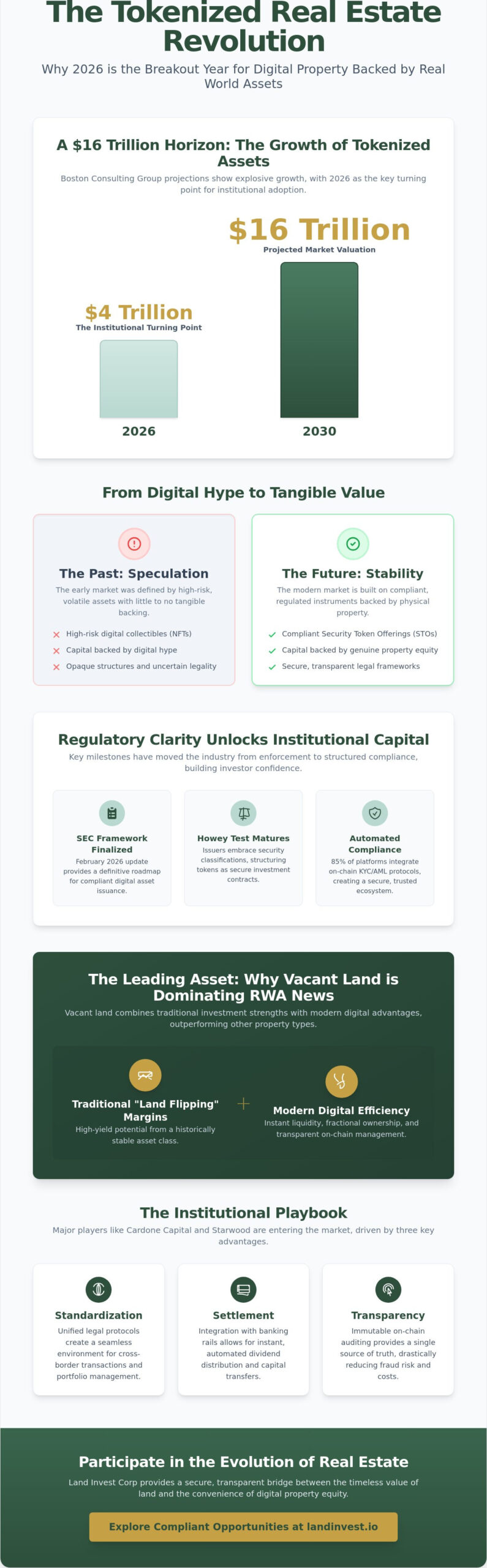
Boston Consulting Group projects that tokenized assets will reach a $16 trillion valuation by 2030, but the $4 trillion milestone expected in 2026 marks the true turning point for institutional adoption. Keeping up with tokenized real estate news often feels like a full-time job because of the constant stream of conflicting reports and complex regulatory shifts. You’re likely cautious about the crypto label and want to ensure your capital is backed by tangible value rather than digital hype.
We’ve analyzed the current landscape to provide a definitive guide on the trends, regulatory updates, and institutional moves defining this era. You’ll learn why agricultural land is currently outperforming residential property and how recent SEC guidelines have created a safer environment for compliant Security Token Offerings (STOs). This overview breaks down the most stable asset classes and clarifies the legal frameworks that protect your long-term interests in the digital property market. By the end of this article, you’ll have the clarity needed to distinguish between high-risk speculation and the steady growth of tokenized equity.
Key Takeaways
- Understand why 2026 marks the definitive shift for institutional capital as it moves from pilot projects to a projected $4 trillion permanent market.
- Stay ahead of the curve by analyzing the latest tokenized real estate news regarding SEC regulatory milestones and the modern application of the Howey Test.
- Discover why vacant land is emerging as the dominant RWA asset by combining traditional “land flipping” margins with modern digital efficiency.
- Learn how to filter market noise by evaluating whether a digital asset is backed by genuine property equity or a speculative promise.
- Explore how a compliant STO model provides a secure, transparent bridge between the timeless value of land and the convenience of digital property equity.
The Surge in Tokenized Real Estate News: Why 2026 is the Breakout Year
The landscape of property investment has undergone a tectonic shift. By 2026, the industry has moved past the experimental phase of digital collectibles. We’re seeing a disciplined migration toward regulated financial instruments that offer tangible security. This evolution is why tokenized real estate news now focuses on stability rather than short-term speculation. Institutional capital is no longer testing the waters through isolated pilots. Large-scale deployment is the new standard for global portfolios. This transition turns traditional “bricks and mortar” into “digital gold,” providing a level of liquidity that was previously impossible in the property market.
Investors tracking tokenized real estate news will notice that the narrative has shifted from “if” to “how fast.” The move from pilot programs to permanent infrastructure is driven by the need for transparency and efficiency. Large institutions don’t want the friction of 30-day closing periods or opaque fee structures. They’re choosing on-chain solutions because the math works better. The shift from speculative NFTs to compliant Real World Assets (RWA) means that every digital token is backed by a legal claim to physical land or buildings. It’s a modern approach to a conservative asset class, blending the reliability of the earth with the speed of the internet.
The $4 Trillion Milestone: Analyzing the Projections
Deloitte and Forbes reports suggest the market for tokenized assets will reach $4 trillion by 2035. While that date seems distant, 2026 is the pivotal year where the growth curve turns vertical. It’s the moment when the necessary regulatory frameworks, such as MiCA in Europe, have fully integrated with global banking systems. The tokenization of real-world assets serves as the bridge between physical land and digital liquidity. This bridge allows investors to move capital with the precision of a stock trade while maintaining the security of a physical asset.
Major Players Making Headlines: From Cardone to Starwood
Market leaders are driving this momentum. Cardone Capital made waves with its $5 billion tokenization announcement, proving that massive portfolios can be managed on-chain without sacrificing security. Starwood Capital is also active, applying pressure on regulators to lower barriers for retail participants. These moves create a ripple effect across the industry. When firms managing billions of dollars commit to these protocols, retail investor confidence follows. It validates the technology as a reliable tool for long-term wealth preservation. Key drivers for this institutional entry include:
- Standardization: Unified legal protocols for cross-border transactions.
- Settlement: Integration of banking rails for instant dividend distribution.
- Transparency: Immutable on-chain auditing that reduces fraud risk.
Regulatory Milestones and Institutional Adoption Headlines
Regulatory clarity remains the primary catalyst behind the positive tokenized real estate news we see in 2026. The SEC finalized its updated Digital Asset Securities Framework in February 2026, providing a definitive roadmap for issuers. This shift moved the industry away from the era of enforcement and toward a period of structured compliance. Institutional investors, who previously stayed on the sidelines, now view the market with a sense of professional confidence.
The application of the Howey Test has matured. By 2026, most issuers don’t try to bypass security classifications. Instead, they embrace them. Modern real estate tokens are structured as digital investment contracts that represent fractional ownership in specific, tangible assets. This legal alignment ensures that every token holder has the same protections as a traditional shareholder. It’s this transition from “wild west” experimentation to rigorous legal adherence that has allowed the market to approach the $4 trillion valuation mark.
Security is now automated through verified investor pools. By mid-2026, 85% of institutional platforms integrated on-chain identity protocols. These systems handle KYC (Know Your Customer) and AML (Anti-Money Laundering) compliance instantly. This technology ensures that only whitelisted, eligible participants can trade assets. It creates a closed-loop ecosystem where trust is built into the code, not just the paperwork. Understanding these shifts helps investors find stable asset-backed opportunities that prioritize long-term security and predictability.
The Shift Toward Compliant Security Tokens
The distinction between utility tokens and equity-based security tokens is now absolute. Utility tokens, which often lacked underlying value, have been replaced by compliant securities that represent a direct legal claim on property. Smart contracts now automate legal disclosures and dividend distributions. This automation reduces administrative costs by 22% compared to 2024 benchmarks. Most issuers utilize Delaware corporations to provide a familiar legal backing, ensuring that digital assets are recognized by traditional courts and bankruptcy laws.
Global Standards for Digital Property
International markets are rapidly adopting US-led tokenization frameworks to create a unified global liquidity pool. In 2026, cross-border real estate transactions using blockchain increased by 40%. This growth is driven by the transparency of “trust-less” ledgers, which are replacing traditional escrow services. These ledgers provide an immutable record of ownership, effectively eliminating title fraud. Because the blockchain acts as a single source of truth, the time required for title searches and transfers has dropped from weeks to minutes, providing the stability that conservative investors demand.
The Shift Toward Land: Why Vacant Land is Dominating 2026 RWA News
By the second quarter of 2026, the landscape of digital assets has matured significantly. Investors no longer chase the high-maintenance yields of residential rentals with the same fervor seen in previous years. Instead, they’ve turned their focus toward the foundational asset: vacant land. This pivot is the most consistent headline in tokenized real estate news throughout the current fiscal year. While apartments require constant repairs, insurance, and tenant management, land remains a quiet, appreciating asset that doesn’t require a property manager to handle middle-of-the-night emergencies.
The “Land Flipping” 2.0 trend has redefined how capital moves through the blockchain. By stripping away physical structures, developers and investors move assets at unprecedented speeds. Traditional land deals used to take 60 to 90 days to close; in 2026, smart contracts finalize these transfers in less than five minutes. This efficiency allows for a high-margin resale model that combines the ancient stability of the earth with the modern velocity of the digital age. It’s a cleaner model that avoids the “tenant and toilet” risks that have plagued residential RWA platforms since their inception.
Land vs. Residential: The 2026 Performance Gap
Data from the first half of 2026 reveals a widening gap between these asset classes. Residential RWA portfolios often struggle with overhead costs that consume 20% to 35% of gross revenue. In contrast, vacant land portfolios typically see overhead stay below 5%. This financial clarity is why fractional land ownership has become the preferred passive income play for conservative portfolios. High-margin resale models are now outperforming rental yields in 70% of major metropolitan outskirts.
- Zero Maintenance: No structural depreciation, no pest control, and no utility management.
- Strategic Resale: Land acquired at wholesale rates is sold to developers as demand for housing inventory peaks in late 2026.
- Regulatory Simplicity: Land tokenization faces fewer zoning complexities compared to multi-family residential units.
The Quiet Growth of Land-Based RWAs
While flashy commercial projects often grab headlines, the steady growth of land-based Real World Assets (RWAs) provides the actual backbone for the $4 trillion market. Residential vacant land offers a unique hedge against the volatility seen in the 2026 housing market. Land doesn’t burn down; it isn’t subject to the same wear and tear as built environments. Current tokenized real estate news highlights how national land acquisition strategies help diversify digital portfolios across various geographic regions simultaneously, spreading risk across multiple jurisdictions.
Land Invest Corp has stayed at the forefront of this movement. By building a sophisticated vacant land marketplace, they’ve simplified the process of identifying high-potential parcels. Their platform bridges the gap between traditional land value and modern digital accessibility. This ensures that stability remains the primary goal for every participant, providing a calm harbor in a fast-moving financial world.
How to Filter and Act on Tokenized Property News Trends
Separating valuable insights from marketing hype requires a disciplined approach. When you scan tokenized real estate news, your first priority is the underlying legal framework. A legitimate offering isn’t a vague digital promise; it’s a regulated security. By 2026, the industry has shifted toward Security Token Offerings (STOs) that utilize Delaware Series LLCs or similar structures to ring-fence assets. If a headline doesn’t mention an SEC filing like Form D or Regulation A+, it’s likely noise.
Secondary market liquidity remains a critical metric for 2026 investors. You shouldn’t assume a token is liquid just because it’s on a blockchain. Evaluate these factors before acting on a trend:
- Exchange Listings: Is the token traded on a licensed Alternative Trading System (ATS)?
- Daily Volume: Does the platform show consistent trading activity, or is the order book empty?
- Lock-up Periods: Does the legal structure mandate a 12-month holding period under Rule 144?
Investor Due Diligence in the Digital Era
You should look for “Equity Ownership” rather than “Direct Deeds” when reviewing new offerings. Most jurisdictions still require paper-based land registries, so tokens usually represent shares in a Special Purpose Vehicle (SPV) that holds the title. It’s vital to check the track record of the land acquisition firm. A company with a decade of physical asset management experience is far more reliable than a tech startup with no real estate background. You can use real estate crowdfunding news to benchmark returns; if a tokenized project promises 25% while the broader market averages 8%, the risk profile is likely unsustainable.
The Red Flags of Tokenized Real Estate
The most dangerous warning sign is a lack of mandatory KYC (Know Your Customer) and AML (Anti-Money Laundering) procedures. If a platform allows you to invest significant capital without identity verification, it’s operating outside the law. This puts your entire investment at risk of regulatory seizure. Beware of “unbacked” tokens that claim to track real estate prices without owning the physical land or buildings. These are synthetic derivatives, not real-world assets. 2026 news should focus on transparency and audit trails. If a project can’t provide a real-time proof-of-reserve or a third-party audit of its holdings, it doesn’t meet the professional standards of a modern portfolio.
Build your portfolio on a foundation of tangible, professionally managed assets. Explore stable asset-backed opportunities today.
Participating in the Evolution: The Land Invest Corp Model
Land Invest Corp bridges the gap between traditional land flipping and the digital future. By applying the proven mechanics of property acquisition to a modern Security Token Offering (STO) framework, the firm provides a stable entry point for those following tokenized real estate news in 2026. This model doesn’t rely on speculative digital assets. Instead, it offers legal equity in a diversified national portfolio of US land, ensuring that every token is backed by a physical, finite resource.
Investors often struggle with the illiquidity of traditional land deals, which can lock up capital for years. Land Invest Corp solves this by fractionalizing ownership. This allows participants to hold a stake in a broad range of assets rather than being tied to a single plot. The strategy focuses on acquiring undervalued parcels and adding value through rezoning or infrastructure improvements, a method that has sustained wealth for generations but is now accessible through a digital interface.
A Compliant Gateway to US Land
The strength of the Land Invest Corp STO structure lies in its commitment to regulatory transparency. Unlike the unregulated “utility tokens” of previous eras, these security tokens represent actual shares in a company that owns physical property. This setup provides a powerful hedge against inflation. While fiat currencies may lose purchasing power, the value of land historically tracks with or exceeds the cost of living, providing a sanctuary for capital in volatile times.
Randy Goldberg’s expertise drives the firm’s acquisition strategy. With over 30 years of experience in real estate and debt restructuring, Goldberg identifies high-growth corridors across the United States before they reach peak market pricing. This professional oversight ensures that the portfolio isn’t just a collection of random plots, but a curated selection of assets chosen for their appreciation potential. The firm’s disciplined approach prioritizes capital preservation and long-term stability over short-term hype.
From Information to Action
Staying informed via tokenized real estate news is a vital first step, but the 2026 market rewards those who transition from observers to owners. You can begin by exploring how tokenized real estate functions within a diversified portfolio. The onboarding process is designed to be straightforward, emphasizing clarity and investor education at every stage.
The long-term outlook for Land Invest Corp token holders is built on the reality of scarcity. As the US population grows and urban centers expand, the demand for well-positioned land continues to rise. By joining the 2026 digital land revolution now, you’re securing a position in the $4 trillion RWA market through a platform that values professional integrity and technological innovation. It’s time to move beyond the headlines and build a foundation on the most reliable asset class in history.
Securing Your Position in the $4 Trillion RWA Evolution
The transition toward digital ownership represents a structural shift in global finance rather than a temporary trend. By 2026, the Real World Asset (RWA) market is projected to hit a $4 trillion valuation, fueled by institutional adoption and clear regulatory frameworks. Vacant land is becoming a preferred asset class because it offers a hedge against volatility while preserving long-term value. Staying updated with tokenized real estate news helps you identify these stable opportunities before they become mainstream. It’s about moving from speculation to a foundation built on transparency and law-abiding structures.
Land Invest Corp provides this stability through a Delaware-registered corporation led by real estate veteran Randy Goldberg. The platform operates as a fully compliant Security Token Offering (STO), bridging the gap between traditional land value and modern technological efficiency. This approach ensures your capital is backed by tangible assets within a secure, professional environment. It’s time to move beyond the noise and focus on proven investment principles enhanced by digital convenience.
Explore the Land Invest Corp STO and start your journey into tokenized real estate today
Building a resilient portfolio starts with a single, well-informed decision.
Frequently Asked Questions
What is the most important tokenized real estate news in 2026?
The most important tokenized real estate news in 2026 is the full implementation of the SEC’s updated Regulation A+ limits, which now allow for larger capital raises. This shift has enabled institutional players like BlackRock to move 500 billion dollars in physical assets onto the blockchain. These regulatory milestones provide the stability investors need for long-term planning and professional wealth management.
Is real estate tokenization legal in the United States?
Real estate tokenization is legal in the United States when issuers comply with SEC guidelines under Regulation D, Regulation A+, or Regulation S. Most platforms register these tokens as digital securities to ensure compliance with the Securities Act of 1933. By following these established frameworks, the industry moves away from speculative uncertainty toward a regulated, transparent financial environment that protects the investor’s capital.
How does tokenized land differ from a traditional REIT?
Tokenized land offers direct fractional ownership of a specific deed, whereas a traditional REIT involves buying shares in a company that manages a portfolio. Investors in tokenized assets often face lower management fees, which typically range from 1% to 2% annually, compared to the higher overhead of public REITs. This structure provides a more tangible connection to the underlying physical asset and its long-term value.
Can non-accredited investors participate in real estate tokenization news?
Non-accredited investors can participate in tokenized real estate news opportunities through offerings registered under Regulation A+. This specific framework allows individuals to invest in high-quality land assets with minimums as low as 100 dollars. It democratizes access to stable investments that were previously reserved for the wealthiest 3% of the population, allowing for broader portfolio diversification and inflation protection.
What happened to the $4 trillion RWA market projection?
The 4 trillion dollar RWA market projection is currently on track for 2030, according to reports from Citibank and Boston Consulting Group. By mid-2026, the market has already reached 1.2 trillion dollars in total value locked, driven by the migration of private credit and land assets onto decentralized ledgers. This growth reflects a fundamental shift toward more efficient, 24/7 liquidity in global property markets.
How do I know if a tokenized real estate news story is trustworthy?
You can verify if a story is trustworthy by checking for corresponding SEC EDGAR filings or verified on-chain transaction records. Reliable reports always cite specific property addresses and provide transparent data via blockchain explorers. It’s best to avoid sources that promise overnight wealth; instead, focus on platforms that emphasize long-term land value and documented legal structures that ensure safety.
What is the role of smart contracts in property news today?
Smart contracts automate the distribution of rental income and ensure compliance with secondary market trading rules without human intervention. In 2026, these self-executing codes handle 95% of administrative tasks, which reduces the risk of human error in ledger management. This technology bridges the gap between traditional land ownership and modern digital efficiency, providing a secure foundation for every transaction.
Why is vacant land becoming a major trend in tokenization?
Vacant land is a major trend because it’s a finite resource that acts as a hedge against the 3.4% average annual inflation seen in recent years. Unlike developed property, raw land has zero maintenance costs and no depreciation of structures. Tokenization makes this traditionally illiquid asset class accessible to a broader range of investors who prioritize stability and the preservation of generational wealth.