
The traditional path to property ownership is no longer the only route to financial security, and for many, it’s no longer the smartest one either. You’ve likely felt the weight of a market where entry prices have climbed 4.8% in the past year alone, making solo investment feel like an impossible hurdle. It’s natural to hesitate when faced with the prospect of a thirty year mortgage or the potential legal complications of buying with a partner. This guide shows you how a co ownership home structure can bridge the gap between your current capital and the stability of real estate.
We’ll help you discover the legal frameworks and financial benefits of modern property sharing so you can build equity with total confidence. You’ll learn the critical differences between traditional joint tenancy and the rise of tokenized equity models that are reshaping the market in 2026. By the end of this article, you’ll have a clear roadmap to lower entry points and passive appreciation without the typical landlord headaches. We’ll break down how to protect your stake legally while ensuring your investment remains as liquid and transparent as possible.
Key Takeaways
- Understand the 2026 shift from traditional family buying to network-based property acquisition to significantly increase your market purchasing power.
- Compare the high-control management of direct deeds against the high-liquidity and institutional security benefits of tokenized fractional equity.
- Learn how to navigate the legal complexities of a co ownership home agreement, including essential clauses like the “Right of First Refusal.”
- Identify the critical financial and legal steps needed to split ownership and maintenance costs fairly and transparently among all stakeholders.
- Explore how modern STO models offer portfolio diversification and professional management without the traditional burdens of individual property deeds.
What is Co-Ownership of a Home? Understanding the 2026 Landscape
Co-ownership of a home occurs when two or more parties hold legal title and equity in a single property asset. While this was once primarily the domain of married couples, the 2026 real estate market shows a significant shift toward “network buying.” This model involves friends, extended family, or even unrelated investors pooling capital to secure a property. It’s a pragmatic response to a decade of rising costs. By early 2026, non-spousal co ownership home transactions increased by 18% compared to five years prior, reflecting a new standard in property acquisition.
Economic conditions have accelerated this transition. Interest rates stayed above 6.5% throughout much of 2025, and housing inventory in urban centers dropped by 14% year-over-year. These factors created a barrier that few solo buyers could overcome. People now view property not just as a shelter, but as a divisible financial asset. This requires a clear distinction between physical occupancy rights and financial equity rights. Some owners may live in the property, while others participate solely as equity partners, seeking long-term capital preservation and inflation protection.
Common Legal Structures for Co-Buying
The legal foundation of any co ownership home agreement determines how risk and reward are distributed. Most arrangements fall under a Concurrent estate framework, which defines the rights of each party. Tenancy in Common (TIC) is the most flexible option, as it allows for unequal ownership percentages. One partner might own 70% while another owns 30%, and each has the individual right to sell their share.
- Joint Tenancy: This structure requires equal shares and usually includes the right of survivorship, meaning if one owner passes away, their share automatically transfers to the others.
- LLC-Based Co-ownership: Many modern buyers choose to form a Limited Liability Company to hold the title. This adds a layer of protection, shielding personal assets from property-related liabilities and making the transfer of shares much simpler.
Why Co-Ownership is Trending
Technological enablers have removed the friction that used to plague these deals. Specialized platforms now handle split-payments for mortgages, automated legal drafting, and maintenance scheduling. These tools provide the transparency and predictability that Landinvest values. They ensure that every participant’s contribution is tracked with precision, turning a complex social arrangement into a stable, managed investment. This methodical approach builds the trust necessary for long-term wealth creation in a volatile market.
The Pros and Cons of Shared Property Ownership
Financial leverage is the primary driver here. When three partners combine their resources, they can often afford a property in a location with higher historical appreciation rates. This collective approach also extends to ongoing costs. Splitting property taxes, homeowner association fees, and emergency maintenance repairs reduces the monthly financial pressure on each individual. It’s a method that prioritizes capital preservation and steady equity building over high-interest debt.
The Financial Advantages
- Reduced Entry Barriers: Partners split the initial 20% down payment and the 2% to 5% closing costs, making market entry possible years earlier than solo buying.
- Risk Diversification: Investors can choose to own smaller stakes in multiple locations. Understanding the benefits of fractional ownership helps in building a portfolio that isn’t tied to the economic health of a single neighborhood.
The Management and Legal Hurdles
Legal remedies like “partition actions” exist to resolve disputes, but they’re often slow and expensive. These court-ordered sales can result in a lower price than a standard market listing. To avoid this, a comprehensive co ownership home agreement is essential. This document must outline buyout clauses, exit strategies, and maintenance schedules. For those seeking a more hands-off approach to property, exploring digitally managed equity options can provide the same exposure with less personal friction. Clear documentation isn’t just a safety net; it’s the foundation of a professional investment relationship.
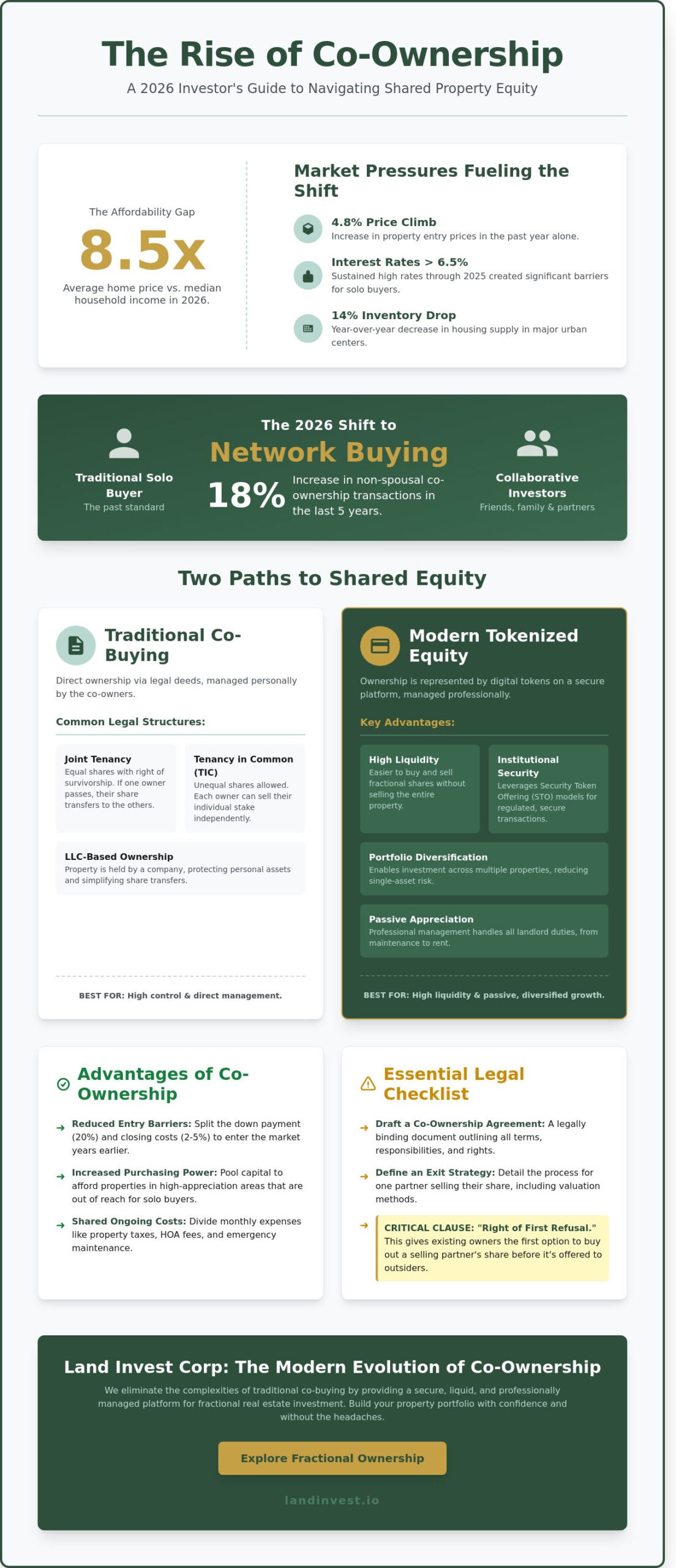
Traditional Co-Buying vs. Tokenized Fractional Equity
The choice between physical property sharing and digital participation represents a fundamental shift in how we approach a co ownership home. Traditional methods require significant upfront capital and a high degree of personal involvement. In contrast, tokenization leverages blockchain technology to lower entry barriers and automate the administrative burdens that often derail private partnerships.
Direct Co-Buying with Friends or Family
Direct Co-Buying is a high-touch commitment requiring deep legal vetting and a shared long-term vision for the property. This model remains the preferred choice for individuals who intend to reside in the home or maintain a vacation property within a trusted social circle. It relies heavily on joint ownership structures where each party holds a deeded interest in the physical asset.
The financial barrier here is substantial. Most traditional lenders require a 20% down payment to avoid private mortgage insurance. On a $300,000 property, this means a $60,000 initial investment plus closing costs. Beyond the capital, the primary challenge is the “human element.” Managing daily operations, utility bills, and differing exit timelines requires constant communication and robust legal agreements to prevent disputes.
The Tokenized Alternative: RWA Equity
For those seeking a passive approach, tokenized real estate offers a streamlined path. This model converts the equity of a property into digital tokens on a blockchain, removing the need for interpersonal trust between participants. Instead of relying on a friend’s ability to pay their share, you rely on smart contracts and institutional-grade security. If you’re new to this concept, understanding what is fractional ownership and how shared equity structures work is an essential first step before committing capital.
- Lower Entry Costs: While traditional co-buying starts at $50,000 or more, tokenized platforms often allow participation starting at $1,000.
- Institutional Management: The platform acts as the asset manager, handling all regulatory compliance and property oversight.
- Liquidity: Digital equity can often be traded on secondary markets, providing an exit strategy that doesn’t require selling the entire physical house.
This digital version of a co ownership home is built for diversification. It allows a single investor to spread $50,000 across fifty different properties rather than tying all their capital to one roof.
Addressing the Management Gap
The most practical difference between these models appears when maintenance is required. In a direct co-buying scenario, if the roof leaks, the owners must manually source contractors, agree on costs, and oversee the repair. This often leads to friction if one partner lacks immediate liquidity.
Tokenized models bridge this “management gap” by professionalizing the process. The platform maintains a reserve fund for repairs and employs professional property managers. Investors don’t receive a call when a pipe bursts; they simply see the impact reflected in the transparent financial reporting of the asset. This structural stability makes tokenization the superior choice for those prioritizing capital preservation and steady growth over physical occupancy.
Essential Checklist for Starting a Co-Ownership Agreement
Stability in a co ownership home arrangement depends on a clear, legally binding framework that prioritizes transparency over assumptions. Professional investors view the Co-Ownership Agreement (COA) as the property’s constitution. It must define the ownership split based on initial capital and ongoing contributions. If one partner provides 60% of the down payment but only 40% of the monthly mortgage, the equity calculation needs a precise formula to avoid future disputes. Clear rules prevent friction and protect the underlying asset value.
- Right of First Refusal: This clause ensures that if one party decides to sell their share, the existing partners have the legal right to purchase it before it’s offered to external buyers. It protects the group from unwanted third-party entries and maintains the integrity of the partnership.
- CapEx Voting Process: Major capital expenditures, such as a $15,000 roof replacement or modernizing heating systems, require a predefined voting threshold. Usually, a 75% majority is the benchmark for structural changes, while routine maintenance might only need a simple 51% consensus.
- Liquidation Triggers: You need a clear exit strategy from day one. Define specific dates or market conditions that allow a partner to trigger a sale or a buy-out. A 90-day notice period is the industry standard for initiating these transitions, providing enough time for valuation and financing.
Financial Due Diligence
Legal Safeguards
Land Invest Corp: The Modern Evolution of Co-Ownership
Traditional investment models often tie your capital to a single property. If the roof leaks or a tenant stops paying, your yield drops immediately. Land Invest Corp changes this dynamic by moving beyond the single-asset risk of a traditional co ownership home. Instead of relying on one structure, you’re securing equity in a nationwide land portfolio. This diversification acts as a protective shield; if one local market slows, the thousands of other parcels in the portfolio maintain the collective balance.
Our Security Token Offering (STO) model provides compliant equity without the deed-management headache. You won’t spend weeks signing stacks of paper at a local registrar’s office. We’ve digitized the legal framework to ensure your ownership is recorded accurately and securely on the blockchain. This approach offers the stability of residential vacant land, which historically avoids the volatility seen in the rental market. Land is a finite resource that doesn’t require repairs or property managers, making it an ideal foundation for long-term wealth.
Fractional Equity in a Diversified Portfolio
Investing in fractional real estate is significantly safer when your shares are backed by a massive pool of assets rather than a single house. We utilize professional acquisition and resale strategies that outpace DIY co-buying efforts. Our team analyzes thousands of data points to identify undervalued land before it hits the open market. By merging the centuries-old security of land ownership with the efficiency of blockchain technology, Land Invest Corp bridges the gap between traditional land flipping and digital finance.
- Risk Mitigation: Spreading capital across multiple states reduces the impact of local economic shifts.
- Professional Management: We handle the taxes, zoning checks, and sales negotiations so you don’t have to.
- Asset Stability: Vacant land doesn’t depreciate due to wear and tear or outdated interior design.
Getting Started with Passive Co-Ownership
Tokenization is the ultimate hands-off co ownership home solution for 2026. It removes the social and legal friction often found when friends or family buy property together. The process is streamlined to prioritize your time and security. You aren’t just buying a “piece” of a house; you’re participating in a sophisticated investment vehicle designed for the modern era.
The journey begins with a simple onboarding process through our secure portal. Once verified, you can participate in the STO and immediately see your holdings reflected in your account. You can track your equity and portfolio performance via the digital dashboard, which provides 24/7 transparency into every parcel we hold. This level of insight is rarely available in traditional real estate deals.
Secure Your Financial Future through Strategic Equity
The real estate market in 2026 demands a shift from traditional, rigid structures to more flexible ownership models. Choosing a co ownership home strategy allows you to distribute risk while maintaining a stake in tangible assets. You’ve seen how tokenized equity offers liquidity that traditional joint tenancy lacks. This evolution isn’t just about technology; it’s about making stable land investments accessible through clear legal frameworks. Success depends on choosing partners who prioritize transparency over market noise.
Land Invest Corp stands as a Delaware Registered Corporation, providing a secure foundation for your capital. By utilizing a Compliant Security Token Offering (STO), the platform ensures every transaction meets rigorous regulatory standards. You aren’t just buying a digital asset; you’re gaining exposure to a Strategic Nationwide Land Portfolio managed with professional precision. This methodical approach to diversification helps protect your wealth against volatility while building a lasting legacy.
Join the future of property equity; invest in Land Invest Corp today
Take the next step toward a balanced and secure portfolio today.
Frequently Asked Questions
Is co-ownership of a home a good idea for first-time buyers?
Co-ownership is a practical path for first-time buyers to enter the market with lower capital requirements. A 2023 report from the National Association of Realtors found that 11% of buyers co-purchased with a friend or relative. It’s a way to build equity faster than renting. You’ll share the burden of the 20% down payment and monthly maintenance costs.
What is the difference between co-ownership and a timeshare?
The primary difference is that a co ownership home gives you actual equity and title, while a timeshare usually only grants usage rights. The American Resort Development Association (ARDA) reported in 2024 that timeshare owners don’t hold the same transferable property rights as co-owners. Co-ownership allows you to benefit from the property’s appreciation over time. It’s an investment, not just a vacation prepay.
Can I get a mortgage for a co-owned property?
How do taxes work when you co-own a home with someone else?
Co-owners pay taxes proportional to their ownership percentage listed on the property deed. IRS Publication 936 confirms that each individual can deduct their specific share of mortgage interest on their tax returns. This prevents confusion and ensures everyone gets their fair share of tax benefits. It’s a transparent process that mirrors traditional homeownership rules.
What happens if a co-owner wants to sell their share but I do not?
A pre-signed Co-ownership Agreement typically outlines the process for one party to exit. The Uniform Partition of Heirs Property Act, adopted in 21 states by 2022, provides a right of first refusal to the remaining owners. This means you have the first chance to buy the departing owner’s share. It protects the stability of the investment and prevents unexpected sales to third parties.
Is tokenized co-ownership legally recognized in the United States?
Tokenized co-ownership is legally valid when it’s structured through an LLC registered in states like Delaware or Wyoming. These digital tokens represent membership interests in the company that owns the deed. The 2026 update to the Uniform Commercial Code (UCC) Article 12 provides a robust framework for these assets. It’s a regulated way to trade property shares on a digital ledger.
What are the risks of co-owning land versus a residential house?
How does Land Invest Corp handle the management of co-owned assets?
Land Invest Corp manages assets by serving as the professional administrator for the holding LLC that owns the property. They oversee all legal compliance, tax filings, and physical maintenance tasks. This structure ensures a professional co ownership home experience where individual owners don’t have to worry about daily operations. It’s a hands-off approach designed to provide stability and long-term growth for every investor.