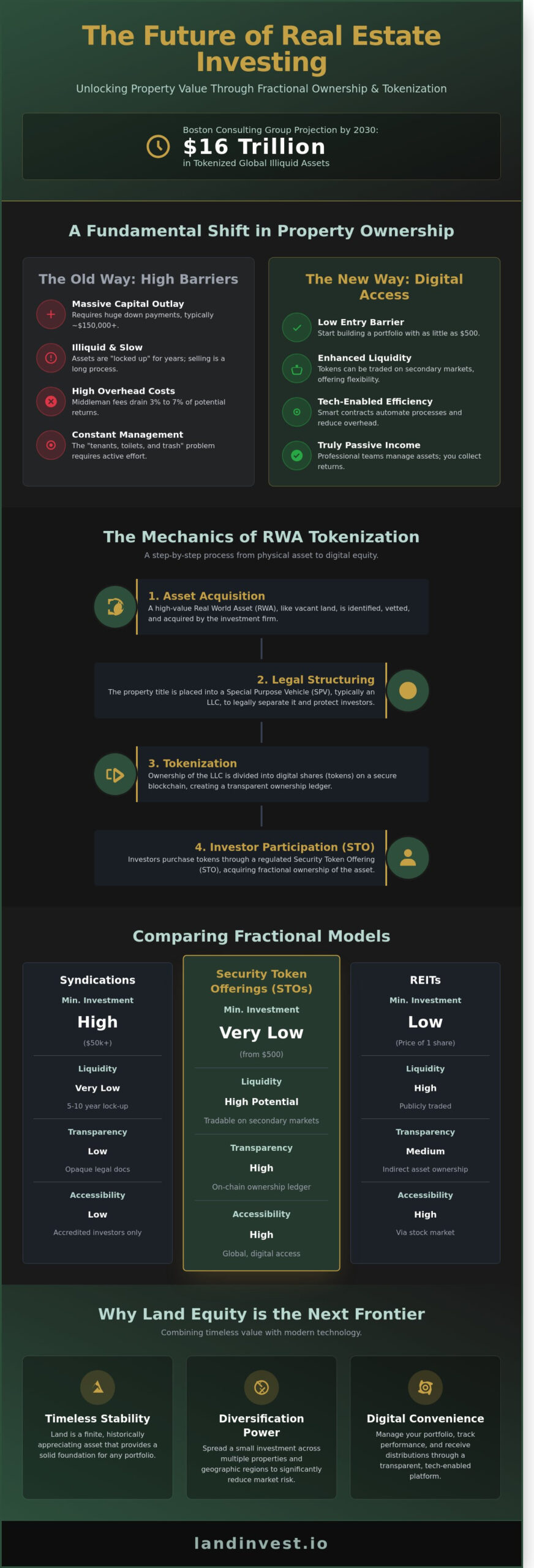
Did you know that the Boston Consulting Group projects the tokenization of global illiquid assets will reach a $16 trillion valuation by 2030? This shift means the era of needing massive down payments is finally ending, as fractional real estate investing bridges the gap between traditional land value and modern digital accessibility. You’ve likely felt the frustration of watching property prices climb while your savings struggle to keep pace. Traditional property ownership has become a high-barrier game that often demands constant management and offers very little liquidity in a fast-moving economy.
We agree that real estate should be an accessible foundation for long-term stability, not a source of management stress or financial exclusion. This guide will show you how to build a diversified portfolio with minimal capital through the power of RWA tokenization. You’ll discover how to secure passive income and equity growth through a transparent, tech-enabled investment process. We’ll examine the mechanics of digital equity and the specific steps you can take to participate in this evolving market with confidence and professional oversight.
Key Takeaways
- Understand the evolution of property ownership as digital-first platforms and tokenization lower the entry barriers for high-value assets.
- Learn how to build a diversified portfolio with minimal capital by utilizing fractional real estate investing through secure legal structures and blockchain-backed ownership.
- Compare the liquidity and cost efficiency of modern Security Token Offerings (STOs) against traditional REITs to optimize your capital allocation.
- Master a professional framework for evaluating management track records and underlying asset values to ensure long-term stability and transparency.
- Discover why land equity represents a unique opportunity to combine the timeless stability of vacant land with the modern convenience of digital equity.
What is Fractional Real Estate Investing in 2026?
Fractional real estate investing has transformed from a niche financial experiment into a cornerstone of the modern retail portfolio. It functions by lowering the capital barrier for high-value assets, allowing individuals to purchase specific percentages of a property rather than the entire deed. This shift reflects a broader movement in global finance where 2026 is recognized as the “year of the RWA” (Real World Asset). Institutional adoption of on-chain assets has stabilized the market; it provides the transparency and liquidity that retail investors previously lacked in traditional private equity circles.
Understanding the fundamental mechanics is essential for any serious investor. For those asking What is Fractional Ownership, it’s a method where several unrelated parties share the risks and rewards of a tangible asset. In the 2026 market, fractional real estate serves as a hedge against currency volatility. It provides a stable anchor for a diversified portfolio, moving away from the high-entry costs of traditional syndications toward digital-first platforms that offer real-time tracking and lower overhead for the end user.
The Evolution of the Fractional Model
The journey began with Real Estate Investment Trusts (REITs), which offered exposure but often lacked transparency and direct asset control. Technology has since removed the middleman costs that once drained 3% to 7% of potential returns in traditional investing. Regulatory clarity from the SEC has been a catalyst; specific frameworks established between 2023 and 2025 have solidified investor confidence. This evolution means investors now hold direct property shares rather than just shares in a management company, ensuring a closer link between the asset’s performance and the investor’s wallet.
Key Benefits for the Modern Investor
- Accessibility: You can begin building a portfolio with $500 instead of the $150,000 typically required for a down payment on a single-family home.
- Diversification: An investor can spread $10,000 across twenty different properties in five different geographic regions, significantly reducing localized market risk.
- Passive Management: The model solves the “tenants, toilets, and trash” problem. Professional management teams handle all daily operations, making the income truly passive for the shareholder.
The Mechanics: How Fractional Ownership and Tokenization Work
The foundation of fractional real estate investing isn’t just code; it’s a robust legal framework. Most platforms use a Special Purpose Vehicle (SPV), typically organized as a Limited Liability Company (LLC). This entity holds the actual title to the property. When you invest, you aren’t buying a physical brick or a patch of soil directly. Instead, you’re purchasing a share of that LLC. This structure isolates the asset from the platform’s operational risks, providing a layer of security that traditional direct ownership often lacks for smaller investors.
Blockchain technology acts as the digital ledger for these shares. It tracks ownership and automates the distribution of returns through smart contracts. This transparency is a major shift from the opaque systems of the past. For a deeper dive into the technical side, you can explore this tokenized real estate guide to see how digital equity is changing property markets. Because these shares are represented by tokens, they can eventually be traded on secondary markets. This provides liquidity in an asset class that has historically been “locked up” for years.
The process usually begins with a Security Token Offering (STO). This is a regulated event where the platform issues tokens to investors. According to a Fractional Real Estate Investing Guide from Forbes, this model allows investors to bypass the high capital requirements of traditional acquisitions while maintaining a clear legal claim to the underlying asset’s value.
Understanding RWA Tokenization
Real World Assets (RWAs) are tangible assets like land or buildings brought onto the blockchain. The mapping of physical land value to a digital security token creates a permanent, unchangeable record. This digital “twin” of the property ensures that every fraction is accounted for. Investors can audit the on-chain ledger at any time, verifying the total supply of tokens against the property’s valuation. By 2024, the RWA sector has seen a surge in institutional interest because it combines the stability of hard assets with the efficiency of modern finance.
Security Token Offerings (STO) vs. Traditional Investing
STOs are the compliant evolution of digital finance. Unlike the speculative “utility tokens” seen in 2017, STOs are backed by real assets and fall under strict regulatory oversight. Investor protections are hard-coded into the smart contract level. This means rules regarding dividend payouts or voting rights are executed automatically without human interference. Security is further enhanced through mandatory protocols:
- KYC (Know Your Customer): Every investor’s identity is verified to prevent fraud.
- AML (Anti-Money Laundering): Systems monitor transactions to ensure capital comes from legitimate sources.
- Automated Compliance: Smart contracts can restrict token transfers to only verified participants.
This methodical approach turns fractional real estate investing into a predictable, professional endeavor. If you’re looking for a way to build a resilient portfolio, diversifying into stable land assets through a transparent platform is a logical next step for the modern retail investor.
Comparing Fractional Models: Syndications vs. REITs vs. STOs
Choosing the right vehicle for fractional real estate investing requires a clear understanding of how different structures impact your capital. Investors often face a choice between traditional structures and modern digital solutions. While public REITs offer high liquidity, they often correlate closely with broader equity markets. During the 2022 market downturn, many REITs saw double-digit price drops despite the underlying property values remaining stable. This highlights the difference between owning a stock and owning an asset. According to this Forbes guide to fractional real estate investing, understanding these structural nuances is critical for effective risk management.
Transparency remains a primary dividing line between legacy funds and digital platforms. Traditional syndications often include costs like acquisition fees, disposition fees, and asset management charges that can total 5% or more of the capital raised. Digital platforms usually consolidate these into a single, transparent service fee. Tax treatment also varies; REIT dividends are often taxed as ordinary income, whereas direct ownership models may allow for depreciation pass-throughs, reducing the taxable burden on your annual returns.
- Liquidity: REITs are liquid; Syndications and STOs typically require a 3 to 7 year commitment.
- Ownership: REITs offer a basket of assets; Syndications and STOs focus on specific properties.
- Fees: Digital platforms offer real-time fee tracking; traditional funds rely on quarterly reports.
REITs vs. Fractional Platforms
Publicly traded REITs provide a convenient entry point but lack granular control. You’re buying into a diversified pool managed by a third party. Modern investors increasingly prefer fractional platforms because they allow for the selection of specific assets. This direct exposure ensures that your capital performs based on the actual rental yield or appreciation of a chosen property, rather than the sentiment of the stock market. It’s a shift from passive speculation to active portfolio building.
Direct Deed Shares vs. Equity Tokens
Managing a single property deed with 200 or 500 individual names is a legal and administrative nightmare. It slows down transactions and increases costs for everyone involved. Equity tokens solve this by representing ownership in a Special Purpose Vehicle (SPV) that holds the title. This digital layer simplifies the transfer of interests. For instance, fractional land ownership frequently utilizes the equity model to maintain efficiency. It ensures that the underlying asset remains secure while the investment remains agile. This shift toward tokenization reduces the time required for secondary market transfers from weeks to mere minutes.
Evaluating Fractional Opportunities: A Due Diligence Framework
Success in fractional real estate investing depends more on the quality of the underlying asset than the interface of the investment platform. While a smooth digital experience is convenient, the physical property generates the actual yield. Investors must look past the dashboard to analyze the location, usage rights, and local economic drivers of the specific plot or building. If the platform itself faces operational challenges, the legal claim to a high-quality asset remains your primary safeguard.
Liquidity remains a critical factor for retail participants. Unlike public stocks, real estate is inherently illiquid. You must understand the exit strategy before committing capital. Does the platform offer a secondary marketplace? Is there a mandatory holding period, such as a 5-year lock-up? Understanding these timelines ensures your investment aligns with your personal financial goals.
Red Flags in Fractional Platforms
High management fees represent a significant risk to long-term wealth. If a platform charges more than 2% in annual administrative fees, it significantly erodes the compounding effect of your returns. Lack of clarity regarding legal structures is another warning sign. Every investment should be backed by a clear legal entity, such as a Special Purpose Vehicle (SPV), which isolates the asset from the platform’s own liabilities. Finally, be skeptical of “guaranteed” returns. Real estate markets fluctuate. Any provider promising fixed, high double-digit returns without mentioning market risk is likely prioritizing marketing over financial reality.
Checking the Asset Quality
Smart investors stay informed by reviewing the vacant land marketplace to identify broader shifts in land value and demand. Verification is essential. You can often confirm ownership through public land registries or third-party title reports. In the context of digital assets, third-party audits play a vital role. These audits ensure that the number of digital tokens issued exactly matches the value of the physical asset held in trust. This verification process bridges the gap between traditional property law and modern fractional real estate investing.
Why Land Equity is the Next Frontier for Fractional Investors
While many retail participants focus on the residential rental market, vacant land represents a different kind of opportunity. Rental properties often come with management headaches like maintenance, tenant turnover, and rising insurance costs. While you can discover Airlift Concrete Experts to understand the professional structural maintenance required for developed assets, land flipping focuses on raw appreciation and development potential. According to data from the 2023 Land Report, land values in several US regions have shown consistent growth, making it a stable foundation for fractional real estate investing. Land Invest Corp targets residential vacant land at high-margin entry points, often acquiring properties significantly below market value to ensure a buffer for growth.
The Land Invest Corp Model Explained
Land Invest Corp uses a Security Token Offering (STO) to modernize how people hold land assets. Instead of buying a single plot, you hold equity in the firm’s entire national portfolio. These digital tokens are compliant financial instruments. They represent a stake in a diversified operation that flips land across multiple US states. This approach eliminates the risk of being tied to one specific location. It’s a high-margin business model. By participating in the firm’s operations rather than just collecting rent, you benefit from the scalability of a professional team that processes hundreds of transactions. The model focuses on speed and volume, which can outperform the slow yields of traditional rentals.
Building Long-Term Wealth with Land Equity
Land is a finite resource. It doesn’t depreciate or require constant repairs. This makes it an ideal asset for those seeking stability in a volatile market. By using fractional real estate investing, individuals access wealth-building strategies once reserved for institutional buyers. Land Invest Corp bridges the gap between traditional land ownership and modern digital convenience. It’s a way to secure a future through the earth’s most foundational asset.
- Diversification: Your investment spreads across a national portfolio of residential land rather than a single property.
- Transparency: Digital tokens provide a clear, immutable record of your equity stake in the company.
- Accessibility: The platform removes the high capital barriers typically associated with land acquisition and development.
To get started, you can register on the Land Invest Corp platform and review the current portfolio data. The process is designed to be straightforward. Once you’ve completed the necessary verification steps, you can allocate capital to the STO and track your equity growth through a secure digital dashboard. It’s about combining the wisdom of the past with the tools of the future. This methodical approach ensures that your portfolio is built on tangible assets with a clear path to value realization.
Securing Your Position in the 2026 Digital Land Rush
The landscape of wealth creation has shifted from exclusive boardrooms to accessible digital platforms. By 2026, tokenization is projected to become a $16 trillion industry according to Boston Consulting Group reports. This evolution makes fractional real estate investing a practical reality for those seeking to diversify beyond volatile equities. You’ve seen how the shift from traditional REITs to Security Token Offerings (STOs) provides direct, transparent ownership of tangible assets. High-margin US residential vacant land remains a standout category because it lacks the maintenance burdens of developed property while benefiting from the 4.3 million unit housing shortage identified by Fannie Mae.
Land Invest Corp bridges the gap between ancient land values and modern blockchain efficiency. Their framework utilizes a compliant STO structure to ensure every digital share represents a legally binding interest in real world assets (RWA). It’s a method designed for stability, focusing on the intrinsic value of American soil rather than speculative hype. Through modern RWA tokenization, the platform provides a clear window into asset performance and ownership records. For investors seeking alternatives to traditional single ownership, exploring co ownership home structures can provide additional pathways to property equity through shared investment models.
If you’re still asking what is fractional ownership and how shared equity structures can lower the entry barrier to premium real estate, a dedicated guide to modern fractional models can help clarify the legal frameworks and asset classes best suited to your investment goals.
Explore Fractional Land Equity Opportunities with Land Invest Corp
Taking the first step toward a resilient portfolio starts with choosing assets that endure. You’re now equipped to navigate this digital frontier with confidence and professional foresight.
Frequently Asked Questions
Is fractional real estate investing legal in the United States?
Yes, fractional real estate investing is legal in the United States under strict SEC regulations. The JOBS Act of 2012 paved the way for retail participation through Regulation A+ and Regulation D frameworks. These legal structures require platforms to maintain high standards of transparency and reporting. It’s a secure, regulated method for individuals to own a portion of high value assets without traditional barriers.
What is the minimum investment for fractional real estate?
Minimum investments for these assets typically range from $10 to $1,000 depending on the chosen platform’s requirements. Some providers allow entries at $100 to ensure the market remains accessible to everyone. This low entry point lets you spread $5,000 across 50 different properties to manage risk. It’s a calculated way to build a diversified portfolio without needing the massive capital required for traditional ownership.
How do I earn money from a fractional real estate investment?
You earn money through fractional real estate investing via quarterly rental distributions and long term capital appreciation. If a property yields a 5% annual return from tenants, you receive your proportional share of that income. When the property is eventually sold after a 5 or 7 year period, you profit from the increase in market value. This combination provides both immediate cash flow and future growth.
Can I sell my fractional shares or tokens whenever I want?
No, you generally can’t sell your shares whenever you want since real estate is an inherently illiquid asset. Most platforms suggest a holding period of 5 to 10 years to maximize the property’s value. While a few companies offer secondary markets, these aren’t as liquid as public stock exchanges. You should treat these investments as stable, long term commitments rather than short term trades.
What happens if the fractional platform goes out of business?
Your capital is protected because properties are usually held in a separate Limited Liability Company (LLC) known as a Special Purpose Vehicle. This bankruptcy remote structure ensures the asset remains independent of the platform’s own finances. If the platform goes out of business, the property belongs to the shareholders, not the company’s creditors. A new manager would simply be appointed to oversee the investment’s completion.
Do I need to be an accredited investor to participate in fractional real estate?
You don’t need to be an accredited investor to participate in the majority of fractional offerings available today. SEC Regulation A+ allows platforms to accept capital from any retail investor regardless of their income level. While some exclusive Regulation D offerings still require a $200,000 annual income, most modern platforms are designed for the general public. This shift has opened institutional markets to millions of new participants.
How is fractional real estate taxed for individual investors?
Investors are taxed on their share of rental income and capital gains, usually reported via a Schedule K-1 or 1099-DIV form. Rental profits are generally treated as passive income, which may be offset by your portion of the property’s depreciation. If you hold the investment for over 12 months, the final sale profits are typically taxed at long term capital gains rates. These rules vary based on your specific tax bracket.
Is fractional real estate a good hedge against inflation?
Real estate acts as a reliable inflation hedge because rents and property values historically move in tandem with the Consumer Price Index. During the high inflation period of 2022, tangible assets often outperformed cash and bonds by maintaining their intrinsic value. As the cost of building materials increases, existing properties become more expensive to replace. This physical scarcity provides a layer of protection for your purchasing power over time.