Why should the security of land ownership be restricted to those with $250,000 in liquid capital? For decades, the most stable asset class on earth remained locked behind a gate of high entry costs and complex management. You’ve probably noticed that while land values grew by 7.4% in key agricultural regions during 2024, the average investor stayed sidelined by management headaches or a simple lack of cash. It’s frustrating to see inflation erode your savings while tangible assets feel out of reach.
This 2026 guide proves that the barrier has finally collapsed. Through fractional real estate and RWA tokenization, you can now own a verified piece of high-value property for a fraction of the traditional cost. We’ll explain how this modern approach delivers passive income and equity growth through a diversified portfolio. You’ll learn exactly how to lower your financial risk while securing the timeless value of the earth beneath your feet with an entry point as low as $500.
Key Takeaways
- Understand how modern digital frameworks have democratized property ownership, moving beyond traditional high-barrier syndications to accessible entry points.
- Learn how to leverage fractional real estate through SPVs and security tokens to gain legally backed equity in high-value assets with lower capital requirements.
- Compare the efficiency of fractional equity against REITs and direct ownership to find the optimal balance of control, liquidity, and risk management.
- Discover the unique advantages of residential vacant land as a strategic, low-overhead investment that bypasses the complexities of property maintenance and tenant relations.
- Develop a professional due diligence checklist to evaluate platform leadership and legal offerings, ensuring your capital is placed in a secure and transparent environment.
What is Fractional Real Estate? The Democratization of Property
Real estate ownership used to require a massive down payment and a perfect credit score. Fractional ownership changes that dynamic by splitting the equity of a property into smaller, affordable shares. You aren’t buying the whole building; you’re buying a percentage of it. This approach gives you the same proportional rights to appreciation and income as a traditional landlord without the heavy financial burden. It’s a shift from owning one large, illiquid asset to holding a portfolio of diversified interests. If you’re new to this concept, our comprehensive breakdown of what is fractional ownership and how shared equity investing works provides a detailed foundation for understanding the legal frameworks and asset classes involved.
The landscape has evolved rapidly over the last decade. Before the 2012 JOBS Act, real estate syndications were exclusive clubs for the ultra-wealthy. Fast forward to 2026, and technology has turned these assets into liquid investments. You can now buy or sell your property shares through digital platforms in minutes. This shift means fractional real estate is no longer a decade-long commitment; it’s as flexible as a standard stock portfolio. The barriers that once kept retail investors on the sidelines have effectively vanished.
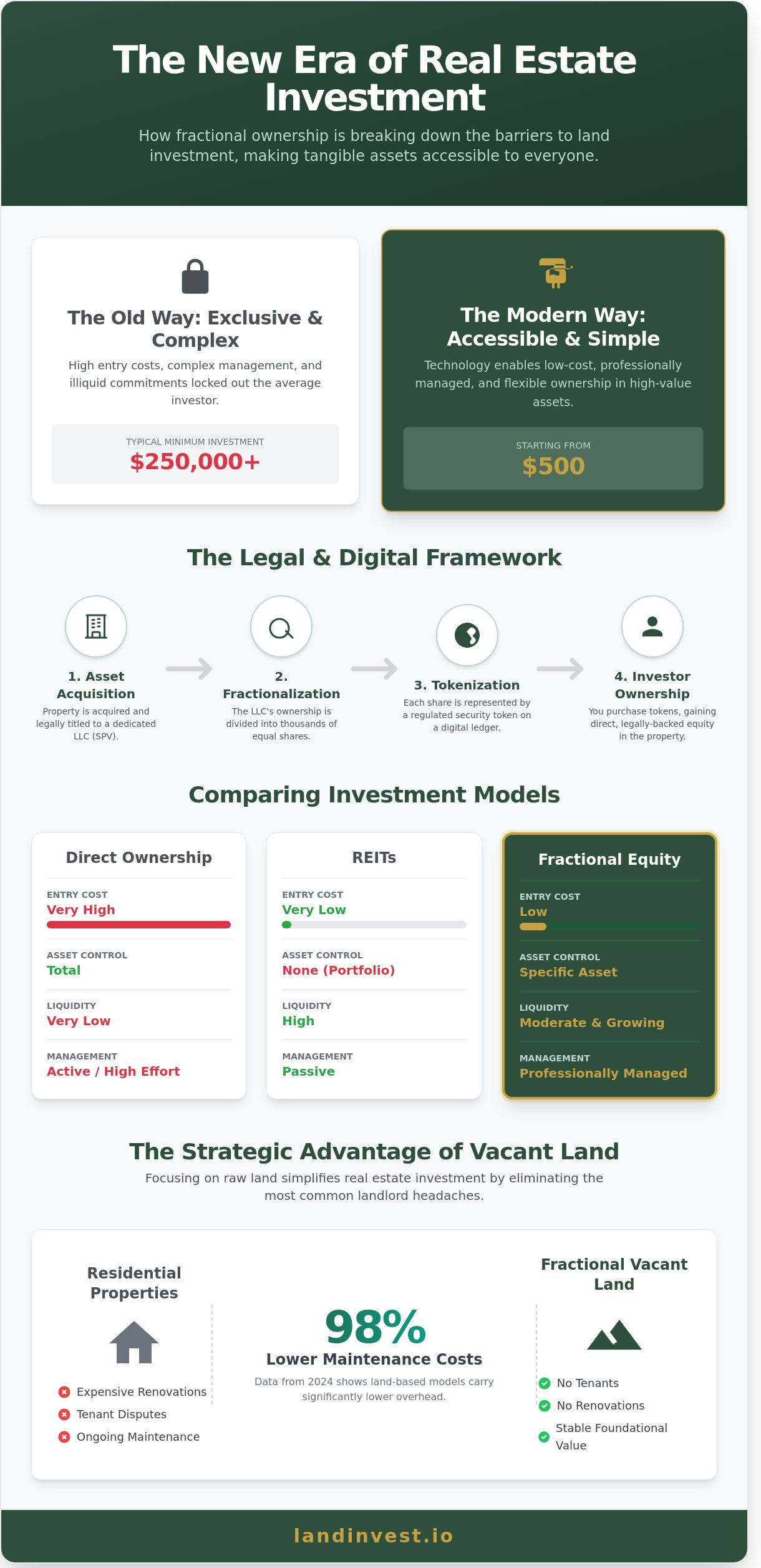
Many investors are now focusing on vacant land within this model. It’s a strategic choice based on simplicity. Raw land doesn’t involve broken pipes, tenant disputes, or expensive renovations. Data from 2024 indicates that land-based fractional real estate models carry 98% lower maintenance costs than residential properties. It’s a clean way to capture value from the earth’s natural scarcity. Since land doesn’t depreciate like a building, it remains a stable foundation for long-term wealth preservation.
The Core Benefits of the Fractional Model
Entry costs are the most immediate advantage. You can start building a portfolio with $500 instead of $500,000. This accessibility allows for genuine diversification. You can spread your capital across different soil types and geographic regions to mitigate risk. Since a professional management firm handles the tax filings and legal compliance, the investment remains truly passive. You get the benefits of property appreciation without the headache of daily operations.
Who is Fractional Investing For?
Retail investors find this model attractive as a stable inflation hedge that doesn’t require a bank loan. Accredited investors use these platforms to gain precise exposure to specific land markets. It’s also the perfect fit for the “hands-off” investor. These individuals want to profit from the 12% average annual growth seen in strategic land acquisitions without the stress of personally scouting locations or negotiating with developers. It provides a professional entry point into a historically complex market.
How Fractional Ownership Works: The Legal and Digital Framework
The foundation of fractional real estate rests on the Special Purpose Vehicle (SPV). This legal entity, usually structured as an LLC, holds the title to a specific property. By isolating the asset within its own company, the investment remains protected even if the platform operator faces financial trouble. Investors purchase shares in the LLC rather than owning a percentage of the deed directly. This structure simplifies tax reporting and limits liability for the individual. It’s a proven method used in institutional finance for decades to manage high-value assets.
Digital tokens represent these ownership shares through Security Token Offerings (STOs). These aren’t just digital entries; they’re regulated securities that fall under the jurisdiction of the SEC. Most platforms utilize exemptions like Regulation D or Regulation A+ to remain compliant. This Morningstar analysis of fractional ownership vs. REITs explains that while REITs provide broad market exposure, fractional models offer granular control over specific parcels. The intersection of blockchain and the U.S. legal system ensures that every token is tied to a verified legal document, making ownership verification instantaneous and immutable.
Compliance isn’t optional. Platforms must follow the Fair Credit Reporting Act (FCRA) to protect investor data and perform necessary KYC (Know Your Customer) checks. In 2023, the SEC filed 784 enforcement actions, proving that regulatory oversight in the digital asset space is tightening. Working within these frameworks isn’t a hurdle; it’s the primary way to build long-term trust in a volatile market.
Understanding Real World Asset (RWA) Tokenization
RWA tokenization is the digital bridge between physical land and global liquidity. The process involves taking a physical land parcel and creating a digital twin on the blockchain. This ledger records every transaction with 100% transparency. Because the blockchain is immutable, no one can alter the ownership history or the terms of the investment. This technology removes the need for expensive intermediaries, which can reduce closing costs by up to 40% compared to traditional land sales.
The Role of the Platform Operator
The operator acts as the steward of the investment. They perform rigorous due diligence, often reviewing over 50 data points like soil quality, water rights, and historical yield before a property enters the portfolio. They manage the essential but time-consuming tasks:
- Paying property taxes on time.
- Filing annual legal documents for the SPV.
- Managing lease agreements with local farmers.
Investors track their ROI and equity growth through a centralized dashboard. If you want to see how these legal structures protect your capital, you can view our current land offerings to understand the underlying documentation. This professional management ensures that the asset retains its value without requiring daily effort from the investor.
Comparing Models: Direct Ownership vs. REITs vs. Fractional Equity
Choosing the right vehicle for property investment requires a balance between control and risk. Direct ownership offers the highest level of autonomy, but it demands significant capital and time. According to 2023 market data, the average down payment for an investment property remains near 20%, often exceeding $80,000 in developed markets. Beyond the initial cost, the owner bears 100% of the operational risk. If a tenant vacates, the income stream stops instantly while taxes and maintenance costs continue to accrue.
REITs provide a different path by allowing investors to buy shares in large portfolios. While they offer high liquidity, their value often moves in sync with the stock market rather than the underlying property value. A REIT might drop 10% in a week due to broader economic fears, even if the buildings it owns remain fully occupied. Fractional real estate serves as the middle ground. It provides the asset-backed stability of physical property with the digital ease of a modern platform.
Risk Mitigation in Fractional Portfolios
Single-asset risk is the primary threat to traditional landlords. A local factory closure or a neighborhood decline can devalue a single property by 15% or more overnight. Equity-based fractional models mitigate this by allowing you to hold shares in a firm that manages a diversified portfolio. If one parcel underperforms, the remaining assets in the company stabilize the overall return. Liquidity also improves in this model; while selling a physical house takes an average of 22 to 61 days, digital shares can often be traded on secondary markets within 48 hours.
Cost and Fee Structures
- Management Fees: Most platforms charge between 1% and 2% annually to cover professional oversight and administration.
- Closing Costs: Traditional buyers pay 2% to 5% in closing fees; fractional models distribute these costs across hundreds of participants.
- Financing: By pooling capital, fractional real estate platforms often eliminate the need for high-interest bank loans, which currently hover around 7.5% for investment properties.
Traditional ownership carries hidden burdens. Data from 2023 suggests owners spend 1% of the property’s value each year on maintenance alone. Equity models internalize these costs, providing a net yield that’s more predictable. By owning shares in a company rather than a specific deed, you’re protected from the direct liability of property-specific failures. This structure creates a professional and conservative path to wealth preservation that avoids the volatility of the stock market and the heavy lifting of land management.
The Strategic Advantage of Fractional Vacant Land
While many investors focus on crowded apartment syndications, residential vacant land remains the hidden gem of the fractional real estate market. It offers a level of simplicity that improved properties can’t match. Traditional rentals come with a heavy burden of maintenance; they require constant attention to plumbing, roofing, and tenant relations. Land eliminates these variables. There are no midnight emergency calls, no insurance claims for water damage, and no depreciating buildings to maintain. This lack of “sticks and bricks” often reduces ongoing management costs by as much as 80% compared to multi-family units.
The “Flip” strategy provides the engine for high margins in this sector. Professional acquisition firms typically target parcels at 50% to 70% of their projected market value. By purchasing through wholesale channels or distressed situations, these firms build immediate equity for fractional owners. Scalability is the natural byproduct of this model. It’s far more efficient to manage a portfolio of 100 land parcels through a centralized digital ledger than it is to oversee 100 individual rental homes spread across different zip codes. This efficiency allows fractional real estate platforms to pass more value back to the individual investor.
Land as a Scarcity-Based Asset
Land is a finite resource that cannot be manufactured or duplicated. Historically, residential land in high-growth corridors has outpaced inflation by 3% to 4% annually since 1975. When land carries residential zoning, it becomes highly liquid for developers who need “shovel-ready” lots to meet housing demands. Land represents the rawest form of real estate value, stripped of depreciating structures. It’s a foundational asset that gains value as the surrounding infrastructure matures.
Acquisition Strategies in 2026
By 2026, data-driven firms will rely on predictive analytics to identify undervalued parcels before they hit the open market. These firms use GIS mapping and proprietary algorithms to scan for tax deeds and distressed sales across thousands of counties simultaneously. This systematic approach ensures a high-yield portfolio built on objective data rather than local guesswork. You can learn more about these methods by reading our guide on Investing in Vacant Land: A Beginner’s Strategy. This disciplined acquisition process is what separates professional fractional real estate offerings from speculative gambles.
Ready to build your portfolio with tangible, low-overhead assets? Explore our current land investment opportunities and secure your share of the earth’s most stable asset.
Starting Your Journey: Due Diligence and Next Steps
Entering the world of fractional real estate requires a methodical approach centered on transparency and risk management. Your first task involves a deep dive into the platform’s leadership and history. Success in this sector depends on the people managing the assets. For example, Randy Goldberg brings over 30 years of institutional real estate experience to Land Invest Corp, providing a layer of professional oversight that newer, unproven teams lack. You aren’t just buying a token; you’re trusting a team to manage physical land.
The offering circular is your most important legal tool. This document outlines exactly what your tokens represent and how your ownership is recorded. It’s the difference between a speculative digital asset and a legally binding claim to property. Beyond the paperwork, look at the geography of the assets. Secure platforms focus on U.S. growth markets where land values show consistent upward trends. In 2023, states like Texas and Florida saw significant domestic migration, making them prime targets for long-term land appreciation. Start with a small commitment. Testing the platform’s distribution process with a modest entry point allows you to verify the technology before scaling your portfolio.
The Security Token Offering (STO) Checklist
Compliance is the bedrock of digital property rights. You must verify that the offering follows SEC guidelines, typically under Regulation D for accredited investors or Regulation S for international participants. These exemptions provide a structured legal framework for your investment. Security also extends to custody. Ask the platform how tokens are stored and what protocols exist if you lose access to your account. Understanding these safeguards is vital for long-term peace of mind. For a detailed breakdown of these structures, see Security Token Offerings (STO): A Compliant Way to Invest.
Final Steps to Fractional Ownership
The transition from observer to investor is a streamlined process. It begins with the Know Your Customer (KYC) phase. You’ll provide identification to meet anti-money laundering standards, a process that usually completes within 24 to 48 hours. Once approved, you can fund your account. Most platforms offer a choice between traditional ACH bank transfers and digital currency options to suit your preference.
- Account Setup: Complete your profile and verify your identity through the secure portal.
- Portfolio Selection: Choose specific land assets based on market data and growth potential.
- Active Monitoring: Use the platform dashboard to track your equity and annual distributions.
- Long-term Strategy: Reinvest your earnings to leverage the power of compound growth in fractional real estate.
A professional dashboard serves as your command center, offering real-time insights into asset performance and tax documentation. This transparency ensures you’re always informed about the status of your holdings. Ready to build your land portfolio? Explore Land Invest Corp’s Tokenized Equity.
Secure Your Stake in the Next Generation of Property Ownership
The 2026 investment landscape demands more than just traditional diversification; it requires a move toward tangible assets that offer both security and growth. Fractional real estate investing has effectively dismantled the barriers to entry, allowing you to bypass the high capital requirements once reserved for institutional players. By shifting toward modern equity-based ownership, you’re securing a piece of the physical world through a framework that’s transparent and liquid. This evolution isn’t just about accessibility; it’s about reclaiming control over where your capital resides.
Land Invest Corp bridges the gap between ancient stability and modern technology. Their portfolio focuses on high-margin residential vacant land, a sector that provides a foundational hedge against inflation. Every investment is governed by a fully compliant Security Token Offering (STO), providing the legal rigor necessary for long-term peace of mind. It’s a calculated, professional approach to building a legacy on the very ground that supports our future. Don’t let the complexity of old-world finance hold you back from modern opportunities.
Invest in the Future of Land with Land Invest Corp
The path to a resilient portfolio starts with a single plot of earth. Take the next step toward a stable financial future today.
Frequently Asked Questions
Is fractional real estate a safe investment in 2026?
Fractional real estate remains a stable option in 2026 because of the matured regulatory oversight established by the SEC and local authorities over the last five years. These investments are backed by tangible assets, which historically provide a reliable hedge against inflation. While no investment is risk-free, the 2026 market benefits from transparent reporting standards and years of historical performance data from established platforms.
Do I get a deed to the property when I invest fractionally?
You don’t receive a direct deed to the physical property in most fractional real estate models. Instead, investors typically hold membership interests in a Special Purpose Vehicle, such as a Delaware LLC, which holds the actual title. This legal structure protects individual investors from personal liability. It ensures that 100% ownership of the asset is clearly documented in the entity’s operating agreement.
What is the difference between fractional real estate and a REIT?
The primary difference lies in asset selection and control. A Real Estate Investment Trust manages a broad portfolio of 50 or more properties where you own a share of the fund. In contrast, fractional real estate allows you to choose specific individual properties to invest in. This provides a direct connection to the underlying asset’s performance and full transparency regarding the property’s location and management.
Can I sell my fractional real estate shares whenever I want?
Liquidity is often limited, so you can’t always sell shares instantly. Most platforms require a minimum holding period of 3 to 5 years to maximize property appreciation. Some modern platforms have introduced secondary marketplaces where you can list your shares for sale to other verified investors. However, these transactions depend on current market demand and specific platform rules.
What happens if the fractional real estate company goes out of business?
Your investment is protected because the property is held in a separate legal entity from the management company. If the platform fails, the assets in the LLC remain intact and are managed by a third party trustee or a backup manager. This structure ensures that creditors of the platform can’t claim the property. Investors usually vote on whether to sell the asset or appoint a new management firm.
How much money do I need to start fractional real estate investing?
You can start investing with as little as $100 on several major platforms. This low entry point democratizes access to high value assets that usually require a 20% down payment on a traditional mortgage. By lowering the threshold, roughly 85% of retail investors can now diversify their portfolios across multiple asset classes without needing millions in liquid capital. For those considering alternative approaches to property ownership, exploring co ownership home structures can provide additional pathways to real estate investment with reduced individual capital requirements. For a comprehensive overview of how to get started with minimal capital, our ultimate guide to fractional real estate investing provides detailed strategies for building wealth through digital equity platforms.
Is tokenized real estate legal in the United States?
Tokenized real estate is legal in the United States when it complies with SEC regulations like Regulation D or Regulation A+. These digital tokens represent a fractional interest in a property and are treated as securities. Platforms must verify investor status and provide detailed disclosures. Since 2021, the legal framework has clarified that blockchain technology is simply a digital ledger for recording these traditional ownership rights. Modern tokenized equity models offer significant advantages over traditional joint ownership arrangements, particularly in terms of legal clarity and transferability. For investors seeking a thorough understanding of the shared equity landscape, our guide on what is fractional ownership and the 2026 shared equity investing framework covers the legal protections and asset class opportunities available to both retail and accredited investors.
What are the tax implications of fractional ownership?
Investors typically benefit from pass-through taxation, meaning profits and losses are reported on your personal tax return. You’ll likely receive a Schedule K-1 each year detailing your share of rental income and depreciation. This depreciation can often offset a portion of your taxable gains. It’s a structure used by 90% of private equity real estate deals to provide tax efficiency for participants.