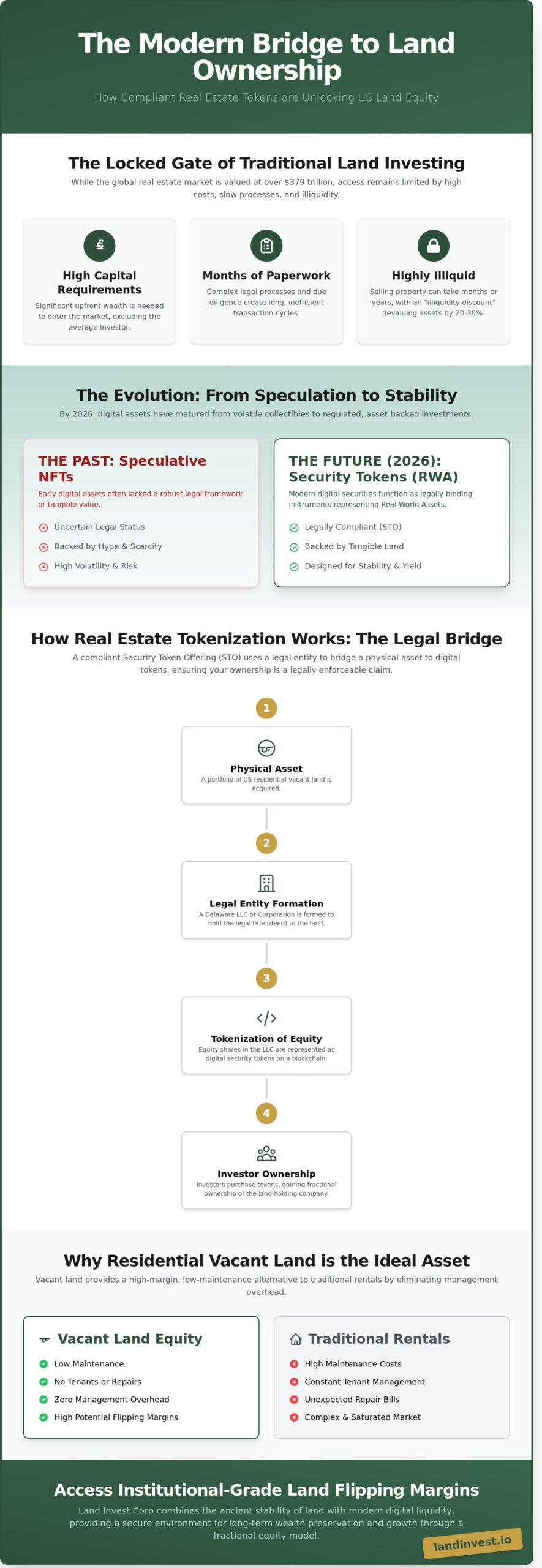
For decades, the most stable asset on the planet has been locked behind a gate of high capital requirements and months of legal paperwork. While the 2024 total value of global real estate hit $379 trillion, the average investor still finds it nearly impossible to access high-margin US land opportunities without significant upfront wealth. You’ve likely noticed that while the world moves toward instant digital transactions, property remains illiquid; however, the emergence of the real estate token is finally changing that dynamic. It’s a common frustration to watch inflation erode cash while the most secure hedges remain out of reach for many.
It’s time to bridge the gap between ancient value and modern efficiency. This guide reveals how digital equity transforms US land into a liquid, compliant, and fractional asset. You’ll discover how to gain passive exposure to land flipping margins through a regulated Security Token Offering (STO) without ever managing a physical deed. We’ll break down the 2026 roadmap for building a secure, land-backed portfolio that prioritizes long-term stability and transparency over the typical volatility of the crypto market.
Key Takeaways
- Understand the evolution of digital assets from speculative NFTs to compliant Security Token Offerings backed by tangible real-world assets.
- Learn how the legal bridge between blockchain technology and US corporate law ensures your investment is protected through regulated transfer agents.
- Discover why residential vacant land provides a high-margin, low-maintenance alternative to traditional rentals by eliminating management overhead.
- Master the essential investor’s checklist to verify asset ownership and confirm regulatory compliance before committing capital to a real estate token.
- Explore how to access institutional-grade land flipping margins through a fractional equity model that combines traditional land stability with modern digital liquidity.
What is a Real Estate Token? Defining RWA in 2026
A real estate token represents a fundamental shift in how investors interact with property ownership. By 2026, these digital assets have matured into precise representations of Real World Assets (RWA) secured on a blockchain. Unlike the speculative digital collectibles of previous years, a Security Token in the property sector functions as a legally binding instrument. It bridges the gap between physical land and digital equity, providing a verifiable claim to ownership or income rights without the traditional administrative friction.
The year 2026 is widely recognized as the year of institutional adoption for tokenized equity in the United States. This transition follows the 2025 regulatory breakthroughs that clarified how digital securities must be managed. Major financial institutions now utilize these tokens to provide 24/7 liquidity in a market that was historically slow and rigid. Fractional ownership has become the standard, allowing individuals to purchase specific portions of high-value assets. Smart contracts handle the heavy lifting, automating compliance, tax reporting, and dividend distributions instantly. This level of automation removes the need for manual oversight and reduces the risk of human error in complex transactions.
The Evolution of Tokenized Real Estate
The journey from early, experimental property tokens to modern equity-backed securities reflects a maturing financial ecosystem. Initial attempts at tokenization often lacked a robust legal framework, which created uncertainty for conservative investors. Today, the 2026 market for tokenized real estate is built on a foundation of transparency and regulatory compliance. Real estate blockchain technology has successfully addressed the “illiquidity discount” of traditional land, which typically devalued private assets by 20% to 30% due to the difficulty of selling. By digitizing these assets, sellers can find buyers across the globe in seconds, ensuring the property’s true value is always accessible.
Fungible vs. Non-Fungible Tokens in Real Estate
The technical structure of a real estate token determines its specific role within a portfolio. Fungible tokens, typically following the ERC-20 standard, are the preferred choice for fractional equity. They allow a single property to be divided into thousands of identical units, making them easy to trade on secondary markets. In contrast, Non-Fungible Tokens (NFTs) are used to represent unique, indivisible land parcels where specific geographic data is paramount.
- Fungible Tokens: Best for sharing yield and ownership in large-scale commercial or agricultural projects.
- NFTs: Ideal for identifying specific plot boundaries and unique historical deeds.
Land Invest Corp utilizes these tokenization strategies to scale business operations efficiently. By combining the ancient stability of land with modern digital convenience, the platform provides a secure environment for long-term wealth preservation. This methodical approach ensures that a real estate token is not just a digital entry, but a reliable stake in a tangible, productive asset.
How Real Estate Tokenization Works: Equity STOs vs. Direct Deeds
The transition from a physical land asset to a digital real estate token requires a robust legal bridge to ensure investor protection. In the 2026 market, this bridge is almost exclusively built using a Delaware Corporation or Limited Liability Company (LLC). The legal entity holds the title to the property, while the digital tokens represent specific membership interests or shares within that entity. This structure ensures that your ownership isn’t just a line of code, but a legally enforceable claim recognized by US courts.
While some early experiments attempted “Direct Deed Tokenization,” where fragments of a property title were put on-chain, this method proved problematic. Managing a single title with 5,000 individual owners creates immense bureaucratic friction and “deadlock” risks during a sale. Equity tokenization solves this by placing the management power in the hands of the corporate entity, while investors enjoy the economic benefits of the asset without the administrative burden of being on the physical deed.
The Mechanics of a Security Token Offering
A compliant Security Token Offering (STO) follows a strict lifecycle to maintain market integrity. It begins with the onboarding process, where a SEC-registered transfer agent manages KYC (Know Your Customer) and AML (Anti-Money Laundering) protocols. This ensures every holder of a real estate token is verified, preventing illicit activity and maintaining the platform’s reputation for stability. Once issued, the tokens utilize smart contracts to automate complex tasks:
- Dividend Distributions: Rental income or agricultural yields are sent directly to investor wallets based on their holdings.
- Governance: Smart contracts facilitate transparent voting on major property decisions, such as renovations or liquidation.
- Secondary Trading: Tokens can be traded on regulated Alternative Trading Systems (ATS), providing liquidity that traditional property lacks.
Following these protocols ensures that crypto real estate remains a secure asset class rather than a speculative gamble. By focusing on transparency, platforms like LandInvest.io help investors build portfolios grounded in tangible value.
Legal Structures: Why the Delaware Corp Model Wins
The regulatory landscape in 2026 is defined by Regulation D (for accredited US investors) and Regulation S (for international participants). These frameworks allow issuers to offer tokens legally without a full IPO. Holding equity in a diversified portfolio through a Delaware Corp provides a layer of protection that single-asset investments don’t offer. If one property in a portfolio underperforms, the others provide a buffer, mirroring the stability of a traditional REIT but with the lower fees of blockchain technology. An STO represents the gold standard for real estate tokens in 2026 because it fuses SEC-compliant security frameworks with the efficiency of blockchain-based settlement.
Why Residential Vacant Land is the Ideal Asset for Tokenization
Most investors instinctively look toward apartment complexes or commercial office spaces when considering property. However, residential vacant land represents a foundational asset class that often carries higher profit margins. While rental properties typically struggle with 4% to 6% annual yields after accounting for repairs, vacant land flipping can generate significantly higher returns because the entry price is lower and the exit strategy is faster. Land is the raw material for all future development. It’s a finite resource that doesn’t depreciate through wear and tear.
The primary advantage of land is the total absence of “tenants, toilets, or termites.” Traditional real estate requires constant management, property taxes, insurance, and emergency repairs. Vacant land removes these operational headaches. This lack of overhead makes it the perfect candidate for a real estate token. When an asset is digitalized, the goal is to minimize the friction between the physical property and the investor. Land achieves this by requiring zero physical maintenance while its value appreciates based on local demand and zoning shifts.
Scalability is another factor where land excels. Buying fifty individual houses is a logistical nightmare involving fifty inspections and fifty sets of keys. Tokenization allows a platform to acquire hundreds of parcels across multiple states simultaneously. This creates a diversified pool of assets that would be impossible for a single investor to manage alone. Selecting the right real estate tokenization platform is therefore a critical decision that determines how efficiently you can access and manage this diversified exposure.
The Economics of Land Flipping
Strategic acquisition is the engine of land equity. By purchasing residential lots at 40% to 60% of their future market value, investors lock in immediate equity. This process relies on identifying motivated sellers who prefer a quick cash exit over waiting for a retail buyer. You can explore how these opportunities are sourced through our vacant land marketplace. Because land is the starting point for every construction project, its value is tied to the fundamental need for housing, making it a resilient asset during various economic cycles.
Diversification Through Fractional Ownership
A single real estate token can provide exposure to a broad national portfolio rather than a single plot. This geographic spread protects capital from localized economic downturns. Through fractional land ownership, you don’t need to commit six figures to own a piece of the American landscape. Land tokens provide a stable hedge against the high-interest-rate volatility often seen in urban commercial real estate. This structure ensures that your portfolio remains balanced, even when metropolitan markets face pricing pressure.
The Investors Checklist: Evaluating a Real Estate Token
Moving from traditional land ownership to a digital format requires a rigorous vetting process. Investors must look past the interface and examine the underlying legal and physical structures. Verification starts with the chain of title. A legitimate real estate token project links every digital unit to a specific, deeded parcel of land through a Special Purpose Vehicle (SPV). You should verify this via public land registries or third-party legal audits to ensure the land actually exists as described.
Transparency is the bedrock of this asset class. By the start of 2025, leading platforms began integrating real-time property valuations through decentralized oracles. These systems provide frequent updates on soil quality or local market shifts, moving away from the static annual appraisals of the past. If a provider can’t show a clear, blockchain-traceable audit trail of the property’s value, the risk of overvaluation increases significantly. Understanding how to compare and evaluate each real estate tokenization platform against these transparency standards is essential before committing capital.
Liquidity remains a primary concern for long-term holders. Check if the token is compatible with established secondary trading venues like tZERO or Archax. Most offerings include a one-year lock-up period under SEC regulations; therefore, your exit strategy must account for this timeline. Finally, evaluate the “boots on the ground.” A land-management team needs a documented history of agricultural or development success, as technical expertise alone won’t generate yield from the soil.
Due Diligence on the Token Issuer
Reviewing the corporate structure is non-negotiable. Most US-based issuers register as Delaware LLCs to provide a stable legal framework for investors. You must examine the “waterfall” of payments to see if token holders are paid before or after management fees. Under SEC Rule 506(c), many high-yield land opportunities require “Accredited Investor” status, which currently demands a net worth of $1 million excluding a primary residence.
Technical Security and Custody
The choice of blockchain dictates the security and cost of your investment. While Ethereum remains the gold standard for institutional security, Polygon offers lower transaction fees for fractional owners. Security also depends on how you hold your assets. Institutional-grade custody solutions or hardware wallets are essential for protecting your holdings. Your private keys are the modern equivalent of a physical property deed; losing them means losing your legal claim to the equity.
Land Invest Corp: A Modern Gateway to Tokenized Land Equity
Land Invest Corp bridges the gap between traditional land flipping and the digital future of finance. The company specializes in the acquisition of residential vacant land across the United States, targeting properties that can be purchased at 20% to 40% of their projected market value. This high-margin business model relies on a national reach, allowing the team to source assets from Florida to Washington without geographic constraints. By focusing on raw land, the company avoids the depreciation and maintenance costs associated with physical buildings, creating a leaner investment vehicle.
The operational success of this model is driven by Randy Goldberg and a team of seasoned real estate professionals. Their expertise lies in identifying undervalued parcels and managing the complex legal and administrative hurdles of land acquisition at scale. This professional oversight ensures that the underlying assets in the portfolio are vetted for title clarity and resale potential. Investors gain access to a business engine that has been refined over decades, now accessible through the efficiency of blockchain technology.
The Land Invest Corp STO Model
The Security Token Offering (STO) model provides a compliant way for individuals to gain equity stakes in the company’s growing land portfolio. Holding a real estate token issued by Land Invest Corp is fundamentally different from owning a physical deed. A deed requires the owner to manage property taxes, local zoning laws, and individual resale efforts. In contrast, the token represents a fractional interest in a diversified business operation. This structure removes the high entry barriers and administrative burdens typically found in land speculation.
Future Outlook: Land Tokenization in 2026 and Beyond
As the regulatory environment for digital assets continues to mature, the demand for asset-backed tokens will likely increase. Land Invest Corp remains committed to transparency and expert management, ensuring that every real estate token reflects a tangible piece of the American landscape. This commitment to stability and professional excellence makes the platform a cornerstone for those looking to build a legacy in the digital age.
Explore Land Invest Corp’s Tokenized Equity Opportunities to learn how you can participate in this evolving market.
Securing Your Position in the Digital Land Rush
The shift toward tokenized real-world assets isn’t a trend; it’s a structural evolution of the global economy. By 2030, the Boston Consulting Group projects the tokenization of illiquid assets will reach a $16 trillion valuation. Investing in a real estate token allows you to bypass the traditional barriers of high entry costs and complex legal paperwork. You’re choosing a path that prioritizes stability through residential vacant land, an asset class that historically maintains value even when urban commercial markets fluctuate. Success in 2026 requires a focus on transparency and regulatory compliance through established Security Token Offerings. For a deeper understanding of how real estate blockchain integration is reshaping RWA tokenization at an institutional level, the current trend analysis offers essential context for any serious investor.
Land Invest Corp provides the necessary infrastructure to navigate this landscape safely. Their approach combines a compliant STO structure with a national US land portfolio, ensuring every digital share is backed by tangible acreage. They use an expert-led land acquisition strategy to identify high-growth zones before the broader market reacts. It’s about building a legacy on a foundation that’s as solid as the earth itself. You don’t need to navigate the complexities of deed transfers alone when technology offers a clearer, more efficient route to equity. Taking the first step today positions your portfolio for the long-term growth of the American landscape.
Invest in the Future of US Land with Land Invest Corp Tokens
Frequently Asked Questions
What exactly am I buying when I purchase a Land Invest Corp token?
You’re buying a fractional interest in a legal entity, typically a Limited Liability Company, that holds the direct title to a specific parcel of land. This digital real estate token represents a proportionate claim to the asset’s value and any future appreciation. You aren’t just buying code; you’re acquiring a legally documented share of a tangible, physical asset secured by blockchain technology.
Is a real estate token a legal security in the United States?
Yes, these tokens are classified as securities under the Howey Test established by the Supreme Court in 1946. Land Invest Corp operates under SEC exemptions like Regulation D or Regulation S to ensure full legal compliance. This framework provides you with the same protections as traditional private equity. It ensures that every offering is registered or exempt according to federal law and investor protection standards.
How is the value of a real estate token determined?
The value is directly tied to the Net Asset Value of the underlying property, which independent RICS-certified appraisers calculate every 12 months. These professionals evaluate local market data, soil quality, and recent sales of comparable acreage. If the land’s market value increases by 5% in a year, the token’s base value reflects that growth. This process removes speculative volatility and anchors your investment in real-world data.
Can I sell my real estate tokens whenever I want?
You can sell your tokens on supported secondary trading platforms after the initial 12-month holding period required by SEC Rule 144. While blockchain enables 24/7 transfers, liquidity depends on market demand at the time of your sale. We provide a dedicated secondary marketplace to facilitate these transactions between verified users. This structure offers more flexibility than traditional land sales, which often take 180 days or longer to close.
Do I need to be an accredited investor to buy real estate tokens?
Current US regulations generally require you to be an accredited investor for Regulation D offerings. This means having a net worth over $1 million excluding your primary residence or an annual income exceeding $200,000 for the last two years. However, certain offerings under Regulation CF may allow non-accredited individuals to participate. You should check the specific offering memorandum for the eligibility criteria of each individual land project before committing capital.
What happens to my tokens if the company dissolves?
Your investment remains protected because the land is held in an independent Special Purpose Vehicle separate from the company’s operational accounts. If Land Invest Corp dissolves, the SPV’s assets are liquidated or transferred to a new manager according to the operating agreement. Investors hold a first-priority claim on the proceeds from the sale of the land. This legal separation ensures your capital stays tied to the physical asset.
How are taxes handled for tokenized real estate investments?
You’ll receive a Schedule K-1 or Form 1099 each year, depending on the legal structure of the specific investment. Since the real estate token represents ownership in a pass-through entity, profits and losses flow directly to your personal tax return. Many investors benefit from long-term capital gains rates if they hold the asset for more than 365 days. We recommend consulting a tax professional to understand how these distributions affect your specific bracket.
Why is vacant land better for tokenization than rental properties?
Vacant land is superior because it eliminates the high maintenance costs and tenant risks associated with buildings. Agricultural land has shown lower volatility, with US farmland providing an average annual return of 10.2% between 1992 and 2022. Without structures to depreciate or plumbing to fix, your investment remains focused on the pure appreciation of the earth. It’s a stable, long-term strategy that fits the digital format perfectly.