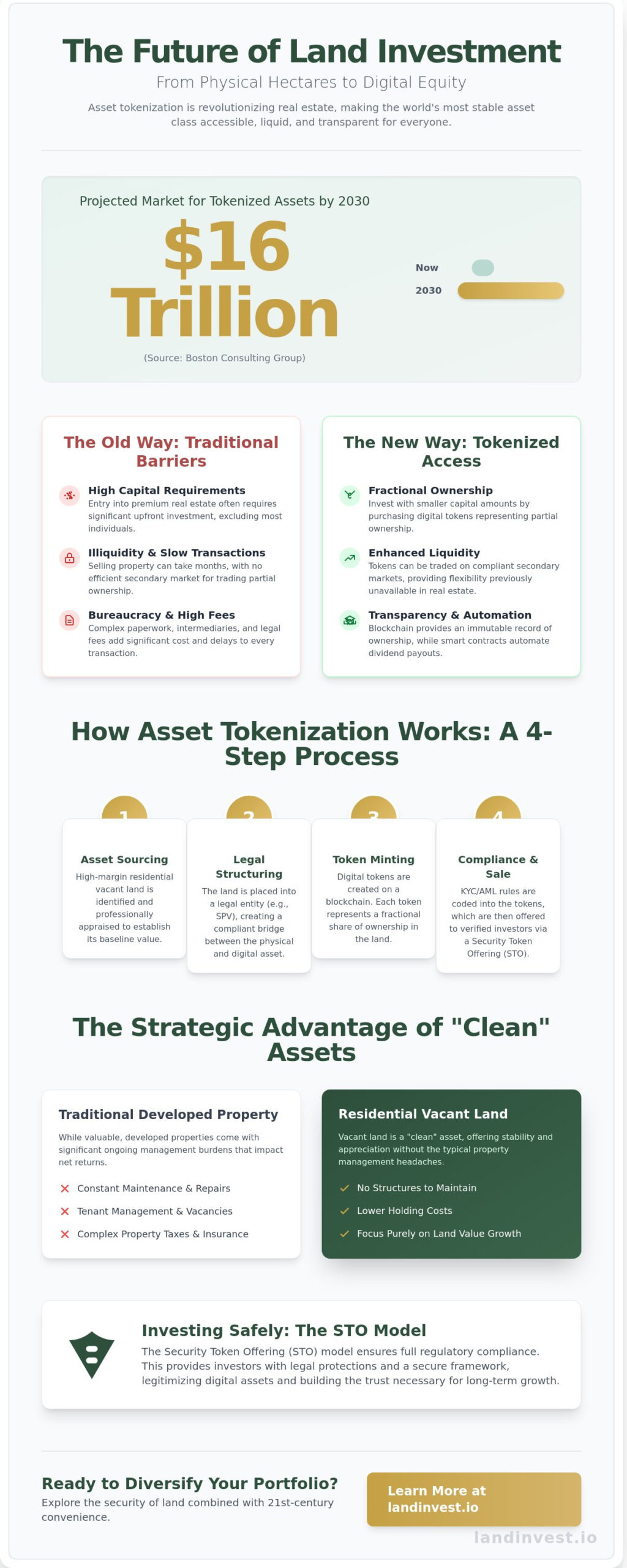
The Boston Consulting Group projects that the market for tokenized illiquid assets will reach $16 trillion by 2030, a figure that highlights the growing dominance of asset tokenization in modern finance. You likely understand that land is the ultimate foundation of stability, yet the entry barriers have remained stubbornly high for decades. Between high minimum capital requirements and the lack of a secondary market, traditional real estate often feels like a closed club. It’s a common frustration to see the most reliable asset class locked behind layers of bureaucracy and illiquidity.
This guide demonstrates how digital technology is finally making land investment accessible to everyone by converting physical hectares into liquid digital equity. We’ll strip away the complex blockchain jargon to reveal a professional, compliant framework for modern investing. You’ll learn how to identify secure RWA opportunities and diversify your portfolio with fractional ownership that combines the ancient security of the earth with 21st-century convenience.
Key Takeaways
- Understand how asset tokenization bridges the gap between physical land and digital equity, allowing for secure ownership rights on the blockchain.
- Discover the technical and legal process of transforming high-margin residential vacant land into a transparent, corporate-backed digital asset.
- Learn how fractional ownership lowers the barrier to entry, making premium real estate investment accessible with smaller capital amounts.
- Explore the strategic advantages of “clean” assets like vacant land, which provide stability and growth without the management burdens of traditional property.
- Identify how the Security Token Offering (STO) model ensures regulatory compliance and provides the liquidity needed to trade your holdings on secondary markets.
What is Asset Tokenization? Demystifying RWA in 2026
The financial landscape has shifted from physical ledgers to immutable digital records. At its core, asset tokenization is the process of converting ownership rights of a physical asset into a digital token on a blockchain. These tokens represent a direct claim on the underlying value, whether it’s a piece of machinery, a painting, or a hectare of fertile land. By 2026, this technology has moved beyond the experimental phase. It now serves as the primary infrastructure for modern wealth management.
Central to this evolution is the concept of Real World Assets (RWA). These assets serve as the essential bridge between traditional finance and decentralized finance (DeFi). If you’re wondering What is a Real World Asset (RWA)?, it’s simply a tangible or intangible asset that exists outside the digital world but is brought on-chain to increase liquidity. While traditional paper deeds once defined ownership, they often caused delays and required expensive intermediaries. Digital tokens replace these slow, manual processes with instant, verifiable proof of equity.
Institutional adoption has reached a critical mass this year. Major investment banks and sovereign wealth funds have shifted toward tokenized equity to streamline their operations. This isn’t just a trend for tech enthusiasts; it’s a structural change in how global capital is allocated. Asset tokenization is the digital twin of legal equity.
The Core Concept: From Physical to Digital
To understand the mechanics, imagine a physical plot of land. In a tokenized ecosystem, this land is represented by a specific number of digital tokens. Each token corresponds to a fractional share of that property. The blockchain acts as the “source of truth,” meaning the digital ledger mirrors the legal ownership status in real time. This synchronization ensures that what’s recorded on the blockchain is legally binding and recognized by regulatory frameworks. It eliminates the “double-spend” risk and ensures that ownership history is transparent and unalterable.
Why RWA Tokenization is Gaining Momentum
Investors are increasingly seeking stability in a volatile digital market. While pure cryptocurrencies often fluctuate wildly, RWAs provide a floor of tangible value. The rise of tokenized real estate has been particularly influential in modernizing portfolios. It allows individuals to diversify into high-value property markets with smaller capital outlays. Transparency is another key driver. Because every transaction is recorded on a public or permissioned ledger, the risk of fraud in property transactions is significantly reduced. This clarity builds the trust necessary for long term capital preservation and steady yield generation. For a deeper look at how real estate blockchain technology is reshaping institutional finance, our 2026 trend analysis examines the full scope of this transformation.
How Asset Tokenization Works: The Technical Foundation
The process of asset tokenization transforms a tangible, illiquid asset into a digital format that’s easily divisible and tradable. It begins with rigorous asset sourcing and valuation. At Land Invest Corp, this focus is specifically on high-margin residential vacant land. This selection process ensures that the underlying asset has a clear path to value appreciation. A professional appraisal establishes the baseline price before any digital transition occurs.
Once the land is secured, the second step involves legal structuring. The physical property is placed into a dedicated legal entity, often a Delaware Corporation or a similar Special Purpose Vehicle (SPV). This step is crucial because it creates a clear legal bridge between the physical earth and the digital world. This shift represents what the World Economic Forum describes as the next generation of value exchange, where digital efficiency replaces legacy paper-based systems.
The third phase is token minting. Digital equity tokens are created on a blockchain to represent fractional shares in the legal entity that owns the land. Finally, compliance integration ensures the system stays within regulatory bounds. Developers embed KYC (Know Your Customer) and AML (Anti-Money Laundering) rules directly into the token’s code. This means the asset can’t be transferred to an unverified wallet, maintaining a secure environment for all participants.
The Role of Smart Contracts
Smart contracts are the logic gates of modern investment. These self-executing agreements handle the distribution of funds and the transfer of ownership automatically. They operate on “if/then” logic; for example, if a parcel of land is sold, the smart contract automatically calculates and distributes the proceeds to token holders. This automation removes the need for expensive middleman administration and reduces the potential for human error. It’s a precise, code-driven way to manage asset tokenization without the overhead of traditional brokerage firms.
Blockchain as an Immutable Ledger
Security in this model relies on the blockchain’s role as an immutable ledger. Unlike traditional county record databases that might rely on centralized servers, a blockchain records every transaction across a distributed network. This makes the data nearly impossible to forge or delete. Investors gain 24/7 auditability, allowing them to verify their holdings and the asset’s history at any second. This level of transparency is a defining characteristic of crypto real estate protocols. If you’re ready to see how these technical foundations create stable opportunities, you can learn more about our current projects at landinvest.io.
The Benefits of Tokenizing Real-World Assets
Asset tokenization represents a fundamental shift in how we preserve and grow wealth. It isn’t just a technical upgrade; it’s an evolution of ownership that aligns the stability of tangible assets with the speed of the digital age. By converting physical land or property into digital tokens on a blockchain, we remove the gatekeepers that have historically limited high-value markets to institutional players or the ultra-wealthy. This process creates a transparent, immutable record of ownership that provides a sense of security often missing in volatile paper markets.
Breaking Barriers with Fractional Equity
Traditional land acquisition often requires six-figure down payments, effectively locking out the average investor. Fractional land ownership changes this dynamic by dividing a single property into thousands of affordable units. This democratizes the market. Investors are moving away from the burden of managing a single physical house toward owning diversified equity in a high-performing portfolio. For instance, an individual with $1,000 can now secure a stake in a multi-million dollar agricultural land portfolio, a feat impossible in the 20th-century banking model. This shift from “owning a house” to “owning equity” allows for much better risk management through diversification.
Efficiency and Reduced Transaction Friction
The legacy real estate market is notoriously slow. A standard closing process in the United States takes an average of 30 to 50 days, involving a mountain of paperwork and multiple intermediaries. In contrast, a real estate token allows for near-instant settlement. Smart contracts handle the heavy lifting, automating compliance checks and legal verifications. This reduces administrative fees by up to 20% compared to traditional broker-led transactions. Digital markets don’t close at 5:00 PM on Fridays; they operate 24/7, providing liquidity that was previously unheard of in the land sector.
Beyond speed and cost, asset tokenization offers several structural advantages for the modern portfolio:
- Increased Liquidity: You don’t have to wait six to nine months for a land sale to finalize. You can trade tokens on secondary markets whenever you need to rebalance your holdings.
- Global Accessibility: An investor in Tokyo or Berlin can hold US-based land equity as easily as a local resident. This removes the complex cross-border banking hurdles that used to stymie international growth.
- Lower Entry Costs: By removing the need for title companies and escrow agents for every small trade, the overhead per transaction drops significantly.
- Transparency: Every transaction is recorded on a public ledger, ensuring that ownership history is clear and undisputed.
This new model doesn’t just make investing easier; it makes it more logical. When you strip away the layers of bureaucracy and high entry costs, you’re left with the core value of the land itself. It’s a bridge between the ancient reliability of the earth and the efficiency of modern code. Investors no longer need to choose between the stability of real estate and the convenience of digital assets. Through tokenization, they can finally have both.
Specific Use Case: Tokenizing Residential Vacant Land
While many investors focus on high rise buildings or multifamily complexes, residential vacant land offers a unique “clean” entry point for asset tokenization. Raw land represents the most fundamental form of property ownership. It lacks the operational friction associated with developed real estate, often referred to in the industry as the absence of “tenants, toilets, and trash.” This simplicity makes it a stable foundation for digital portfolios.
The core strategy involves land flipping on a professional scale. This process identifies residential parcels in high growth corridors, often acquired at 50% to 70% of their current market value through distressed sales or tax liens. By reselling these plots at full market price, the model captures significant spreads. Tokenization allows an individual to participate in a diversified basket of these assets across multiple jurisdictions, such as Florida, Texas, and Arizona, without the need to manage individual closings or local regulations in each state.
The Low-Maintenance Advantage
Land is a non-depreciating asset. According to data from the Lincoln Institute of Land Policy, land values in the United States have historically accounted for a steadily increasing share of total real estate value. Because there are no structures, there is no physical wear and tear. You don’t have to worry about roof leaks, HVAC failures, or property management fees that typically erode profits in residential rentals. This lack of overhead maximizes the Return on Assets (ROA) for token holders. Every dollar of appreciation stays within the investment rather than being diverted to emergency repairs or maintenance crews.
Equity Tokens vs. Direct Deeds
A frequent question from traditional investors is whether they receive a physical deed to the property. In the tokenization model, the legal structure is designed for efficiency and protection. Direct ownership of a 1/100th fraction of a physical deed would be a legal nightmare to sell or transfer. Instead, the land is owned by a Special Purpose Vehicle (SPV), a legal entity created specifically to hold the asset. Your tokens represent equity shares in that entity.
This structure offers several advantages:
- Liquidity: You can trade your tokens on a secondary market in minutes, whereas transferring a physical deed usually takes 30 to 45 days.
- Legal Protection: The corporate structure shields individual investors from personal liability.
- Simplified Management: The entity handles all tax filings and legal compliance, leaving the investor with a truly passive income stream.
Investing Safely: The Land Invest Corp STO Model
The early years of digital finance were defined by Initial Coin Offerings (ICOs), which often lacked oversight and left investors vulnerable. Security Token Offerings (STOs) emerged as the compliant, professional alternative. Land Invest Corp utilizes this model to bridge the gap between digital efficiency and traditional security. By operating under Delaware corporate law, the company ensures that tokens aren’t just speculative entries on a digital ledger; they represent actual equity in a legal entity that owns tangible land. This structure means the asset tokenization process isn’t a gamble on software code, but a fractional claim on a physical, appreciating resource.
Adhering to SEC compliance standards is the foundation of this model. By following established regulations like Regulation D, the platform ensures transparency and protects the integrity of the investment. These standards require investor accreditation, which filters the pool for serious participants who understand the long-term nature of land acquisition. The technology is merely the delivery mechanism. The true value stays rooted in the soil, providing a level of protection that purely digital assets can’t match. Using asset tokenization as a tool allows for liquidity and ease of access, but the underlying land provides the actual wealth preservation.
Compliance as a Feature, Not a Bug
Land Invest Corp treats legal frameworks as a competitive advantage rather than a hurdle. While many platforms chase market hype, this model prioritizes stability and long-term trust. Robust Know Your Customer (KYC) protocols are mandatory. These checks protect the entire investor pool by ensuring all participants are verified, reducing the risk of fraud or institutional interference. The business model focuses on residential land resales, a sector backed by the reality of housing demand. Since US housing starts reached an annualized rate of over 1.4 million in late 2023, the need for buildable land remains a constant. This focus on factual market data creates a predictable environment for growth.
How to Get Started with Land Invest
The journey to land ownership through the platform is designed to be efficient. Investors begin by creating a secure profile and completing the necessary accreditation steps. Once verified, you gain access to the STO dashboard where you can review the specific details of the offering and the land parcels involved. It’s a modern gateway to a classic wealth-building strategy: land flipping. Instead of dealing with the headaches of local property taxes, deed transfers, and physical inspections, you use the platform to handle the logistics. You get the benefits of real estate ownership without the traditional barriers to entry. Selecting the right real estate tokenization platform is a critical step in ensuring your capital is protected by a compliant, transparent structure.
Securing Your Legacy Through Digital Land Ownership
By 2026, the landscape of wealth management looks fundamentally different. Asset tokenization has evolved from a technical concept into a massive market reality, with analysts from Roland Berger projecting the tokenized asset market could reach $10 trillion by 2030. This shift allows you to move away from volatile markets and toward the enduring stability of US residential vacant land. You’re no longer limited by geographic barriers or high capital requirements. Instead, you can rely on the transparency of the blockchain to verify every acre you hold.
Choosing the right partner is the most critical step in this transition. Land Invest Corp operates as a Delaware-registered corporation, ensuring your capital is protected by a compliant Security Token Offering (STO) framework. We focus exclusively on high-margin US residential vacant land, a sector that remains resilient even when other asset classes falter. It’s about combining the wisdom of traditional land ownership with the efficiency of modern finance. You don’t have to navigate these complexities alone. Our model is built on the foundation of professional expertise and a commitment to long-term growth.
Start Investing in Tokenized Land Equity with Land Invest Corp to begin building a portfolio rooted in tangible value. The path to financial stability starts with a single, well-informed decision today.
Frequently Asked Questions
Is asset tokenization legal in the United States?
Asset tokenization is legal in the United States when issuers comply with SEC frameworks like Regulation D for private placements or Regulation S for international offerings. The SEC treats most asset-backed tokens as investment contracts under the 1946 Howey Test. This classification ensures that investors receive legal protections similar to traditional securities. Since 2017, the SEC’s DAO Report has served as the primary roadmap for compliant digital asset issuance in the domestic market.
What is the difference between a utility token and a security token?
Security tokens represent a legal ownership stake in an underlying asset, while utility tokens provide access to a specific product or service within an ecosystem. Under the US Securities Act of 1933, security tokens must be registered or qualify for an exemption because they promise a potential return on investment. Utility tokens don’t carry these ownership rights. For instance, a token giving you 5% of a farm’s profit is a security, but a token used only to pay for software is a utility.
Can I sell my tokens if I need cash quickly?
You can sell your tokens on secondary marketplaces or through peer-to-peer transfers, though liquidity depends on the specific asset’s demand. Many security tokens issued under Regulation D require a 12 month holding period before they’re eligible for resale to non-accredited investors. Once this period ends, you can list your holdings on Alternative Trading Systems like tZERO or INX. These platforms operate 24/7, providing faster settlement than traditional real estate transactions which often take 30 to 60 days to close.
Do I need to be an accredited investor to buy tokenized land equity?
Accredited status isn’t always required, as it depends on the specific regulatory exemption the issuer chooses. Offerings under Regulation A+ allow any investor over 18 to participate, whereas Regulation D offerings often limit participation to individuals with a $1 million net worth or $200,000 annual income. In 2020, the SEC expanded the definition of an accredited investor to include certain financial professionals. This change increased the number of eligible participants in the private equity market.
What happens to my investment if the tokenization platform goes out of business?
Your ownership remains secure because the asset is typically held in a Special Purpose Vehicle that’s legally separate from the tokenization platform. The blockchain ledger provides a permanent, immutable record of your holdings that exists independently of the company’s internal servers. If a platform fails, a third-party trustee or administrator manages the underlying assets according to the original smart contract terms. This structure ensures your claim to the land or profit stays intact regardless of the platform’s operational status.
How are dividends or profits from land sales distributed to token holders?
Profits are distributed automatically to your digital wallet through smart contracts, which execute payments once specific conditions are met. These programmed scripts eliminate manual accounting errors and can reduce administrative costs by up to 20% compared to traditional distribution methods. When a harvest is sold or a land parcel is liquidated, the funds are split proportionally among token holders. You’ll receive these payments in stablecoins or fiat currency, depending on the platform’s technical architecture.
Is tokenized real estate the same as a REIT?
Tokenized real estate differs from a Real Estate Investment Trust (REIT) by offering direct fractional ownership of specific properties rather than shares in a managed corporation. While REITs often have high management fees and trade on stock exchanges, asset tokenization reduces intermediary costs and allows you to choose individual assets. Research from 2023 shows that tokenization can lower entry barriers, letting you invest in specific hectares of land rather than a broad, opaque portfolio. It’s a more granular approach to diversification. For a comprehensive overview of how real estate blockchain trends are driving this shift away from traditional REIT structures, our 2026 trend analysis provides detailed market projections and institutional adoption data.