The traditional view of land as an illiquid asset is becoming obsolete as we move toward 2026. You likely recognize the inherent stability of the soil, yet the high capital requirements and the 180-day due diligence periods often found in us land market trends can feel like significant obstacles to diversification. It’s a common challenge to seek a hedge against currency volatility while facing a market that historically lacked the speed and transparency of modern digital financial products.
This article demonstrates how a 4.7% rise in national average cropland values, as documented by the USDA in 2024, is paving the way for a more accessible and liquid asset class. You’ll discover the macroeconomic drivers and technological innovations that are finally bringing efficiency to the agricultural sector. We’ll examine how these shifts allow you to benefit from the security of the earth through professional frameworks that simplify the path to long-term wealth preservation. This transition ensures that the enduring value of the land is no longer restricted by the complexities of traditional physical acquisition.
Key Takeaways
- Understand why the 77% price surge since 2020 has established a permanent floor for land values and how the current inventory lock impacts your entry strategy.
- Analyze the latest 2026 us land market trends to see how persistent inflation and interest rate stabilization are unlocking dormant development capital.
- Evaluate why residential vacant land currently offers a lower barrier to entry and more flexible exit strategies compared to traditional commercial real estate.
- Explore how Real World Asset (RWA) tokenization is dismantling the historical “illiquidity discount” by transforming land into a digitally tradable asset class.
- Learn to distinguish between direct flipping and passive equity models to select the most stable path for your long-term portfolio diversification.
The State of the US Land Market in 2026: Scarcity as the New Normal
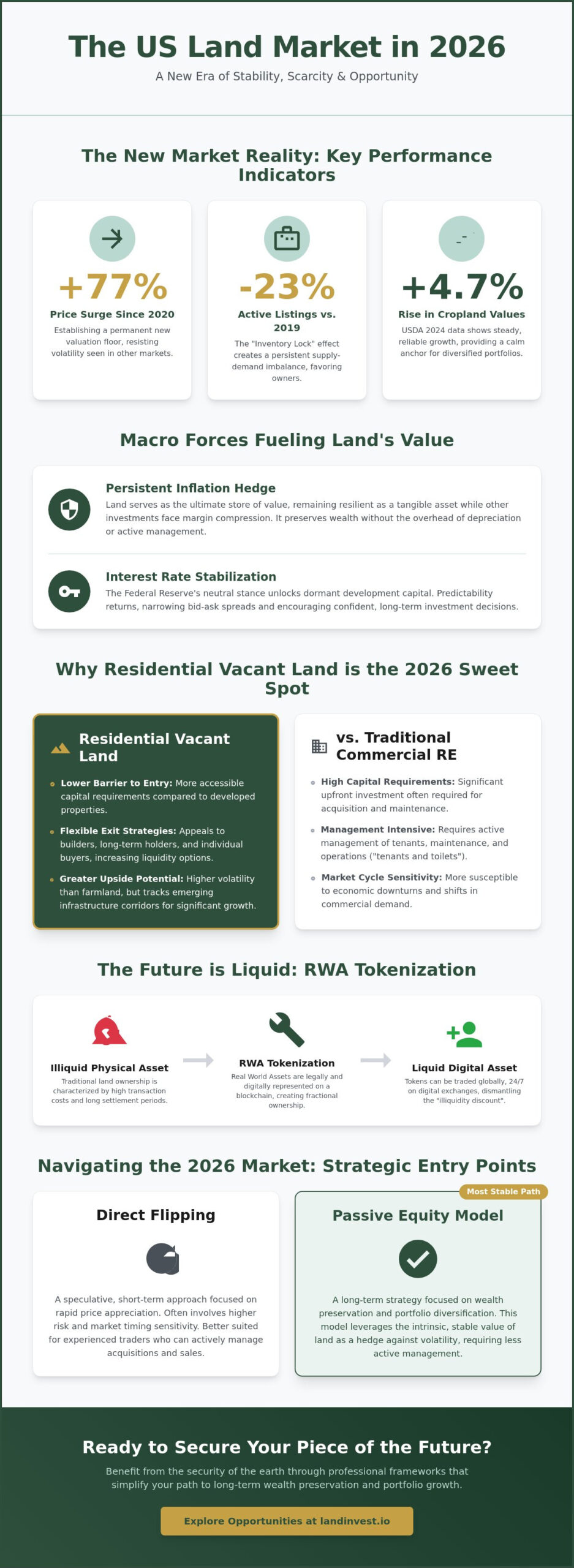
The US land market has undergone a structural transformation that favors long term stability over short term speculation. Since the 2020 pivot, prices have surged by 77 percent, establishing a permanent valuation floor that resists the volatility seen in traditional equity markets. While the broader residential housing market cooled significantly throughout 2025 due to interest rate fatigue, the raw land sector remained remarkably resilient. This divergence is driven by a “finite resource” psychology. Both institutional funds and retail investors are aggressively securing parcels as a hedge against currency debasement. Current us land market trends indicate that the “Inventory Lock” effect is now a structural reality; active listings remain 23 percent below 2019 levels, creating a persistent supply demand imbalance.
The Post-Pandemic Inventory Crunch
The market has transitioned from being builder led to investor led. During the mid-2020s, developers consumed the majority of “shovel ready” lots, which forced new capital toward raw residential land. This consumption cycle has fundamentally changed how participants view land tenure systems and the long term security of physical ownership. In 2026, land scarcity is defined as a function of restrictive zoning and the increasing costs of infrastructure expansion, which prevents new supply from reaching the market. Investors don’t just see dirt; they see a protected entry point into a shrinking asset class.
Price Trajectories Across National Segments
Data from the first half of 2026 shows a steady 4.3 percent annual growth rate in farmland, providing a calm anchor for diversified portfolios. In contrast, residential lots show higher volatility but offer greater upside for those who track us land market trends in emerging infrastructure corridors. Understanding these nuances is vital for accurate valuation.
- Metric Accuracy: Median price per acre is a misleading metric without the context of soil quality, water rights, or entitlement status.
- Flight to Quality: There’s a clear premium on parcels with existing utility access, as the cost of “bringing power to the line” has risen 18 percent since 2024.
- Institutional Focus: Large scale acquisitions are increasingly targeted at parcels with carbon sequestration potential or renewable energy lease possibilities.
The current landscape rewards the patient investor who prioritizes transparency and tangible value. As urban sprawl meets the limits of available infrastructure, the intrinsic worth of well positioned land continues to solidify. It’s no longer about rapid flipping; it’s about the quiet strength of owning a piece of the future foundation.
Macroeconomic Drivers Shaping Land Values This Year
The landscape of 2026 is defined by a hard-earned stability. After the volatility of previous years, the Federal Reserve has transitioned to a neutral stance, which has finally unlocked dormant development capital. Investors who stayed on the sidelines during the 2024 rate hikes are now re-entering the market with more confidence. This predictability is a cornerstone of current us land market trends, as it allows for more accurate long-term forecasting and narrows the bid-ask spread between buyers and sellers.
Inflation and the Hard Asset Narrative
Persistent inflation has cemented the status of land as the ultimate hedge. While traditional equities often face margin compression when costs rise, land remains a resilient store of value. It’s a tangible asset that doesn’t require the constant maintenance or “tenants and toilets” management associated with improved real estate. Historical USDA farmland value data indicates that land has consistently served as a reliable inflation buffer over multi-decade cycles. We’re seeing a profound psychological shift where investors value the “quiet strength” of a physical asset over the frantic fluctuations of a digital-first economy. Land’s lower carrying cost makes it an ideal vehicle for those seeking to preserve wealth without the overhead of depreciation or structural repairs.
The Infrastructure Act Impact
Federal spending on rural broadband and road expansion is now reaching its peak implementation phase. This massive capital injection is “activating” parcels that were once considered too remote for serious investment. When high-speed fiber optics reach a previously disconnected county, the surrounding land often sees an immediate valuation lift. Proximity to these newly funded infrastructure hubs has become a primary driver of rapid appreciation. You’ll find that the modern vacant land marketplace is increasingly focused on these high-connectivity zones, as they offer the highest potential for future residential or commercial use.
The demand for suburban and exurban residential lots remains robust due to the “Remote Work 2.0” movement. This isn’t just a lingering effect of the pandemic; it’s a permanent structural change in how the American workforce operates. Consequently, we’re seeing a “builder softening” trend where large-scale developers are more selective about their lot acquisitions. Instead of holding massive, risky inventories, they’re looking for shovel-ready parcels. This shift creates a unique opening for private investors to hold liquid land equity and supply the market as needed. If you’re considering your next move, analyzing land as a stabilizing force in your portfolio is a logical step toward long-term security.
- Interest Rate Neutrality: Predictable borrowing costs are encouraging new project starts.
- Broadband Expansion: Rural land is gaining utility and value through federal connectivity grants.
- Tangible Security: A move away from speculative digital assets toward physical, finite resources.
Why Residential Vacant Land is the 2026 Investment Sweet Spot
Residential vacant land represents a unique intersection of low overhead and high demand within current us land market trends. Unlike commercial developments or multi-family complexes that require millions in upfront capital and complex management, residential parcels often allow entry for less than $50,000 in high-growth corridors. This lower barrier to entry democratizes real estate, allowing retail investors to secure tangible assets without the debt load typically associated with built structures.
Investors in 2026 are moving away from the “hope and pray” holding strategy of previous decades. Instead, a bifurcated approach has emerged. Short-term “flipping” focuses on identifying parcels with minor title issues or tax liens, clearing those hurdles, and reselling to builders within 6 to 12 months. Long-term holding remains a hedge against inflation, particularly as USDA analysis of farmland values continues to show that raw land maintains its core value even during volatile equity cycles. Residential zoning provides the ultimate exit flexibility; if the retail market slows, the land remains a viable site for a single-family home, a duplex, or even a modular placement, depending on local ordinances.
The most common objection involves the perceived need for development expertise. Successful investors realize they don’t need to be builders. By 2026, the “land merchant” model has matured, where the investor acts as a bridge between a motivated seller and a developer. You aren’t managing a construction site; you’re managing a deed. This shift in perspective transforms land from a “dirt” problem into a liquid equity solution.
The High-Margin Resale Model
Modern acquisition relies on predictive analytics rather than physical scouting. Investors now use GIS mapping and automated valuation models to identify undervalued parcels in the path of suburban expansion. This data-centric approach minimizes the risk of “dead land,” which are parcels encumbered by environmental liens or restrictive topographical features like unbuildable wetlands. By verifying buildability through digital municipal records before purchase, investors ensure their exit strategy remains intact from day one.
Transitioning from Dirt to Equity
The rise of fractional land ownership has redefined how individuals approach the us land market trends of the mid-2020s. Small-scale investors now pool capital through transparent platforms to acquire larger, prime-zoned tracts that were once reserved for institutional developers. This collective buying power increases leverage and reduces individual risk. Residential land is the only asset that cannot be overproduced. While developers can overbuild apartments, the supply of well-located, zoned earth is finite, ensuring that equity remains protected by scarcity.
Technological Disruption: RWA Tokenization and Digital Liquidity
The integration of Real World Asset (RWA) tokenization represents the most significant shift in us land market trends for decades. At its core, RWA tokenization involves creating a digital twin of a physical land parcel on a blockchain. This digital representation isn’t just a record; it’s a programmable financial instrument that carries the legal rights and economic value of the underlying soil. By converting a physical asset into digital tokens, we can bridge the gap between the permanence of the earth and the efficiency of modern finance.
Historically, land ownership was bound to paper deeds and localized registries. By 2026, the transition to Security Token Offerings (STOs) has matured, providing a compliant framework that satisfies both regulatory requirements and investor demand for stability. This isn’t about speculative digital currencies; it’s about using technology to unlock the inherent value of land, making it accessible to a broader range of investors who value security and transparency.
Solving the Liquidity Problem
Land has always suffered from an “illiquidity discount,” often valued 20% to 30% lower than its true potential because it’s difficult to sell quickly. Traditional land transactions in the US typically involve a 60 to 90 day closing period. Tokenization eliminates this barrier by enabling fractional ownership and secondary market trading. This means you don’t have to sell an entire farm to access capital; you can trade a portion of your holdings on a digital exchange.
Investors can now exit a position in minutes rather than months. This 24/7 trading capability transforms land from a static, long term hold into a dynamic component of a diversified portfolio. For a deeper dive into the mechanics of this shift, you can read our guide on what is tokenized real estate to understand how these digital structures function in a modern portfolio.
Transparency and Security on the Ledger
Trust is the foundation of any land investment. Blockchain technology provides an immutable ledger that records every title change and transaction with cryptographic certainty. This system reduces transaction costs by approximately 40% because it removes the need for multiple layers of administrative intermediaries. When every record is visible and unalterable, the risk of title disputes or fraud decreases significantly.
Smart contracts automate the complex parts of ownership. These self executing codes handle investor distributions, tax reporting, and compliance checks without human error. By 2026, institutional players have recognized this efficiency, fundamentally reshaping us land market trends as they shift capital toward transparent, digital registries. A Boston Consulting Group report suggests the RWA market will reach $16 trillion by 2030, and agricultural land is a primary driver of this growth. Staying current with tokenized real estate news is essential to understanding how the $4 trillion milestone expected in 2026 is reshaping institutional adoption of land-backed digital assets. The stability of the soil now meets the speed of the digital age, creating a more accessible market for everyone.
Navigating the 2026 Market: Strategic Entry Points for Investors
Success in the current environment requires a move away from speculative guesses toward data-driven positioning. As us land market trends continue to favor liquidity and transparency, investors face a fundamental choice between active management and passive participation. Traditional land flipping offers high potential returns but demands significant time, local expertise, and the ability to manage complex zoning hurdles. For many, the overhead of managing individual deeds across different jurisdictions creates a barrier to scaling effectively in a fast-moving economy.
Direct vs. Fractional: Choosing Your Path
Active land flipping remains a viable strategy for those with the capacity to handle 12 to 18 month hold periods and direct negotiations. However, the market is shifting. We’re seeing a significant migration where real estate crowdfunding is evolving into sophisticated tokenized models. These fractional structures allow you to bypass the daily operational friction of property management while maintaining exposure to the asset class’s inherent stability. When you evaluate a land investment firm in 2026, look for three specific markers of health:
- Portfolio Geographic Diversity: A national scope is vital. Concentrating assets in a single state like Florida or Texas exposes you to regional regulatory shifts or climate-related insurance hikes.
- Asset Class Focus: Residential vacant land remains a high-conviction sector due to the persistent housing shortage that defined the mid-2020s.
- Verified Track Records: Prioritize firms that demonstrate consistent exit multiples over at least a five-year window.
The Land Invest Corp Advantage
Land Invest Corp simplifies the complexities of us land market trends by focusing on high-velocity residential vacant land acquisitions across the United States. Instead of tying your capital to a single piece of dirt, our model provides equity in the entire business operation. This approach ensures that your investment is backed by a diversified engine of constant acquisition and resale rather than the fate of one specific parcel. It’s a method built for stability, designed to mitigate the risks of regional economic downturns through broad market exposure.
The future of land ownership is digital, liquid, and professionally managed. You can participate in this evolution through our compliant Security Token Offering (STO). By joining Land Invest Corp, you’re choosing a path of stability and expert-led growth. We invite you to join the future of land investing. Visit our investor portal today to review our prospectus and secure your position in the 2026 land economy.
Securing Your Position in the Future of Real Estate
The landscape of 2026 demands a shift from traditional holding patterns to active, liquid strategies. As scarcity becomes the defining characteristic of the market, savvy investors are moving toward residential vacant land to capture value before development peaks. Current us land market trends indicate that the integration of Real World Asset (RWA) tokenization has finally bridged the gap between the permanence of soil and the speed of digital finance. Success in this evolving environment relies on transparency and institutional-grade structure rather than speculative hype. It’s a period where the stability of the earth meets the efficiency of the blockchain.
Land Invest Corp, led by real estate entrepreneur Randy Goldberg, provides a compliant Security Token Offering (STO) that simplifies access to a diversified national portfolio of residential vacant land. This framework transforms a historically illiquid asset into a flexible tool for long-term wealth preservation. By combining the inherent stability of the land with modern technological security, you’re able to navigate the volatility of the mid-2020s with professional confidence. It’s time to ground your capital in something tangible and enduring.
Explore the Land Invest Corp STO and start building your land-backed portfolio today.
Building a legacy on solid ground is one of the most reliable ways to ensure your financial peace of mind for years to come.
Frequently Asked Questions
Is the US land market expected to crash in 2026?
The US land market isn’t expected to crash in 2026 because structural demand for residential and industrial space remains high. While interest rates affected 2023 and 2024 cycles, the 2026 outlook aligns with the Urban Land Institute’s forecast of moderate price stabilization. This stability makes us land market trends appear more like a cooling period than a bubble burst. Supply remains constrained by a 3.2 million unit housing shortage identified by Freddie Mac.
How does inflation affect the value of vacant land?
Vacant land serves as a tangible hedge because its finite nature causes it to appreciate when the dollar’s purchasing power drops. Data from the Bureau of Labor Statistics shows that during high inflation periods, hard assets often outperform liquid cash. Land values historically rise by 3% to 4% above the annual inflation rate. This makes it a reliable store of value for long-term wealth preservation during economic shifts.
What is the difference between buying land and buying a land security token?
Traditional land purchase requires a 100% capital commitment and direct title management. In contrast, a land security token allows you to own a fractional share of the property’s value via blockchain technology. This digital approach removes the need for physical maintenance or complex legal paperwork. You gain the same economic benefits of land ownership without the high entry barriers or administrative burdens of holding a full deed.
Can non-accredited investors participate in land tokenization?
Non-accredited investors can participate in land tokenization through offerings registered under SEC Regulation Crowdfunding or Regulation A+. These frameworks allow individuals to invest smaller amounts, often starting at $500 or $1,000, depending on the specific platform. Before 2016, these opportunities were mostly restricted to the top 3% of earners. Now, these regulations democratize access to institutional-grade real estate for everyone.
What are the carrying costs of holding vacant residential land?
Holding vacant land involves recurring expenses like property taxes, liability insurance, and basic vegetation management. According to the National Association of Realtors, these costs generally range from 1% to 3% of the asset’s total value each year. If the land isn’t generating income, these out-of-pocket costs can erode your total returns over time. It’s vital to factor these into your long-term financial strategy before purchasing.
How liquid is a land investment in 2026 compared to 2020?
Land investments are significantly more liquid in 2026 due to the rise of secondary markets for tokenized assets. In 2020, selling land took an average of 6 to 12 months through traditional brokers. By 2026, the adoption of security token exchanges has reduced this timeframe to days or even hours for fractionalized shares. This evolution in us land market trends reflects a shift toward liquid land equity.
What happens to my investment if the developer stops building?
Your investment remains backed by the physical land asset, which holds intrinsic value regardless of the building’s progress. Most security tokens are structured so the land title is held in a separate legal entity, like an LLC, to protect investors from developer bankruptcy. If a project stops, the land can be sold or transferred to a new developer. This ensures that your capital isn’t tied solely to the builder’s operational success.
How do I verify the value of the land behind a security token?
Investors can verify the value through third-party appraisals from a certified member of the Appraisal Institute. These documents are usually available in the platform’s investor portal or via a public smart contract link. Transparency is key, so look for quarterly updates that include tax assessments and local market comps from the last 90 days. This data-driven approach ensures the token’s price accurately reflects the real-world value of the soil.